Termite Contract Red Flags
A termite contract can look like a page of boilerplate. It isn't. Several Southern states have written rules about what these contracts must say, and those rules make a handy checklist for spotting the clauses that cost homeowners money later, wherever you live.
The short version
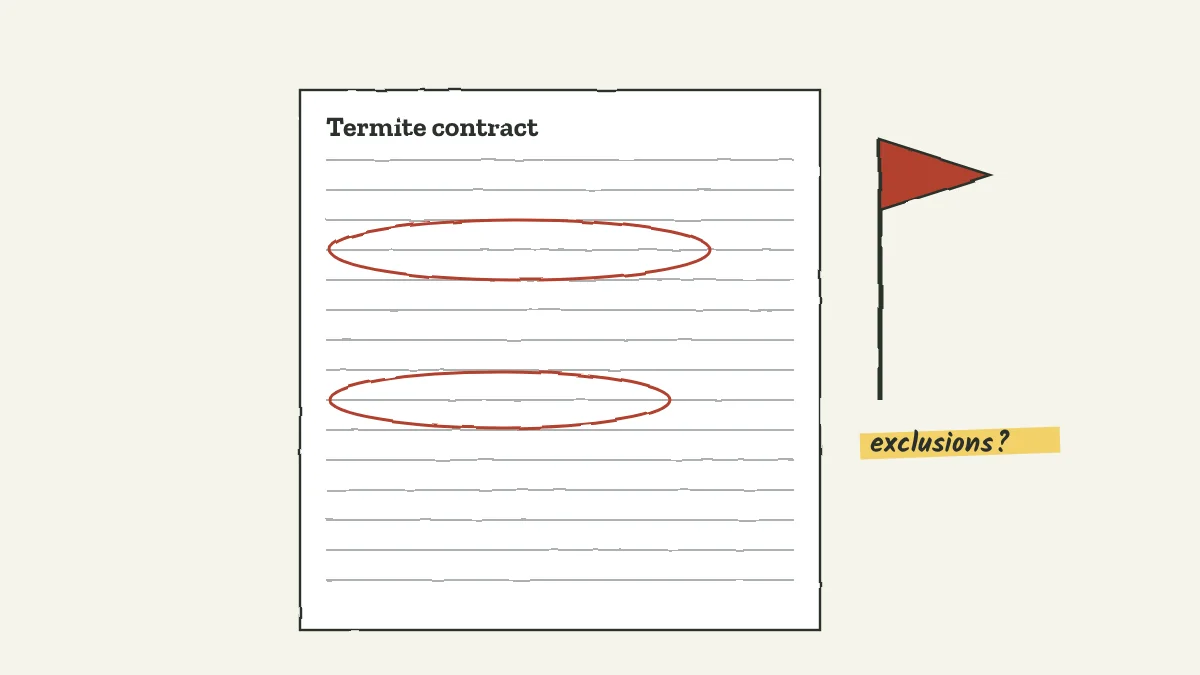
The biggest termite contract red flags are coverage that doesn't say retreatment or repair, exclusions that aren't named, a partial or spot treatment presented as whole-house, no diagram of existing damage, a renewal fee that isn't stated, and annual retreatments with no evidence of termites. States like Florida, Alabama, Texas, Georgia and South Carolina require many of these things to be spelled out.
On this page
Why the contract matters more than the treatment
A treatment happens once. The contract governs what happens for years after: whether the company comes back, who pays for damage, what you have to do to keep coverage, and what happens when you sell. Most disputes between homeowners and termite companies are about what the contract says, not about the chemicals.
The good news is that you don't have to be a lawyer to read one. A handful of states have already decided what a fair termite contract has to include, and those rules work as a checklist anywhere. The broader hiring advice is in how to choose a termite company.
Red flags, and the rules that answer them
Each row is a clause to look for, and a state rule that shows what a better contract looks like. The rules apply only in their own states, but they're fair standards to ask for anywhere.
| Red flag | Why it matters | A state rule that addresses it |
|---|---|---|
| No clear statement of retreatment vs repair | You won't know whether damage is covered until it's too late | Alabama: a bold, boxed statement on page one; Florida: coverage stated on the first page |
| Excluded termites not named | "Termites" may not include the ones you have | Florida: if Formosans or other invasive termites are excluded, the species must be named; South Carolina: Formosan coverage must be stated |
| Broad, vague exclusions | An exclusion can be used to deny almost any claim | Florida: an exclusion can't be used unless the excluded condition was the primary cause, with notice and time to fix it |
| Partial or spot treatment presented as full | Untreated areas stay unprotected | Florida: treated areas listed and a spot-treatment notice; California: whole-structure claims barred for methods that can't reach all wood |
| No diagram of the house and existing damage | Nothing proves later damage is new | Alabama: foundation diagram required; Texas: diagram before treatment |
| Renewal fee missing or open-ended | The price of coverage can climb every year | Florida: annual renewal fee stated; Alabama: renewal fee terms in the contract |
| Warranty sold without treatment | You're paying for a promise with nothing behind it | Alabama and South Carolina: warranty sales prohibited without a state exemption; Georgia: limits on warranty-only contracts |
| Retreatment every year "just in case" | You pay for chemicals you may not need | Texas: annual retreatment prohibited without evidence of reinfestation or a disrupted barrier |
| Untreated areas with no signed waiver | You may not know what was skipped | Alabama, Georgia and South Carolina: official waiver forms signed by the owner |
| A second contract on a house already under contract | You may pay twice for the same coverage | Florida: requires the owner's signed consent on a state form |
Sources are the state rules listed below. State pages have more: Florida, Texas, Alabama, Georgia, South Carolina.
The words that should make you slow down
Some phrases deserve a question every time:
- "Lifetime" or "unlimited." Lifetime of what: the house, the company, or as long as you pay renewals? Florida's rules don't allow a contract with exclusions to call itself full or unlimited.
- "Conditions conducive to infestation are excluded." Which conditions? Moisture, soil against the siding, wood debris and foam insulation below grade are common ones. Get the list.
- "Inaccessible areas are not covered." Fair as far as it goes, but which areas, on your house? They should be on the diagram.
- "Subject to renewal at the company's current rate." That's an open-ended price. Ask for the number, and whether and how much it can rise.
- "Treatment as needed." Needed by whom, and based on what? In Texas, routine yearly retreatment without evidence isn't allowed.
What a good contract includes
Flip the red flags around and you have the checklist. A contract worth signing names the company and its license number; lists the structures covered; names the termites covered and any excluded by species; says on its first page whether it covers retreatment only or repair too; includes a diagram showing existing damage, treated areas and conditions to correct; states the treatment, the product and the price; states the renewal fee and the inspection schedule; lists exclusions specifically; explains how to make a claim and how fast the company must respond; and says whether it transfers to a new owner.
Florida's rule adds a timing standard worth asking for anywhere: inspect within 30 days of your written notice of a covered infestation, and retreat within 90 days of discovery. The questions to ask out loud are in questions to ask a termite company, and how to compare warranty types is in repair vs retreatment termite warranties.
Signing a termite contract
Do
- Take the contract home and read it before signing
- Ask for every exclusion and every untreated area in writing
- Keep the diagram, the label and the signed contract together
- Ask how and when the renewal fee can change
Don't
- Sign a contract that doesn't say retreatment or repair
- Accept "termites" without asking which species are covered
- Pay for a warranty with no treatment behind it
- Sign a second contract on a house that's already covered without checking the first
Questions people ask
What should a termite contract include?
The covered structures and termites, any excluded species by name, whether it covers retreatment only or repair too, a diagram of existing damage and treated areas, the treatment and product, the price and renewal fee, the inspection schedule, the exclusions, the claim process and whether it transfers.
What are red flags in a termite contract?
Coverage that doesn't say retreatment or repair, unnamed exclusions, partial treatments described as full protection, no diagram, an open-ended renewal fee, a warranty sold without treatment, and yearly retreatments without evidence of termites.
Can a termite company deny a claim because of an exclusion?
Sometimes, depending on the contract and the state. Florida sets a limit: the excluded condition has to be what mainly caused the damage, and a company that already knew about the problem owes you written notice and 60 days to fix it before relying on the exclusion.
Is a lifetime termite warranty real?
Read what "lifetime" means in the contract. Usually coverage lasts only as long as you pay renewals and meet the conditions. In Florida, a contract with exclusions can't be called full or unlimited.
Keep reading
Termites in your state
Sources
- Florida Administrative Code 5E-14.105: Contracts for wood-destroying organism treatment
- Florida Statute 482.227: Wood-destroying organism contracts
- Alabama Administrative Code 80-10-9-.16: Subterranean termite control work
- Texas Administrative Code, 4 TAC 7.174: Termite treatment disclosure documents
- Texas Department of Agriculture: Termite FAQs
- South Carolina Regulation 27-1085: Standards for wood-destroying organisms
- Georgia Department of Agriculture: 2014 WDO rule changes
- Georgia Rules 620-6-.07: Correction of deviations
- Georgia Consumer Protection Division: Pest control and exterminators
- California Code of Regulations, Title 16, section 1999.5: Advertising