Termite Disclosure Laws When Selling a House
Whether a seller has to tell you about termites depends on the state, and the answers range from a specific yes-or-no question on a state form to "buyer beware." Here's how the main approaches work, with real examples, and what to do on either side of the sale.
The short version
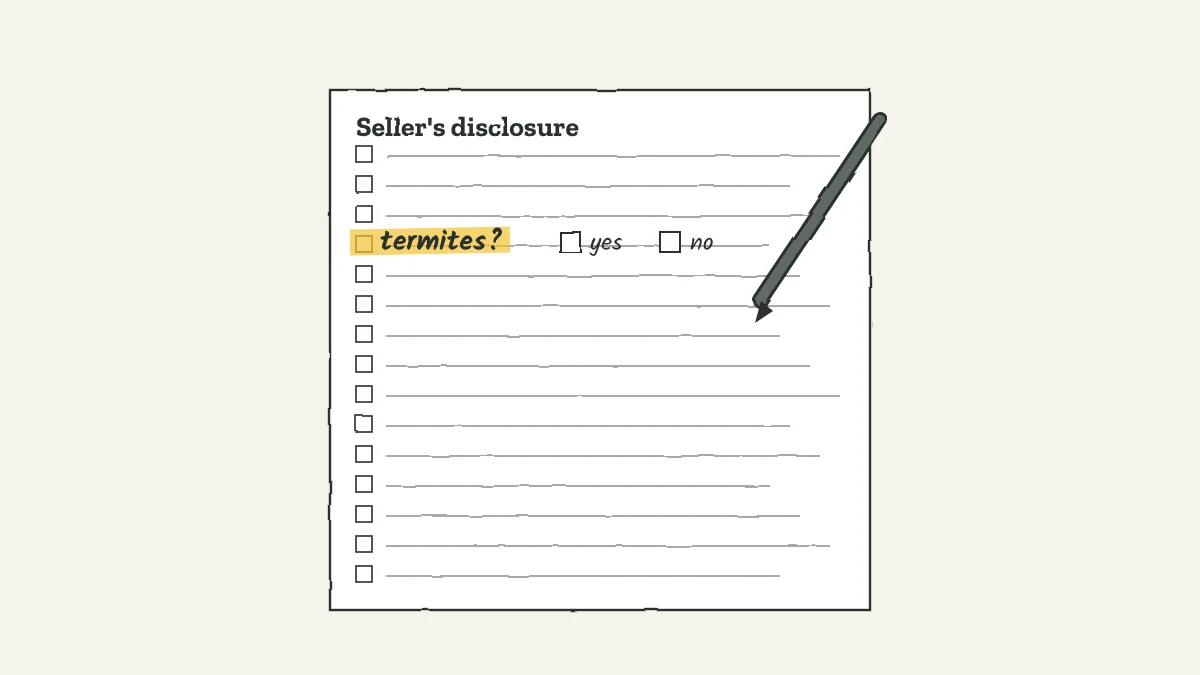
Many states require sellers to disclose known termite problems. Texas and South Carolina put termite questions on their state disclosure forms; Florida courts require sellers to disclose known hidden defects that affect value; Virginia and Alabama lean toward buyer beware. Even where disclosure is required, it covers what the seller knows, so buyers still need their own inspection.
On this page
Four approaches across the states
State disclosure rules for termites fall into roughly four camps. Your state may mix them.
- A state form that asks about termites. The state writes the disclosure form, and termites or wood-destroying insects are named on it. Texas and South Carolina work this way.
- A required disclosure that doesn't single out termites. The state requires a disclosure document but leaves termites to general questions about known conditions. Louisiana's statute, for example, requires sellers to complete a property disclosure document in good faith, without naming termites.
- A duty created by the courts. Florida's Supreme Court held in Johnson v. Davis (1985) that a home seller who knows of facts materially affecting value that aren't readily observable and aren't known to the buyer must disclose them.
- Buyer beware. Virginia's disclosure statement is framed as buyer beware, and the Alabama Association of Realtors describes Alabama as a caveat emptor state, where sellers have only very limited disclosure duties.
Termite disclosure in states we've covered
A quick comparison. This isn't legal advice; check your state's current law and ask a real estate attorney if it matters.
| State | The rule | What it asks about termites |
|---|---|---|
| Texas | Seller's Disclosure Notice, Property Code 5.008, for most single-family sales | Active termites or other wood-destroying insects, damage needing repair, previous damage and previous treatment |
| South Carolina | Residential Property Condition Disclosure Statement, effective 2023 | Known wood problems from termites, insects, wood-destroying organisms, dry rot or fungus; treatment, coverage, provider and termite bond; present infestations |
| Mississippi | Property condition disclosure under the Real Estate Brokers Act of 1954, when a broker is involved | Known termite problems, treatments, repairs and any current termite contract |
| Louisiana | Property disclosure document required by R.S. 9:3198, delivered by the time of an offer | Not named in the statute; covered by the general good-faith disclosure |
| Florida | Court-made duty, Johnson v. Davis | Known latent defects that materially affect value |
| California | Civil Code 1099, when a termite report is a condition of the sale or loan | The seller must deliver the report and any completion notice to the buyer before closing |
| Virginia | Residential Property Disclosure Act, framed as buyer beware | Termites aren't one of the listed items |
| Alabama | Caveat emptor, with very limited required disclosures | No general termite disclosure duty described |
Details are on each state page: Texas, South Carolina, Mississippi, Louisiana, Florida, California, Virginia, Alabama.
What "known" means, and why it matters
Disclosure laws almost always cover what the seller knows. Louisiana's statute is explicit that the document isn't a warranty, doesn't replace inspections, and protects a seller from liability for errors that weren't willful misrepresentations. Florida's rule likewise turns on what the seller knew. A seller who never saw the termites behind the drywall usually hasn't broken a disclosure law.
That's why disclosure is a starting point for buyers, not a substitute for a termite inspection. And it's why the most useful disclosure questions are the historical ones: Texas asks about previous damage and treatment, and South Carolina asks for the treatment provider and termite bond. That history tells a buyer where to look and who to call.
If you're selling
-
Pull your termite history
Find the treatment records, contracts, renewal receipts and any repair invoices. If you don't know the history, your termite company may.
-
Answer the form literally
If the form asks about previous treatment or damage, answer for the whole time you've owned the house, not just this year.
-
Attach what you have
A copy of the last treatment record, the current bond and the most recent annual inspection report answers most buyer questions before they're asked.
-
Check the bond transfer
If there's a termite contract, find out whether and how it transfers. See transferring a termite bond when you sell.
If you're buying
-
Read the disclosure first, then inspect anyway
The disclosure tells you where the seller knows there were problems. The inspection tells you what's there now.
-
Ask for the paper behind every yes
Previous treatment means a company and a date. Ask for both, and call the company.
-
Look for a bond
South Carolina's form asks about the termite bond directly. In other states, ask. A transferable contract can be worth more than a clean report.
-
Know your state's remedy
If you later find the seller knew and hid termite damage, your options depend on state law and the contract. That's a question for a real estate attorney.
Disclosure, done right
Do
- Disclose past termite damage and treatment if the form asks
- Keep treatment records and repair invoices for the next sale
- Give buyers copies of bonds and inspection reports
- Get your own inspection as a buyer, whatever the disclosure says
Don't
- Assume "as is" erases what you know
- Disclose part of a termite history and leave out the rest
- Treat a disclosure form as a warranty
- Skip the inspection because the seller checked "no"
Questions people ask
Do you have to disclose termites when selling a house?
In many states, yes, if you know about them. Texas and South Carolina put termite questions on their state forms, and Florida courts require sellers to disclose known hidden defects that materially affect value. Some states, like Virginia and Alabama, lean toward buyer beware.
Do I have to disclose past termite treatment?
It depends on the state. Texas's disclosure notice asks about previous termite damage and previous treatment, and South Carolina's form asks for termite treatment, the provider and any bond. Where the form asks, answer for your whole time in the house.
What if the seller didn't disclose termites?
Your options depend on state law, what the seller knew, and the purchase contract. Disclosure laws generally cover known problems, so start by gathering evidence of what the seller knew, and talk with a real estate attorney.
Does a termite inspection replace the seller's disclosure?
No, and the reverse is also true. The disclosure covers what the seller knows about the history; the inspection covers what's visible now. Buyers should use both.
Keep reading
Termites in your state
Sources
- Texas Property Code 5.008: Seller's disclosure of property condition
- South Carolina Residential Property Condition Disclosure Statement (2023)
- MSU Extension Publication 2568: Protect your house from termites
- Louisiana R.S. 9:3198: Property disclosure document
- The Florida Bar Journal: Johnson v. Davis redux (2004)
- California Civil Code 1099: Delivery of pest control reports
- Virginia Code 55.1-703: Residential Property Disclosure Act, required disclosures
- Alabama Association of Realtors: Seller property condition disclosures (2026)