Can Termites Get Through Concrete?
A concrete slab feels like armor. To a termite, it's a ceiling with gaps in it. Termites can't chew through concrete, but they don't need to, and a slab house can have termites in its walls without a single piece of wood touching the ground.
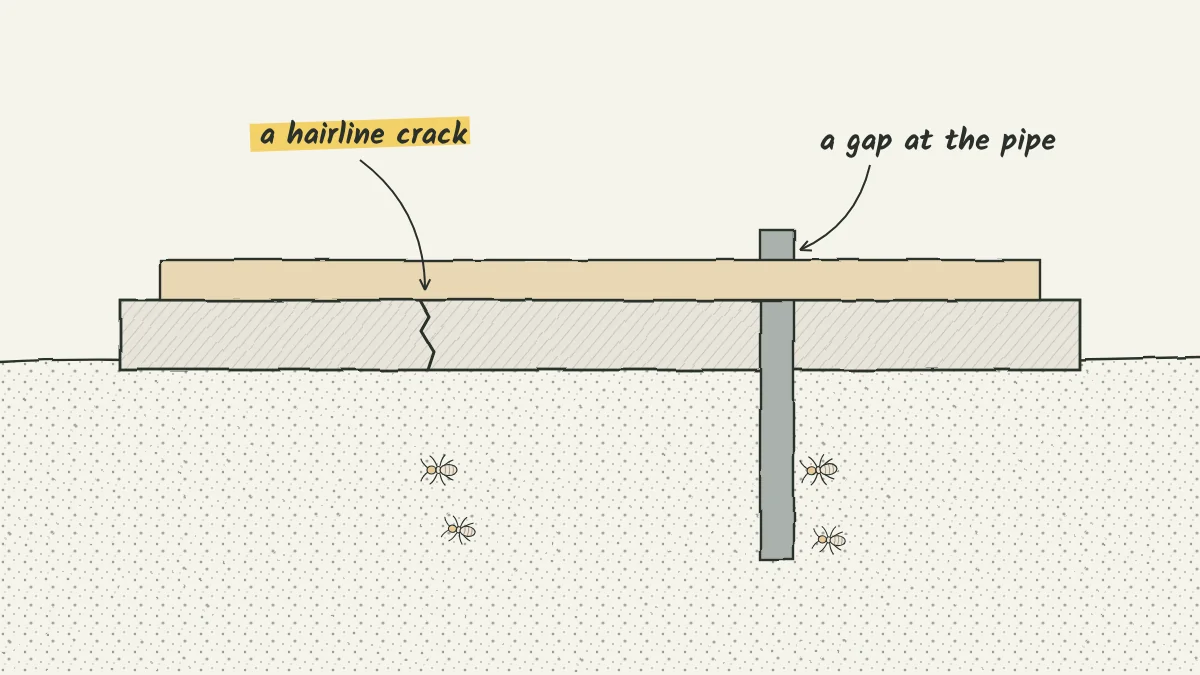
The short version
No, termites can't eat concrete, but they get past it easily. Subterranean termites travel through cracks as thin as 1/32 inch, expansion and construction joints, and gaps around plumbing and utility pipes, and they build mud tubes over foundation walls. Slab houses are protected with soil treatment under and around the slab, baits, or physical barriers, and regular inspections.
On this page
They can't eat it, they go around it
Termites eat cellulose. Concrete has none, so termites don't eat it or tunnel through solid concrete. What they do is find the gaps. University of Tennessee Extension and North Carolina's agriculture department both put the opening a termite can use at about 1/32 of an inch, and a slab has plenty of openings that size or bigger.
Once they're through, termites keep the same habits they have in the soil. They stay in the dark and damp, build mud tubes where they have to cross open surfaces, and head for the nearest wood: a wall plate, a door frame, the back of a baseboard. Because the route is under the floor or inside a wall, it can run for a long time before anyone sees it.
Where termites get past concrete
From Purdue Extension's termite control guide, UT Extension and North Carolina's treatment standards.
| Route | Why it works |
|---|---|
| Cracks in the slab | Settlement and shrinkage cracks open a path from the soil below |
| Expansion and construction joints | Joints between pours, and between the slab and foundation wall, are built-in gaps |
| Plumbing and utility openings | Gaps around drains, water lines and conduits through the slab |
| Hollow block foundation walls | Termites travel up inside the cores to the sill plate |
| Over the foundation | Mud tubes up the outside or inside face of a wall or pier |
| Behind stucco or foam | Finishes that reach the soil give a hidden route an inspector can't see |
The International Residential Code's termite section limits foam plastic insulation below grade in very heavy termite areas and calls for at least 6 inches of clearance between above-grade foam and the soil, so inspectors can see tubes.
Why slab houses get termites
Purdue's guide is blunt about it: in houses built partly or entirely on slabs, termites get in through expansion joints, cracks, and utility and sewer pipe openings. A slab can look solid from inside and still have a perimeter joint, a few shrinkage cracks and a dozen pipe penetrations, all hidden under flooring.
Block foundations have their own weak spot. The hollow cores of concrete block run straight up to the sill plate. Purdue notes that capping a block foundation with a course of solid 4-inch block adds protection only if the cap blocks are tightly joined with no mortar openings, and UT recommends a cap of at least 4 inches of reinforced concrete.
How slabs are protected
Protection works on the soil and the gaps, not the concrete:
- Before the pour. North Carolina's standards call for treating the soil under a slab at 1 gallon per 10 square feet before it's poured. Other options include baits, treated wood and physical barriers. See termite pretreatment.
- After the house is built. Liquid treatment of an existing slab means drilling holes a foot apart along its cracks and joints, close to the foundation, and pumping termiticide into the soil below; North Carolina's standards spell out the spacing. Purdue adds drilling beside interior partitions and utility openings. See liquid termite treatment.
- Baits. Stations in the soil around the house target the colony without drilling the slab. See termite bait stations.
- Openings. Penn State Extension recommends filling visible cracks and voids in the foundation, and sealing around pipe penetrations makes the gap smaller, though sealing alone isn't a termite treatment.
North Carolina's standards also note that trenching only outside a poured slab usually doesn't give satisfactory control. If a quote for a slab house doesn't mention drilling or baits, ask why.
For slab and block foundations
Do
- Keep a visible gap between stucco or foam and the soil
- Ask whether a treatment quote includes drilling the slab
- Report slab leaks and new cracks to your termite company
- Keep the perimeter dry and the grade sloping away
Don't
- Assume a slab means no termite risk
- Cover the bottom of a stucco wall with soil or mulch
- Rely on caulk alone to keep termites out
- Ignore mud tubes on a concrete wall; they're the route
Questions people ask
Can termites eat through concrete?
No. Concrete has no cellulose, so termites don't eat it. They get past it through cracks as thin as about 1/32 inch, joints, and gaps around pipes, or by building mud tubes over it.
Can termites come up through a slab foundation?
Yes. Purdue Extension says termites enter slab houses through expansion joints, cracks, and utility and sewer pipe openings, then follow hidden routes to the nearest wood.
How are termites treated in a slab house?
Usually by treating the soil under and around the slab through drilled holes along cracks, joints and the foundation, or with bait stations around the house. Trenching only outside a slab usually isn't enough.
Do concrete block foundations stop termites?
Not by themselves. Termites can travel up inside the hollow cores to the sill plate. A tightly joined solid cap and treatment of the block voids help.
Keep reading
Termites in your state
Sources
- Purdue Extension E-4-W: Termite control (2017)
- UT Extension PB1344: Subterranean termite control
- NCDA&CS: Post-construction subterranean termite control
- NCDA&CS: Pre-construction subterranean termite control
- NCDA&CS: Homeowner's guide to the wood destroying insect report
- South Carolina Regulation 8-1216: IRC R318.4 foam plastic protection
- Penn State Extension: Eastern subterranean termites