Termites in Honolulu: Oahu's Formosans, Asian Termites and Drywoods
Honolulu is where Hawaii's termite story starts. The Formosan termite was first officially recorded here, the Asian subterranean termite was first found here, and University of Hawaii researchers in Manoa have spent decades tracking all of them. Here's what that research tells an Oahu homeowner.
The short version
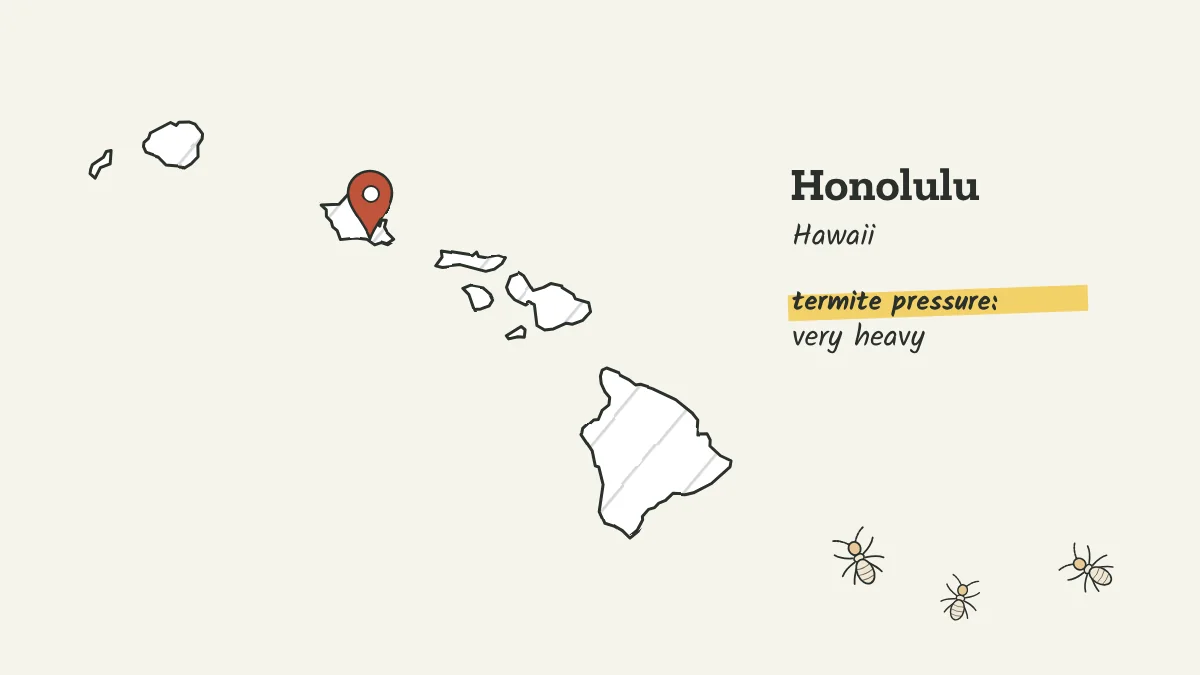
Oahu has Formosan subterranean termites almost everywhere, Asian subterranean termites established around Ewa and Kalaeloa, and West Indian drywood termites in buildings. A UH study found Formosan swarmers on Oahu from April into July or August, peaking in May, with Asian subterranean termites flying about a month later. Honolulu covers all of Oahu.
Honolulu at a glance
- Termite pressure
- Very heavy
- Termites to know
- Formosan subterranean, West Indian drywood
- Why termites like it here
- Warm and humid year-round, with Formosan termites widespread across Oahu, Asian subterranean termites established on the Ewa plain and drywood termites in buildings islandwide.
- Who licenses pest control
-
Hawaii Department of Commerce and Consumer Affairs, Pest Control Board
Check a company's license - Inspection report for home sales
- Termite Inspection Report (PC-9)
On this page
Where Oahu's termites came from
Honolulu is the first place in Hawaii with an official Formosan termite record, from 1913. University of Hawaii Extension says the termite is now widespread on Oahu.
Oahu has collected more termite species than the other islands. A 2017 UH survey of termite distribution and flight periods on Oahu, led by Reina Tong and J. Kenneth Grace, lays out the island's main pests:
- Formosan subterranean termite, the most costly termite in Hawaii and widespread across the island.
- Asian subterranean termite, first found in Hawaii in 1963 in Kaimuki and now established in the Ewa and Kalaeloa areas, where it causes severe damage.
- West Indian drywood termite, the second most costly termite in Hawaii. The study notes that Oahu's Nanakuli area has the only known natural infestation of this species outside its native range.
- Western drywood and Indo-Malaysian drywood termites, each found at only a few Oahu sites so far.
When Oahu's termites fly
From light-trap catches across Oahu in 2011 and 2012, reported by Tong and colleagues at UH Manoa.
| Termite | Months with swarmers caught | Notes |
|---|---|---|
| Formosan subterranean | April to July in 2011; April to August in 2012 | Peak in May; fewer on windy nights, more after rain |
| Asian subterranean | April, June and July 2011; June 2012 | About a month after the Formosan peak |
| West Indian drywood | April to June in 2011; April to July in 2012 | Light traps may help track it |
| Western drywood | Not caught in light traps | Flies by day and may not be drawn to lights |
The traps were mostly at low-elevation, coastal sites. The researchers recommended adding sites on Oahu's north and west sides.
When termites swarm in Honolulu
The chart shows the Formosan and West Indian drywood termites. Expect the Asian subterranean termite's flights to run about a month behind the Formosan peak.
| Termite | J | F | M | A | M | J | J | A | S | O | N | D |
|---|---|---|---|---|---|---|---|---|---|---|---|---|
| Formosan subterranean Dusk, in big clouds around lights | some swarms | peak | peak | some swarms | ||||||||
| West Indian drywood Night, toward lights | common | peak | common |
Light, wind and rain
The Oahu study found patterns a homeowner can use. Wind cut down Formosan flights: nights with higher average wind speeds had fewer swarmers. Rain did the opposite: more rain went with more swarmers. And swarmers came to lights in large numbers, which is how the study counted them.
The researchers also enlisted citizen scientists, students and a household, to run light traps, and suggested that light trapping could help track the West Indian drywood termite and might even reduce the number of swarmers dispersing. For a homeowner, the practical version is simpler: on still, humid May evenings after rain, keep outdoor lights off and close the screens. Statewide swarm basics are on the Hawaii termite page.
Honolulu's two termite problems
Oahu houses usually face two different termite jobs, and they're handled differently.
Subterranean termites, Formosan and Asian, come from the soil and need moisture, and Formosans fill hollow spaces with carton nests. Protection is at the ground: soil treatment, physical barriers like the Basaltic Termite Barrier developed at UH Manoa, bait systems and sealed slab penetrations. See Formosan termite treatment.
Drywood termites live entirely inside dry wood and leave pellets. UH's Ken Grace notes the West Indian drywood termite is largely controlled by tent fumigation, and that injecting insecticide into wood works for small infestations but is difficult. See termite tenting and drywood termite treatment.
A house can have both. Ask an inspector which one they found, and get the PC-9 report that shows where.
Research down the road
Honolulu homeowners have an unusual neighbor: the UH Termite Project at the College of Tropical Agriculture and Human Resources in Manoa, funded by the USDA Agricultural Research Service under the slogan "Educate to Eradicate." Its work on Oahu's species, flight seasons and controls is where most of the facts on this page come from.
For Honolulu homeowners
Do
- Keep outdoor lights off on still May and June evenings
- Ask whether a finding is subterranean or drywood
- Check furniture, frames and attics for pellets
- Get the PC-9 report with a diagram
Don't
- Assume swarms are over after May; Asian termites fly later
- Move recycled lumber or pallets without checking them
- Let soil or plants touch wood siding
- Treat drywood termites with a soil treatment
Questions people ask
When do termites swarm in Honolulu?
Formosan termites swarm on Oahu from about April into July or August, peaking in May. Asian subterranean termites fly about a month after the Formosan peak, and West Indian drywood termites from April into June or July.
Are there Asian subterranean termites in Honolulu?
Yes. The species was first found in Hawaii in Kaimuki in 1963 and is now established in the Ewa and Kalaeloa areas of Oahu, according to UH researchers.
Do drywood termites live on Oahu?
Yes. The West Indian drywood termite is the second most costly termite in Hawaii and is mainly controlled by tent fumigation. Other drywood species have been found at a few Oahu sites.
Who licenses termite companies in Honolulu?
The state Pest Control Board, part of the Department of Commerce and Consumer Affairs. You can check a license on its public license search.
More in Hawaii
Keep reading
Sources
- Tong, Grace and others: Termite species distribution and flight periods on Oahu, Hawaii, Insects 8:58 (2017)
- University of Hawaii CTAHR HSP-2: The Formosan subterranean termite in Hawaii (1999)
- Grace, University of Hawaii: Termites in Hawaii (2009)
- University of Hawaii Termite Project
- Hawaii DCCA: Pest Control Board
- UF/IFAS EDIS IN278: Formosan subterranean termite (2025)