Florida WDO Inspection and the FDACS-13645 Form
In a Florida home sale, the termite report is a two-page state form with a number on it: FDACS-13645. It covers more than termites, and its most important box is often the one listing what the inspector couldn't see. Here's how to read it line by line.
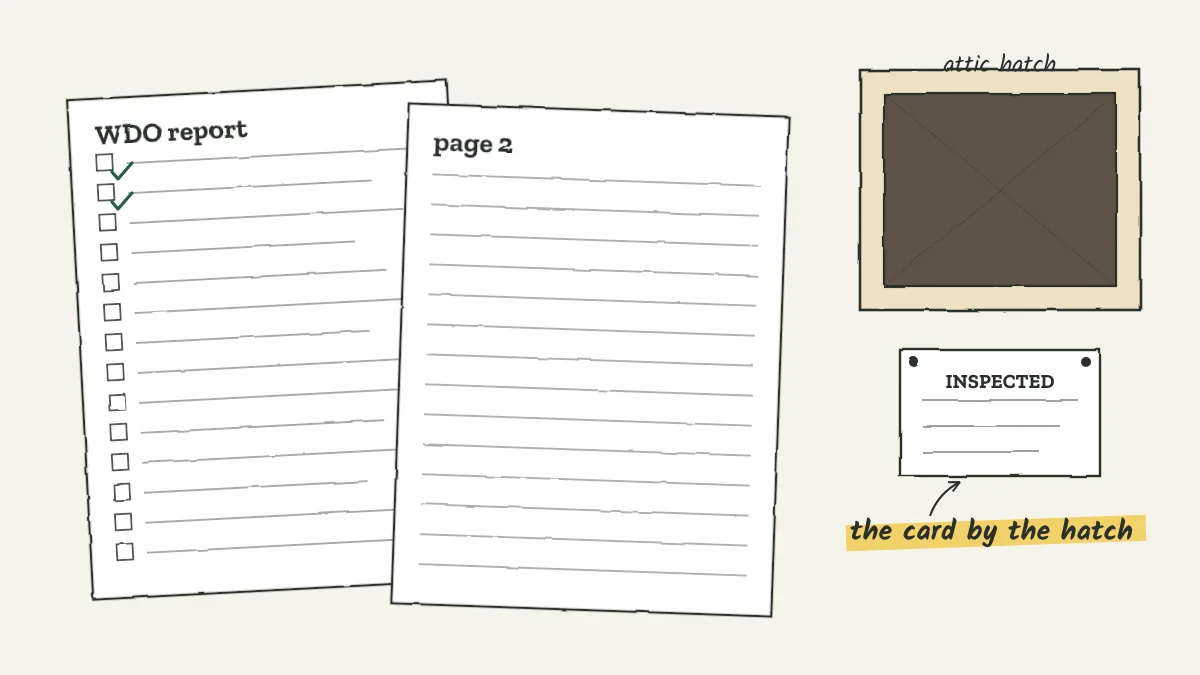
The short version
A Florida WDO inspection is a visual check for wood-destroying organisms, reported on the state's form FDACS-13645. It covers termites, powderpost beetles, old house borers and wood-decay fungi. Only companies with Florida's WDO certification may issue it. It records live organisms, evidence and damage, plus areas the inspector couldn't reach. It is not a guarantee or a structural report.
On this page
- What "WDO" covers in Florida
- The FDACS-13645, section by section
- Section 2: box A, box B, and the three kinds of B
- Section 3: the "no information" box
- Section 4: treatment history and the attic card
- Who may fill it out
- What to do with your report
- Florida's form vs the national NPMA-33
- Florida buyer's checklist
- Questions
What "WDO" covers in Florida
Most states talk about wood-destroying insects. Florida's term is broader. The FDACS-13645 form defines a wood-destroying organism as an arthropod or plant life that damages and can reinfest seasoned wood in a structure, and names four groups:
- Termites: subterranean, drywood and dampwood
- Powderpost beetles
- Old house borers
- Wood-decaying fungi: the rot itself, not mold in general
That last one surprises people. A Florida WDO report can note wood decay even with no insect in sight. It still isn't a mold report: the form says the inspection gives no opinion on health effects or indoor air quality, and points readers to a certified industrial hygienist for that.
The FDACS-13645, section by section
The current form (Rev. 05/21) has five sections over two pages. Here's what each one tells you, and the question to ask about it.
| Section | What's in it | Your question |
|---|---|---|
| 1. General information | Company, license number, inspector and ID card number, date, address, structures inspected, who asked for the report and who receives it | Is every building I'm buying listed, including the detached garage or shed? |
| 2. Inspection findings | Box A: no visible signs. Box B: visible evidence, split into live organisms, evidence such as frass, shelter tubes or exit holes, and damage | Which organism, exactly where, and live or old? |
| 3. Obstructions and inaccessible areas | Attic, interior, exterior, crawlspace and other areas, each with the reason | How much of the house is on this list? |
| 4. Notice of inspection and treatment | Evidence of previous treatment, where the inspection notice was posted, and any treatment this company did | Is there a treatment history, and who did it? |
| 5. Comments and financial disclosure | Notes, the statement that neither company nor inspector has a financial interest in the property, and the signature | Do the comments add anything the boxes don't? |
The form is published by FDACS's Bureau of Inspection and Incident Response and is required by FDACS rule 5E-14.142. A general guide to termite reports across the country is in WDI inspection.
Section 2: box A, box B, and the three kinds of B
Box A means the inspector saw no live organisms, no evidence and no damage in the areas they could reach. It's good news with a footnote, and the footnote is Section 3.
Box B means something was seen. The form makes the inspector say which of three things, by common name and location:
- Live WDOs: an active problem today.
- Evidence: dead insects or parts, frass (drywood pellets), shelter tubes or exit holes. Evidence alone doesn't tell you whether the colony is still active.
- Damage: wood that has been eaten or decayed. The form says plainly that this is not a structural damage report and that hidden damage may exist.
The common Florida combination is evidence plus damage with no live organisms, often from a drywood colony treated years ago. That's where Section 4 helps.
Section 3: the "no information" box
The form's wording here is blunt: for the areas listed as obstructed or inaccessible, the report provides no information on the status of wood-destroying organisms. Each listing has to give the specific area and the reason, such as a sealed attic, stored belongings, insulation, a finished ceiling or a crawlspace with no access.
For a buyer, this section deserves more attention than the checkmarks. A clean Box A on a house where the attic and garage walls were blocked is a much smaller promise than it looks. If the list is long, ask the seller to clear access and pay for a second visit before your inspection period runs out.
Section 4: treatment history and the attic card
Section 4 asks whether there's evidence of previous treatment and what was seen. The form adds a line worth noting: the inspecting company gives no assurance about work done by other companies. Old drill holes in the garage slab or a treatment notice from 2015 tell you something happened, not that it was done well or is still under warranty. Ask the seller for the contract and any renewal paperwork.
The section also records where the inspector posted the notice of inspection. Florida law requires that small card next to the attic or crawlspace access. Older cards from other companies, if they're still there, are a free treatment history. The statewide rules behind them are on the Florida termite guide.
Who may fill it out
Not every inspector can sign a 13645. A UF/IFAS consumer guide notes that completing the form for real estate transactions requires a special FDACS certification in the termite and wood-destroying organism category. Florida law adds several protections for buyers:
- The report must certify that neither the inspector nor the company has any financial interest in the property.
- The company must keep a copy for at least three years.
- Companies doing WDO inspections must carry errors-and-omissions insurance or show equivalent net worth.
Check the company's license on the FDACS database before you hire, and confirm the inspector's ID card number on the report matches a real person.
What to do with your report
-
Read Section 3 first
Count the inaccessible areas. If they cover the attic, garage walls or large parts of the interior, ask for access and a reinspection.
-
Pin down every Box B entry
For each finding, get the organism's name, the exact location and whether anything was live. "Termite evidence" on its own isn't enough to negotiate with.
-
Ask for treatment records
If Section 4 shows previous treatment, request the contract, the dates, the product and whether a warranty transfers. Florida contracts must state on page one, in bold, whether they cover repair, retreatment or neither.
-
Get damage assessed by someone who fixes things
The form tells you to consult qualified building-trade experts about structural soundness. A contractor's estimate turns "damage observed" into a number you can negotiate with.
-
Check the dates against your loan
Lenders set how recent the report must be; FHA treats a clean report as valid for 90 days. Schedule it so it doesn't expire before closing.
Florida's form vs the national NPMA-33
If you've bought a house in another state, here's what's different in Florida.
| Florida FDACS-13645 | National NPMA-33 | |
|---|---|---|
| Organisms covered | Termites, powderpost beetles, old house borers, wood-decay fungi | Termites, carpenter ants, carpenter bees, reinfesting wood-boring beetles |
| Fungi | Wood decay included | Only with an optional attachment |
| Who may sign | Holders of Florida's WDO certification | Varies by state |
| Where it's used | Required in Florida | Used in most states without their own form |
| Accepted for FHA and VA | Yes; HUD lists Florida among states with their own form | Yes |
More on the national form in NPMA-33.
For your own walk-through
As an Amazon Associate I earn from qualifying purchases.
-
View on Amazon
Bright LED flashlight, 1,000+ lumens
The one tool that really matters. A tight, bright beam shows mud tube texture and wing piles in dark corners.
-
View on Amazon
Pin-type wood moisture meter
Wood that reads above about 20% is wet enough to invite rot and termites. Great for sills and subfloors.
Florida buyer's checklist
Do
- Read Section 3 before you celebrate a Box A
- Ask what "evidence" means in plain words: live, old, or unknown
- Look for treatment notices by the attic hatch and in the garage
- Get the previous termite contract and check whether it transfers
- Have a contractor price any damage before your inspection period ends
Don't
- Treat the report as a guarantee; the form says it isn't one
- Assume fungi findings mean a mold problem, or that no fungi means no mold
- Rely on the seller's inspector alone when something was found
- Let the report go stale before closing
Questions people ask
What is a WDO inspection in Florida?
It's a visual inspection for wood-destroying organisms, meaning termites, powderpost beetles, old house borers and wood-decay fungi, done by a company with Florida's WDO certification and reported on form FDACS-13645. It's standard in Florida home sales.
Is Florida's WDO report the same as the NPMA-33?
No. Florida requires its own form, the FDACS-13645, instead of the national NPMA-33. Florida's form also covers wood-decay fungi and old house borers, which the national form doesn't include by default.
Does a Florida WDO report check for mold?
No. It notes wood-decaying fungi that damage wood, but the form states it gives no opinion on health effects or indoor air quality. For mold concerns, the form points you to a certified industrial hygienist.
How long is a Florida WDO inspection good for?
The report describes the house only on the inspection date. Your lender decides how recent it must be; FHA accepts a clean report for 90 days. Ask before you schedule it.
Who pays for the WDO inspection in Florida?
It's negotiated in the purchase contract and often falls to the buyer. VA rules have allowed veterans to pay for a required inspection since 2022. Check your contract's inspection terms with your agent.
Keep reading
Termites in your state
Sources
- FDACS: Form 13645, Wood-Destroying Organisms Inspection Report (Rev. 05/21)
- Florida Statute 482.226: Wood-destroying organism inspection reports and notices
- Florida Statute 482.227: Wood-destroying organism contracts
- UF/IFAS EDIS IN1269: Choosing a pest control company in Florida
- HUD: HOC reference guide, wood destroying insect inspections
- NPMA: Suggested guidelines for completing the NPMA-33
- VA Circular 26-22-11, summarized by Tenaco