Termites in San Diego: Where California's Formosan Story Began
California's Formosan termite story starts in a San Diego suburb in 1992, and it isn't finished. Most San Diego homeowners will only ever meet drywood and native subterranean termites, but the county's history has taught some useful lessons about both.
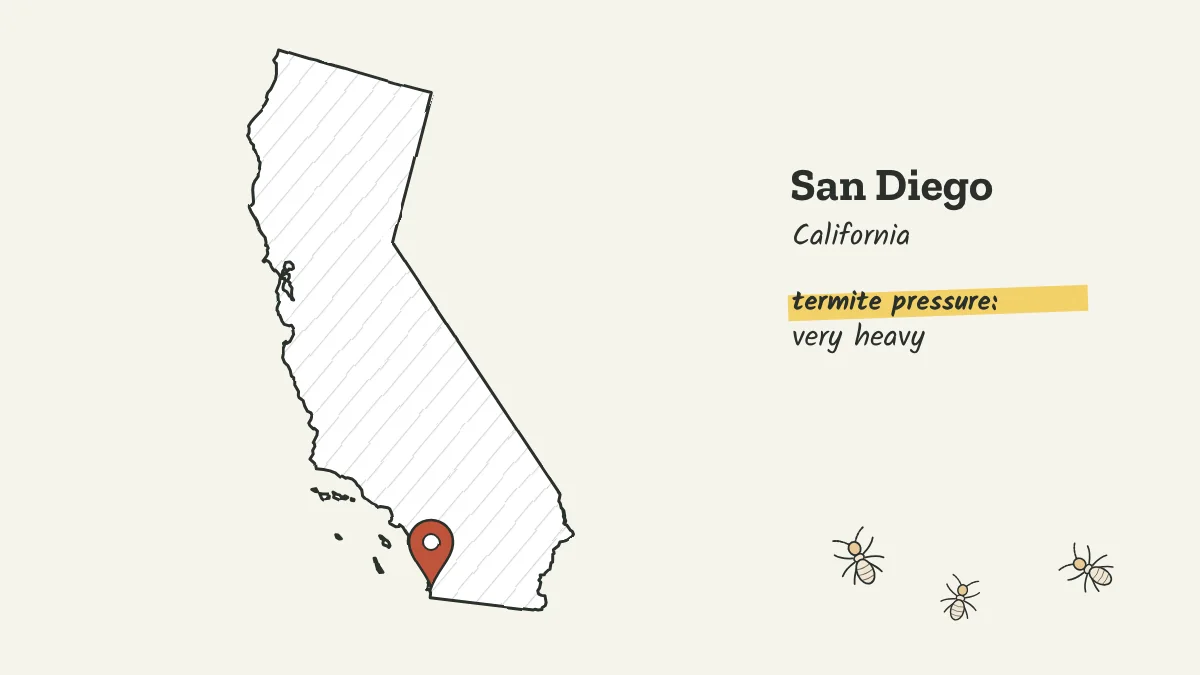
The short version
San Diego's everyday termites are western drywood termites and native subterranean termites. The county also has California's longest Formosan termite history: first found in La Mesa in 1992, found again nearby in 2018, and in Rancho Santa Fe in 2021. Formosans swarm on summer evenings, late May to early August, so report pale swarmers at lights.
San Diego at a glance
- Termite pressure
- Very heavy
- Termites to know
- Western drywood, Western subterranean, Formosan subterranean
- Why termites like it here
- Mild and dry most of the year, with drywood termites common, native subterranean termites in the soil, and California's oldest known Formosan termite sites nearby.
- Who licenses pest control
-
Structural Pest Control Board, California Department of Consumer Affairs
Check a company's license - Inspection report for home sales
- Wood Destroying Pests and Organisms Inspection Report, with Section I and Section II findings
On this page
La Mesa, 1992 and 2018
The Formosan subterranean termite, the species behind huge colonies and fast damage in New Orleans and Honolulu, was first found in California in La Mesa in 1992. The original colony was baited, and newer infestations nearby were baited, fumigated or treated in the soil. Follow-up stopped in 1997, after the money for monitoring was gone.
In 2018 a pest professional found another infestation in La Mesa, about 0.3 miles from the 1992 site. UC Riverside's genetic testing showed the 1992 and 2018 colonies were identical and resembled Asian samples, while a colony later found in Canyon Lake, in Riverside County, was a separate introduction. In other words, the La Mesa termites likely never left. They just went unreported for two decades.
The Rancho Santa Fe lesson
In 2021 a home in Rancho Santa Fe became the fourth documented Formosan colony in California. UC's write-up of the case is a short course in why Formosans are different:
- Soil treatment didn't stop them. Termiticide applied to the soil failed to end the infestation.
- Bait did. The UC team switched to a gel bait containing a chitin synthesis inhibitor, a slow-acting growth regulator that workers carry back to the colony. Results took a few weeks, and the colony was reported eliminated.
- The homeowner kept samples. UC asks anyone who sees a suspicious swarm to put some termites in a sealed bag for identification at UC Riverside.
UC also notes Formosan colonies can reach millions of termites, compared with a few hundred thousand for most native species, and that they can attack living trees and shrubs, which California's native subterraneans don't. If you think you have them, don't treat it yourself. Treatment approaches are covered in Formosan termite treatment.
Telling San Diego's termites apart
Most San Diego calls are drywood or native subterranean termites. Here's how the three compare, based on UC IPM and UC ANR.
| Western drywood | Native subterranean | Formosan subterranean | |
|---|---|---|---|
| Where it lives | Inside dry wood: attics, eaves, trim, furniture | In the soil, coming up through mud tubes | Soil, and moist spots in walls |
| Swarms | Daytime, summer and fall | Clear days after a soaking rain | Evenings, late May to early August, toward lights |
| Swarmer color | Orange-brown | Dark | Pale, yellowish |
| What you find | Hard, six-sided pellets | Mud tubes, soil-packed damage | Fast damage, sometimes live trees attacked |
| How often here | Common | Common | Rare, a few known sites |
Sources: UC IPM Pest Notes 7415 and 7440; UC ANR, 2023. The termite or flying ant quiz helps with the first question: is it a termite at all?
Drywoods and natives, the everyday problem
UC IPM puts Southern California at the heart of the western drywood termite's range. These termites need neither soil nor a leak, so a stucco house with a perfectly dry yard can still have them in the attic. The signs are hard little pellets, not mud. For which treatment fits, see drywood termite treatment.
Native subterranean termites are just as much at home here. In 2025, UC Riverside entomologist Chow-Yang Lee's team described a new native species, Reticulitermes rusti, whose known range runs from Santa Barbara to San Diego. They come up from the soil, so the advice is the usual: keep wood off the ground, keep soil and stucco below the foundation line, and fix leaks.
A UC Cooperative Extension termite handout that lists San Diego County contacts adds a calming point: winged termites flying outdoors don't necessarily mean a building is infested, and flying ants are often mistaken for them.
An Escondido cautionary tale
In 2018, 10News San Diego reported on first-time buyers in Escondido who relied on a termite report the seller had ordered. It listed minor damage. After they moved in, their own inspection quoted up to $10,000 to repair a structural wall. The company said its inspector couldn't reach some areas under the house, and its contract covered only areas visible and accessible at the time. The family filed a complaint with the Structural Pest Control Board, which assigned a state inspector to review the reports and the house.
The lessons are statewide, but this one happened here:
- Read the inaccessible areas. California reports must list every area the inspector didn't inspect and why. That list is the report's fine print. See Section 1 vs Section 2 termite report.
- Order your own. A report the seller ordered was written for the seller. A second opinion costs little next to a wall.
- Know the complaint route. The board investigates complaints and can send its own inspector. The statewide details are on the California termite page.
Older houses and the Mills Act
Owners of designated historical resources in the city can apply for a Mills Act contract, which lowers property taxes in exchange for maintaining and restoring the property in a way that protects its historic features and materials. City Planning staff monitor those contracts.
If your house is under a Mills Act agreement, termite damage to original features isn't just a repair bill. Talk to the city's historical resources staff before replacing original wood, and keep the termite report and the repair invoices with your contract records.
Questions people ask
Are there Formosan termites in San Diego?
Yes, at a few known sites. California's first Formosan termites were found in La Mesa in 1992, again nearby in 2018, and in Rancho Santa Fe in 2021. They aren't known to be widespread, and UC asks people to report pale swarmers seen at lights on summer evenings.
When do termites swarm in San Diego?
It depends on the termite. Drywoods take off in daylight during the warm months of summer and fall, natives wait for a sunny day right after heavy rain, and Formosans fly at dusk between late May and early August.
What should I do if I see a termite swarm in San Diego?
Note where it came from. Swarmers outdoors don't always mean your house is infested, but a swarm from a wall or near the foundation does. If the swarmers are pale and came out at dusk toward lights, bag a few and contact UC Cooperative Extension so UC Riverside can identify them.
Can I complain about a termite inspection in San Diego?
Yes. Termite companies are licensed by the state Structural Pest Control Board, which takes complaints, can assign an inspector to review the report and the house, and can act against a license.
More in California
Keep reading
Sources
- PCT: Formosan subterranean termites rediscovered in Southern California
- UC ANR: Formosan subterranean termites in Southern California (2023)
- UC Riverside CNAS: New termite species discovered in California (2025)
- UC IPM Pest Notes: Drywood termites (Publication 7440)
- UC IPM Pest Notes: Termites (Publication 7415)
- University of California Cooperative Extension: Termites handout
- 10News San Diego: North County family dealing with termite damage after move (2018)
- City of San Diego: Mills Act program