Termites in Los Angeles: Drywoods, Hillsides and Formosan Finds
Los Angeles sits in the part of California where drywood termites are most common, and in the last few years it has also logged the state's newest Formosan termite finds. Add hillside retaining walls, a century of wood-frame bungalows and 35 historic districts, and LA's termite questions are its own.
The short version
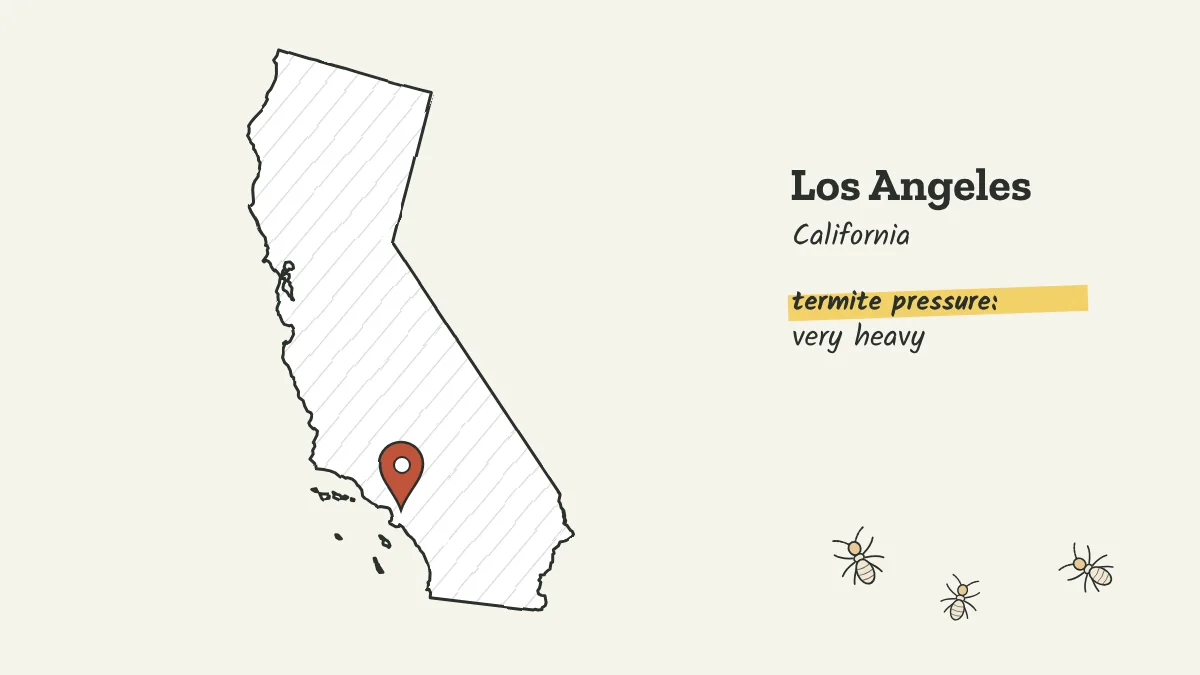
Los Angeles has very heavy termite pressure, led by western drywood termites, which UC says are most common in Southern California, plus native subterranean termites in the soil. Formosan termites were confirmed in Highland Park, the Hollywood Hills and La Verne after 2021. In the city's 35 historic districts, routine exterior repairs go through a quick Conforming Work review.
Los Angeles at a glance
- Termite pressure
- Very heavy
- Termites to know
- Western drywood, Western subterranean, Formosan subterranean
- Why termites like it here
- Dry, warm summers and short rainy winters, with drywood termites common across the basin and native subterranean termites in the soil.
- Who licenses pest control
-
Structural Pest Control Board, California Department of Consumer Affairs
Check a company's license - Inspection report for home sales
- Wood Destroying Pests and Organisms Inspection Report, with Section I and Section II findings
On this page
Drywood termite country
UC IPM says western drywood termites are most common in Southern California, and that's the termite most Angelenos meet first. They live entirely inside dry wood: attic framing, eaves, window trim, furniture. You won't see mud tubes. You'll see small piles of hard, six-sided pellets under a kick-out hole, or winged termites on a warm afternoon in late summer or fall.
When UC Cooperative Extension advisor Siavash Taravati inspected a Hollywood Hills house in 2022 for something more unusual, he still found what LA houses usually have: many small drywood termite infestations, identified by their hexagonal pellets. Several small colonies in one older house is normal here, and it's the reason so many LA inspections end in a choice between local treatment and tenting. That choice is laid out in drywood termite treatment, and the tent itself in termite tenting.
Native subterranean termites are here too, coming up from the soil, and UC Riverside's work on them keeps finding surprises. One species described in 2025, Reticulitermes rusti, ranges from Santa Barbara to San Diego, which puts LA in the middle of it.
Formosan termites in LA County
Until recently, Formosan termites in California meant La Mesa, near San Diego. Then UC researchers documented them in three places in Los Angeles County: Highland Park, the Hollywood Hills and La Verne.
The two cases UC Riverside wrote up in 2022 show how these finds happen:
- La Verne. A homeowner called about a big swarm coming from the neighbor's house. The neighbor had built with a lot of railroad ties, and the pest company suspected some came from an area with Formosan termites. The swarmers didn't look like drywood or native termites, so they went to UC Riverside, which confirmed them. The house was on a slab, no damage was found, and the property is being monitored.
- Hollywood Hills. Termites first turned up flying in a storage loft near a standing light. Taravati found dead Formosans there but no active infestation, by eye or with a microwave motion detector. There was minor damage on the buried part of a downslope fence, of uncertain cause, and the upslope wooden retaining walls were intact.
Neither case proves Formosans are established in LA, and both show how easy they are to miss. UC says California's Formosan swarms run from late May to early August, usually in the evening and toward lights, and the swarmers are paler than native subterranean or drywood swarmers. If you see that, bag a few and contact UC Cooperative Extension; the background is on our Formosan termites page.
Hillsides, ties and buried wood
Both LA County cases involved wood in the ground: railroad ties in La Verne, a fence buried in a slope in the Hollywood Hills. That's a pattern worth noticing on any hillside lot.
- Railroad ties and salvaged timber are a known path for Formosan termites in other states, and the La Verne case suggests the same here. Ask where ties came from before you build with them, and don't move old ones onto your lot.
- Fence posts and retaining walls that sit in damp soil are exactly where subterranean termites start. UC IPM's advice is to keep wood out of soil contact and use pressure-treated lumber for anything that has to touch the ground.
- Stucco to the dirt line. UC IPM warns that stucco running into the soil lets subterranean termites travel unseen up the foundation. On a sloped lot, the downhill side is where soil tends to pile up against the wall.
Repairs in a historic district
Los Angeles has 35 Historic Preservation Overlay Zones, or HPOZs, ranging from about 50 parcels to more than 4,000. The Highland Park-Garvanza HPOZ covers part of the neighborhood where one of the Formosan finds was made. Inside an HPOZ, the city reviews exterior alterations, additions and new construction.
Termite repairs usually don't mean a long fight. The Planning Department approves routine exterior maintenance on contributing buildings as Conforming Work, without a Certificate of Appropriateness or a fee, and says that review takes anywhere from 3 to 21 days. Two practical tips:
- Build the review into your schedule. If the termite report calls for replacing exterior trim, siding or a porch post, call your HPOZ planner before the contractor starts, not after.
- Describe it as repair. Replacing rotted or eaten trim with matching wood is routine maintenance. Swapping wood siding for something different is an alteration, and that's a different review.
Who does what in Los Angeles County
Termite work in LA involves the state board, the county and sometimes the city. Here's who handles which part.
| Agency | What it does for you |
|---|---|
| Structural Pest Control Board | Licenses companies and inspectors; takes complaints; keeps filed inspection reports |
| LA County Agricultural Commissioner | Registers pest control companies working in the county and receives fumigation notices of intent |
| LA City Planning, HPOZ staff | Reviews exterior repairs on houses in historic districts |
| UC Cooperative Extension, Los Angeles County | Insect questions and identification help, including suspected Formosans |
The county agricultural commissioner's office can be reached at 626-575-5466. Statewide rules, including the Section I and Section II report, are on the California termite page.
Tenting in a dense city
LA County's agricultural commissioner describes the usual split: a Branch 3 termite company inspects and handles local treatment, and it contracts with a licensed Branch 1 fumigation company when local treatment won't do. Fumigation companies file a structural fumigation notice of intent with the county.
In a city of duplexes, courtyard buildings and shared walls, that has real consequences. Every unit under the tarp has to be empty, so a fumigation in an attached building needs every household on board. If you rent, your landlord's notice should tell you the pest, the fumigant and who to call. If you own in a building, talk to the neighbors early. The checklist is in how to prepare for termite tenting.
An LA homeowner's short list
Do
- Ask whether drywood colonies found in the report are few and reachable, or widespread
- Check where any railroad ties or salvaged timber on your lot came from
- Keep fence posts and retaining walls out of soil contact where you can
- Bag and report pale swarmers seen at dusk in early summer
- Call your HPOZ planner before exterior termite repairs in a historic district
Don't
- Tent a house for subterranean termites; the gas doesn't reach the soil
- Haul old ties or firewood from someone else's yard onto yours
- Let stucco or soil build up against the foundation on the downhill side
- Assume a quiet winter means the colony is gone
Questions people ask
Are there Formosan termites in Los Angeles?
UC researchers have documented Formosan termites at three Los Angeles County sites: Highland Park, the Hollywood Hills and La Verne. They aren't known to be widespread, but they're easy to miss, so UC asks people to report pale termites swarming at dusk in early summer.
When do termites swarm in Los Angeles?
Drywood termites fly on warm days in summer and fall. Native subterranean termites swarm on clear days after a soaking rain, in spring and after the first fall rains. Formosan swarms in California run from late May to early August.
Do I need city approval to repair termite damage in an LA historic district?
In an HPOZ, exterior work is reviewed, but routine maintenance on contributing buildings is usually approved as Conforming Work, with no Certificate of Appropriateness or fee, in about 3 to 21 days. Call your HPOZ planner first.
Do drywood termites always mean tenting in Los Angeles?
No. A few colonies an inspector can reach may be handled with local treatment. Tenting or whole-house heat makes sense when colonies are widespread or hidden. Ask the inspector how many they found, and where.
More in California
Keep reading
Sources
- UC Riverside: Formosan termites confirmed in two new Southern California locations (2022)
- UC ANR: Formosan subterranean termites in Southern California (2023)
- UC Riverside CNAS: New termite species discovered in California (2025)
- UC IPM Pest Notes: Drywood termites (Publication 7440)
- UC IPM Pest Notes: Termites (Publication 7415)
- Los Angeles City Planning: About the HPOZ program
- Los Angeles City Planning: HPOZ definitions, Conforming Work
- Los Angeles City Planning: Highland Park-Garvanza HPOZ
- Los Angeles County Agricultural Commissioner: Structural pest control