Spot Treatment for Termites: When It's Enough
A spot treatment costs a fraction of a whole-house job, which is exactly why it gets offered and exactly why it deserves a hard look. Sometimes it's the right call. Sometimes it's a discount on a problem you'll pay for again next spring.
The short version
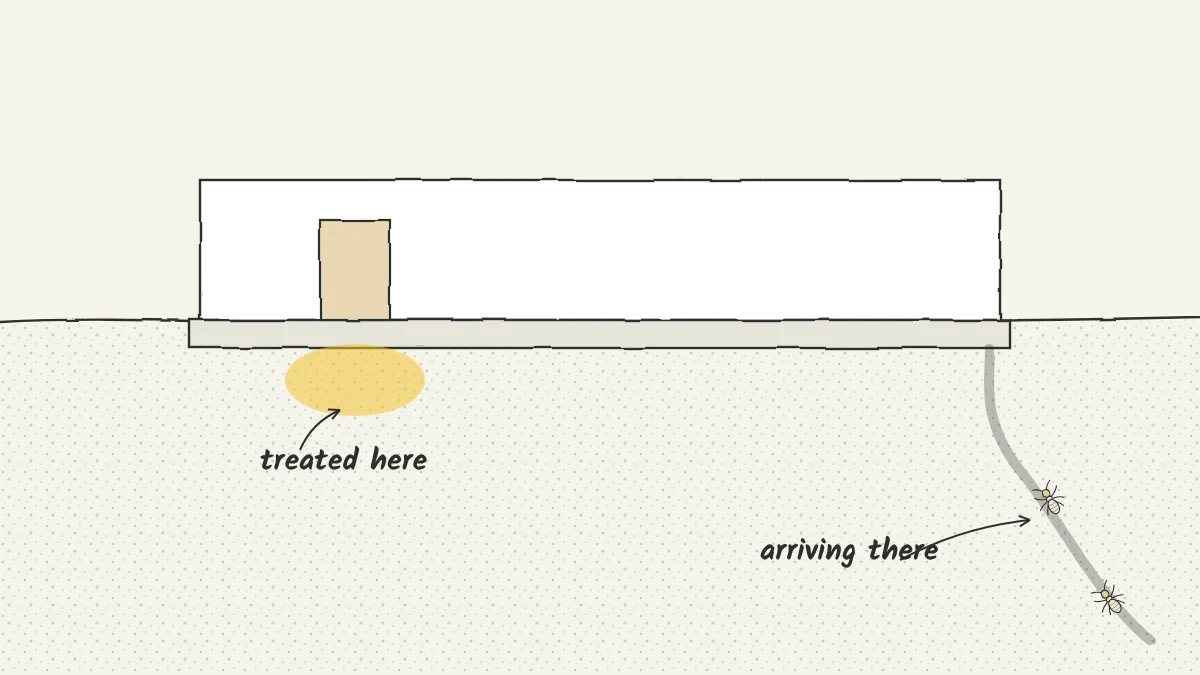
A spot treatment treats only the area where termites were found instead of the whole house. For a single, reachable drywood colony, it can be enough. For subterranean termites, extension entomologists call it a gamble: the colony lives in the soil and often enters the house somewhere else, and spot treatments usually carry limited warranties or none.
On this page
What a spot treatment is, and isn't
A spot treatment applies termiticide only to a limited area: one wall, a doorway, a porch, a single board. It's sometimes called a partial or localized treatment. Everything else stays untreated.
That's fine when the problem really is limited to that spot. The trouble is knowing that it is. With subterranean termites, the colony is out in the soil, foraging in every direction, and what you found is just the first place it showed itself.
When a spot treatment makes sense, and when it doesn't
My rule of thumb, built on what extension services say about each situation.
| Situation | Spot treatment? | Why |
|---|---|---|
| One drywood colony in a board an inspector can reach | Often enough | Drywood colonies live inside the wood; treating that wood treats the colony |
| Drywood colonies in several places, or hidden ones | Not enough | Colonies elsewhere keep going; see drywood termite treatment |
| Subterranean termites found for the first time | Usually not enough | Texas A&M: termites often enter far from where they were found |
| A gap in an existing full treatment, under warranty | Reasonable | Kentucky: termites returning after treatment usually means a gap, not failure of the whole barrier |
| An active spot inside, as part of a bait program | Reasonable | An above-ground bait station on the active site, with in-ground stations around the house |
| Selling the house and need a clean report | Ask first | Lenders and buyers may want a full treatment on record |
The University of Kentucky calls spot treatments for subterranean termites "generally a gamble." NC State Extension says they may not eliminate the colony and often carry a very limited guarantee or none at all.
Why subterranean spots are a gamble
Three facts about subterranean termites work against spot treatments:
- They forage widely. UF/IFAS describes Formosan colonies foraging up to about 100 meters; native colonies cover large areas too. A treated spot is a tiny fraction of what they're exploring.
- They have more than one way in. Every slab crack, plumbing penetration and piece of wood touching soil is a potential entry. Treating one leaves the rest open.
- The value math favors full treatment. Texas A&M AgriLife says spot treatments cost less but often carry limited warranties, and that a full treatment may be the better value.
None of that means a company offering a spot job is acting in bad faith. It does mean you should know what you're buying.
What the rules say spot treatments must disclose
Several states make companies say plainly when a treatment is partial:
- Florida. FDACS rules require the specific treated areas to be listed in the contract, the posted treatment notice to state that only a spot treatment was performed, and, if the company won't retreat those areas, a signed statement saying so before treatment.
- Texas. A company's written estimate must include plain-language definitions of partial, spot, baiting and barrier treatments. The details are on the Texas termite guide.
- California. The Structural Pest Control Board warns consumers about any company claiming whole-house results from a local or spot treatment and calls those claims false advertising.
If your state has no such rule, ask for the same things anyway: a list of treated areas, and the warranty in writing.
What it costs
Spot treatments are cheap because they cover little. Our cost guide puts a spot job for one small, known colony in the low hundreds of dollars, against roughly $600 to $3,200 for a whole-house liquid barrier. The gap shrinks fast if the spot job has to be repeated, or if it misses the colony and repairs follow. The full breakdown, with sources, is in how termite prices work.
If you're offered a spot treatment
Do
- Ask which termite was found, and how the inspector knows
- Ask why the rest of the house doesn't need treatment
- Get the treated areas listed in writing
- Ask what the warranty covers, and for how long
- Compare it with a full-treatment quote
Don't
- Accept a spot job for subterranean termites without a second opinion
- Believe a spot treatment protects the whole house
- Sign anything that doesn't name the treated areas
- Skip next year's inspection because "it was treated"
Questions people ask
Does spot treatment work for termites?
For a single, accessible drywood colony, it can. For subterranean termites, extension entomologists are skeptical: NC State says it may not eliminate the colony, and the University of Kentucky calls it generally a gamble, because termites often enter the house in other places.
How much does a termite spot treatment cost?
Typically a few hundred dollars, roughly $200 to $900 for one small, known colony in our cost guide's ranges, compared with about $600 to $3,200 for a whole-house liquid barrier.
Is a spot treatment covered by a warranty?
Often only partly, or not at all. NC State Extension notes spot treatments often carry a very limited guarantee or none. In Florida, a company that won't retreat spot-treated areas must say so in writing before it treats.
When should I get a full termite treatment instead of a spot treatment?
When subterranean termites are found for the first time, when there's more than one active area, when the source can't be located, or when you need a documented full treatment for a sale.
Keep reading
Termites in your state
Sources
- Texas A&M AgriLife Extension: Subterranean termite control FAQ
- University of Kentucky Entomology: Termite control tips for homeowners (EF604)
- NC State Extension: Monitoring and management of eastern subterranean termites
- UF/IFAS EDIS IN278: Formosan subterranean termite
- Florida Administrative Code 5E-14.105: Contracts for wood-destroying organism treatment
- Texas Administrative Code, 4 TAC 7.174: Termite treatment disclosure documents
- California Structural Pest Control Board: Termites
- EPA-registered label: Recruit HD AG Termite Bait (EPA Reg. No. 62719-652)