Termites in Miami, FL: Asian, Formosan and Drywood Termites
Miami gets two invasive subterranean termites back to back every spring, plus drywood termites in the old buildings and a few species almost nobody else in the country has. Here's the local order of events, and what changes when you live in a condo.
The short version
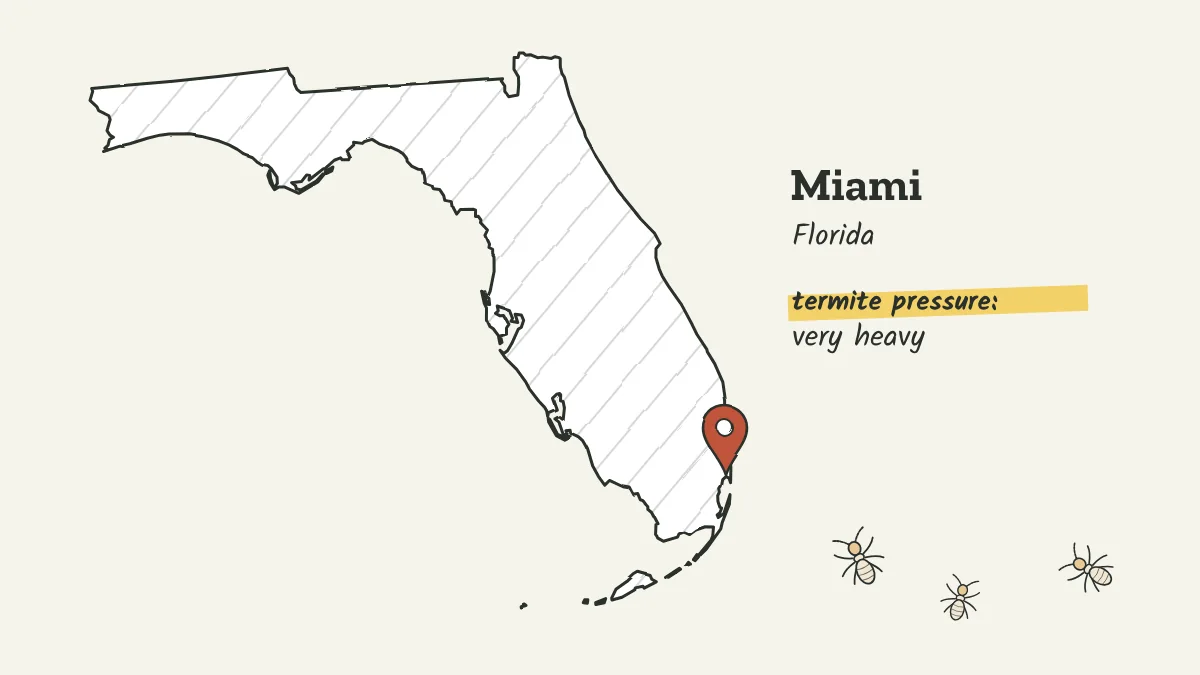
Miami has very heavy termite pressure from two invasive subterranean termites: the Asian subterranean termite, which swarms at dusk from early March, and the Formosan, which follows from late April. West Indian drywood termites infest older buildings and furniture. Condo and townhouse owners face extra rules, because Florida only allows fumigation of an entire, emptied building.
Miami at a glance
- Termite pressure
- Very heavy
- Termites to know
- Asian subterranean, Formosan subterranean, West Indian drywood, Eastern subterranean
- Why termites like it here
- Tropical and humid, with the Asian subterranean termite's longest U.S. track record and Formosans present since 1980.
- Who licenses pest control
-
Florida Department of Agriculture and Consumer Services (FDACS)
Check a company's license - Inspection report for home sales
- FDACS-13645 Wood-Destroying Organisms Inspection Report
On this page
Where America's Asian termite problem began
The Asian subterranean termite was first collected in the continental United States in 1996, from a storefront and a church in Miami, according to UF/IFAS. It's a tropical species, which is why it settled here first, and a UF/IFAS consumer guide in 2021 described it as common from Key West to West Palm Beach.
Formosan termites were here earlier. UF/IFAS entomologist Nan-Yao Su dated their first identification in Dade and Broward counties to 1980. UF's species profile of the Asian termite noted that Broward and Miami-Dade were, at the time, the only Florida counties where both invasive Coptotermes species were established.
That overlap is the Miami story in one sentence. Two of the most destructive subterranean termites in the world share the same neighborhoods, and each can build colonies of several million.
Miami's spring, in order
These are the flights you're most likely to see indoors or around lights, in the order they usually arrive. UF/IFAS research published in 2015 found that the Asian and Formosan seasons overlap more than scientists once thought.
| When | Who | What you'll see |
|---|---|---|
| Daytime, winter into spring | Native subterranean termites | Dark swarmers at sunny windows, often after rain |
| Early March, at dusk | Asian subterranean termite | Large swarms around streetlights and porch lights |
| Late April into June, at dusk | Formosan subterranean termite | Clouds of pale amber swarmers around lights, peaking in May |
| April onward | West Indian drywood termite | Smaller flights, plus pellet piles near windowsills |
Sources: UF/IFAS EDIS IN285, IN278 and IN369, and UF/IFAS news releases from 2015 and 2021. For telling the two invasives apart, see Formosan termites.
Swarm months for Miami's termites
| Termite | J | F | M | A | M | J | J | A | S | O | N | D |
|---|---|---|---|---|---|---|---|---|---|---|---|---|
| Asian subterranean Dusk, around lights | some swarms | common | peak | common | some swarms | |||||||
| Formosan subterranean Dusk, in big clouds around lights | some swarms | peak | peak | some swarms | ||||||||
| West Indian drywood Night, toward lights | common | peak | common | |||||||||
| Eastern subterranean Daytime, often after a warm rain | some swarms | peak | peak | common | some swarms |
Old buildings and the West Indian drywood termite
UF/IFAS reports that the West Indian drywood termite's largest populations are in older buildings in the southern half of Florida. It lives only in structures and wooden objects: framing, trim, cabinets, furniture. UF once called the genus the "furniture termite" because colonies kept turning up in it.
In Miami, that means two things. Older buildings deserve a careful look at trim, doors and attic wood, and secondhand wooden furniture deserves a look before it comes through the door. The 2021 UF/IFAS guide describes the clue as coffee-ground-like droppings, often near windowsills. Pellets and how to read them are covered in termite droppings but no termites.
A termite almost nobody else has
UF/IFAS lists the West Indian subterranean termite (Heterotermes cardini) as present in small pockets in Miami and West Palm Beach, and nowhere else in the state. It's not one of the big structural threats, and you're unlikely to ever meet it. But it's a good illustration of why Miami termite advice starts with identification. With this many species in one metro area, the right treatment depends on which one you have, and the inspector should be able to tell you.
Condos, townhouses and the tenting problem
A large share of Miami lives in shared buildings, and termites don't respect unit lines. Florida's rules make this harder than in a single-family house:
- Fumigation means everyone leaves. FDACS rule 5E-14.111 bars anyone from staying in a fumigated structure or anything physically connected to it, requires an entire multiunit building to be vacated, and requires each unit to be tested for clearance afterward. If that can't be arranged, the building can't be fumigated.
- Single units get other tools. UF/IFAS notes that heat treatments are usually applied to single rooms or apartments rather than whole houses, and drywood colonies that can be reached can be injected locally.
- Responsibility follows the declaration. A Boca Raton condominium attorney, writing in the Palm Beach Post, explained that associations typically handle common elements, which usually begin at the inside surface of the perimeter walls, while owners handle things like their own cabinets. Read your declaration before anyone argues about the bill.
If your building does tent, the steps and safety rules are in termite tenting.
What's coming
By around 2040, roughly one in two buildings in metro South Florida may be within reach of Formosan or Asian subterranean termites. That was a 2016 forecast, and UF's 2026 study says it's still on track. That's not a reason to panic. It is a reason to treat termite inspections in Miami as routine maintenance, the way you treat hurricane shutters, and to keep any termite contract current.
Statewide rules (licensing, the bold-print warranty line on every contract, required notices) are on the Florida termite guide. The WDO report you'll see in a Miami home sale is explained in Florida WDO inspection.
For Miami homeowners and condo owners
Do
- Turn off balcony and porch lights on swarm evenings from March through June
- Save a few swarmers and mail them to UF's free termite ID service in Davie
- Check older trim, cabinets and wooden furniture for pellets
- Ask your association how termite treatment of common elements is handled
- Verify the company's license on the FDACS database
Don't
- Assume all spring swarms are one species
- Bring in old wooden furniture without checking it
- Plan a tent for one unit of a connected building
- Let a termite contract lapse in South Florida
Questions people ask
When do termites swarm in Miami?
Asian subterranean termites start swarming at dusk in early March, and Formosan termites follow from late April through June, peaking in May. Native subterranean termites swarm by day in winter and early spring, and West Indian drywood termites mostly from April onward.
Can you tent a single condo unit in Miami?
Generally no. Florida's fumigation rule requires the whole multiunit building to be vacated and every unit cleared afterward, and no one may remain in any connected structure. Single units are usually handled with local injections or heat instead.
Who pays for termite treatment in a Miami condo?
It depends on your declaration of condominium. Associations typically handle common elements and owners handle what's inside their unit, such as cabinets, but the declaration decides. Read it, and ask the association before you hire anyone.
Are Asian subterranean termites worse than Formosan termites?
They're close relatives with similar biology, and both build colonies of millions. The main difference in Miami is timing: Asian subterranean termites swarm earlier in the year. Either one calls for a professional inspection and treatment.
More in Florida
- Termites in Florida
- Fort Lauderdale
- Fort Myers
- Jacksonville
- Orlando
- Pensacola
- Sarasota
- Tampa
- West Palm Beach
Keep reading
Sources
- UF/IFAS EDIS IN285: Asian subterranean termite
- UF/IFAS EDIS IN278: Formosan subterranean termite
- UF/IFAS EDIS IN236: West Indian drywood termite
- UF/IFAS EDIS IN1360: Termite species distribution in Florida
- UF/IFAS EDIS IN369: Native subterranean termites
- UF/IFAS News (1999): Formosan termite found in Palm Beach, Martin and St. Lucie counties
- UF/IFAS News (2015): Two destructive termite species forming superswarms in South Florida
- UF/IFAS News (2021): As Florida enters termite swarm season
- UF News (February 2026): Invasive termites spreading farther than predicted
- Florida Administrative Code 5E-14.111: Fumigation requirements
- Palm Beach Post, via AOL: Termites eating condo unit's kitchen cabinets. Who pays?
- UF/IFAS EDIS EENY-279: Cryptotermes drywood termites