Termites in Tampa, FL: The New Asian Termite Frontier
Tampa used to be a Formosan-and-natives town. In 2023 it became the first place on Florida's Gulf Coast where the tropical Asian subterranean termite was confirmed swarming. Here's what changed, who's swarming when, and what Tampa's historic and new homes each need.
The short version
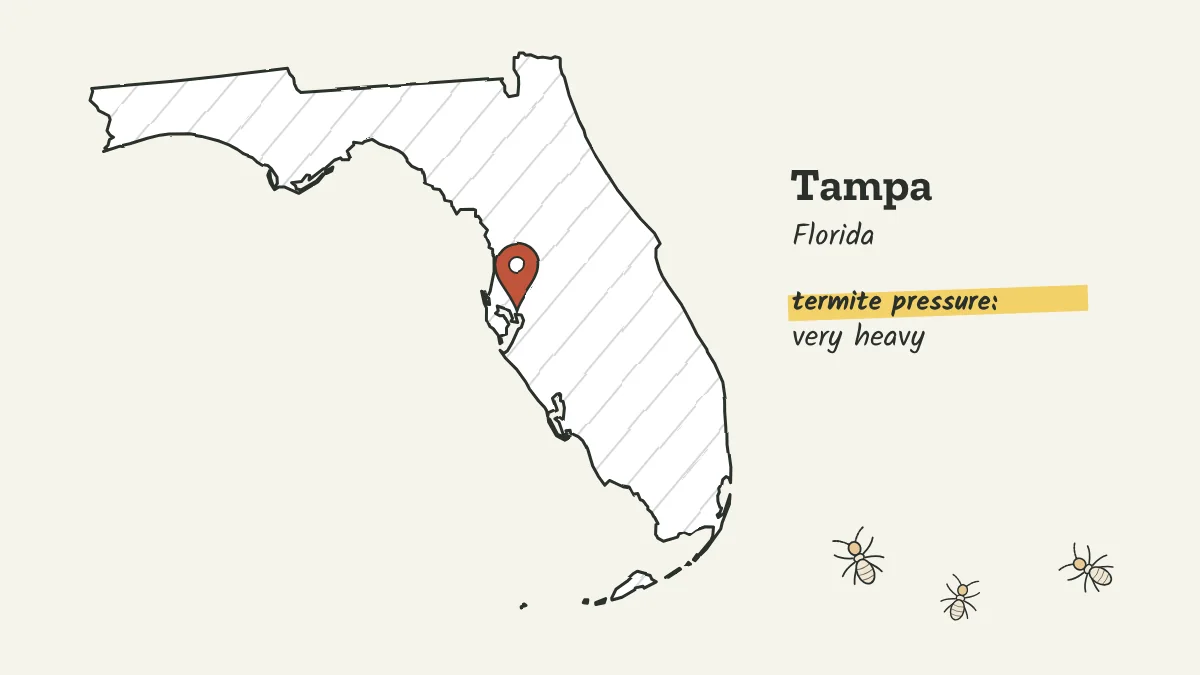
Tampa has very heavy termite pressure. Native subterranean termites swarm by day in winter and spring, Formosans at dusk from late April, and since 2023 Asian subterranean termites have been confirmed swarming in South Tampa in March. In Tampa's historic districts, repairs to original exterior features need a certificate of appropriateness, and new homes need a termite certificate before occupancy.
Tampa at a glance
- Termite pressure
- Very heavy
- Termites to know
- Eastern subterranean, Formosan subterranean, Asian subterranean, West Indian drywood
- Why termites like it here
- Humid subtropical Gulf Coast, with Formosans since at least 1991 and Asian subterranean termites confirmed in South Tampa in 2023.
- Who licenses pest control
-
Florida Department of Agriculture and Consumer Services (FDACS)
Check a company's license - Inspection report for home sales
- FDACS-13645 Wood-Destroying Organisms Inspection Report
On this page
What UF found in South Tampa
In 2023, UF/IFAS termite scientists confirmed that the Asian subterranean termite had become established in South Tampa. The details from UF's announcement:
- The detection came through UF's termite identification service. Hillsborough County pest control operators began submitting specimens in early March, and one winged termite was collected on the evening of March 7.
- It was the first time a tropical invasive termite species had been reported swarming beyond its expected range in Florida, making South Tampa the species' northernmost known infestation in the state.
- Researchers suspect the infestation started seven to ten years earlier, unnoticed.
- UF also noted that the species had been intercepted on private boats in St. Petersburg, Fort Myers and Naples, and that other Gulf Coast cities south of Tampa may already be infested without anyone knowing.
By 2026, UF's statewide study listed the species as established in Hillsborough County, and expected it in all of Florida's 24 southernmost counties before 2040.
Formosans got here first
The Asian termite is the new arrival. Formosan termites have been in Tampa for decades. A 1999 UF/IFAS report dated their discovery near Tampa International Airport to 1991, and noted a Tampa home that had been kept termite-free with baits since 1993.
So Tampa now has both invasive Coptotermes species on top of its native subterranean termites, a combination that until recently was limited to Southeast Florida. In Fort Lauderdale, that overlap has already produced hybrid colonies; see the Fort Lauderdale page for that story.
Which termite is swarming?
The calendar is the quickest clue in Tampa. Here's what each swarm usually looks like.
| You see | Most likely | Why |
|---|---|---|
| Dark swarmers at a sunny window, January to April, early afternoon | Native subterranean termites | UF says eastern subterranean flights run early January to April on warm, still afternoons |
| Brown swarmers around lights at dusk in March | Asian subterranean termites | The pattern behind the 2023 South Tampa detection |
| Pale amber clouds around lights at dusk, late April to June | Formosan termites | Peak flights in May, often by the thousands |
| Smaller flights plus pellet piles on sills | Drywood termites | Colonies inside trim, furniture or attic wood |
Swarmers you can't place? Mail a few to UF's free termite ID service; the address is on the Florida termite guide. For the national picture, see when termites swarm.
Swarm months in Tampa
| Termite | J | F | M | A | M | J | J | A | S | O | N | D |
|---|---|---|---|---|---|---|---|---|---|---|---|---|
| Eastern subterranean Daytime, often after a warm rain | some swarms | peak | peak | common | some swarms | |||||||
| Asian subterranean Dusk, around lights | some swarms | common | peak | common | some swarms | |||||||
| Formosan subterranean Dusk, in big clouds around lights | some swarms | peak | peak | some swarms | ||||||||
| West Indian drywood Night, toward lights | common | peak | common |
Historic bungalows: save the wood if you can
Tampa's historic districts, Seminole Heights among them, are full of early-1900s wood houses with porches, wood siding and original windows. That's a lot of termite food, and it's also a lot of protected material.
The city's Seminole Heights design guidelines are clear that repairs to original building features need a certificate of appropriateness before work starts, and that deteriorated historic features should be repaired rather than replaced. A few specifics that matter after a termite find:
- Deteriorated siding may be replaced with material matching the original in size and shape. Vinyl, aluminum and asbestos siding aren't allowed as replacements, and the guidelines warn that such coverings can seal a wall so the original wood rots.
- Original windows and wood trim should be repaired. Replacements must keep the original size, proportions and pane pattern.
- Any modification, repair or replacement of porch ornamentation needs a certificate. Enclosing or removing a porch goes to a public hearing.
- The guidelines suggest saving rotted parts, because they help match replacements.
Staff can approve minor repairs and appropriate replacements; other work goes to the Architectural Review Commission. Call the city's Architectural Review and Historic Preservation Division at (813) 274-3100, option 3, before a contractor starts cutting. The guidelines date from the early 2000s, so confirm current rules for your district.
New homes: the termite certificate
Tampa is still building, and every new house needs termite protection under the Florida Building Code. The City of Tampa's guide spells out the local step: the licensed pest control company issues a Certificate of Compliance stating that the building has received a complete treatment for the prevention of subterranean termites, the certificate is uploaded to the permit record through the city's online permitting portal, and the building department must approve it before a certificate of occupancy is issued.
If you're buying new, ask for a copy of that certificate and the treatment details, and ask how long the builder's termite warranty runs. The statewide rules for new-construction warranties are on the Florida termite guide, and the treatment itself is explained in termite pretreatment.
For Tampa homeowners
Do
- Treat a March swarm at dusk as worth identifying, not ignoring
- Send a sample to UF's free termite ID service
- Call historic preservation staff before repairing original exterior features
- Keep the termite certificate and warranty paperwork for a new home
- Check your termite contract says whether Formosan or Asian termites are covered
Don't
- Cover termite-damaged wood siding with vinyl
- Throw away the rotted trim before the replacement is matched
- Assume every spring swarm is the same Formosan flight you know
- Let a pre-treatment warranty lapse without asking about extensions
Questions people ask
Are there Asian subterranean termites in Tampa?
Yes. UF/IFAS confirmed in 2023 that the Asian subterranean termite is established in South Tampa, likely for seven to ten years before detection. By 2026, UF listed it as established in Hillsborough County.
When do termites swarm in Tampa?
Native subterranean termites from about January to April by day, Asian subterranean termites at dusk in March, and Formosan termites at dusk from late April into June, peaking in May. Drywood termites add smaller flights in spring and summer.
Do I need approval to repair termite damage in Seminole Heights?
Often, yes. Tampa's design guidelines for the district require a certificate of appropriateness before repairs to original exterior features, and prefer repair over replacement. Call the city's historic preservation division at (813) 274-3100, option 3.
Do new homes in Tampa have to be treated for termites?
Yes. The Florida Building Code requires it, and in Tampa the pest control company's certificate of compliance must be uploaded to the permit and approved before a certificate of occupancy is issued.
More in Florida
- Termites in Florida
- Fort Lauderdale
- Fort Myers
- Jacksonville
- Miami
- Orlando
- Pensacola
- Sarasota
- West Palm Beach
Keep reading
Sources
- UF/IFAS News (2023): UF/IFAS termite scientists confirm first spread of Asian subterranean termites in Tampa
- UF News (February 2026): Invasive termites spreading farther than predicted
- UF/IFAS News (1999): Formosan termite found in Palm Beach, Martin and St. Lucie counties
- UF/IFAS EDIS IN369: Native subterranean termites
- UF/IFAS EDIS IN278: Formosan subterranean termite
- City of Tampa: Seminole Heights design guidelines
- City of Tampa: Residential termite protection requirements