Termites in Orlando, FL: What's Different Inland
Most Florida termite headlines come from the coast. Orlando's situation is different: the natives do most of the work, the Formosans have been here since the 1980s, and the newest coastal invader hasn't been confirmed this far inland. Here's the Central Florida version.
The short version
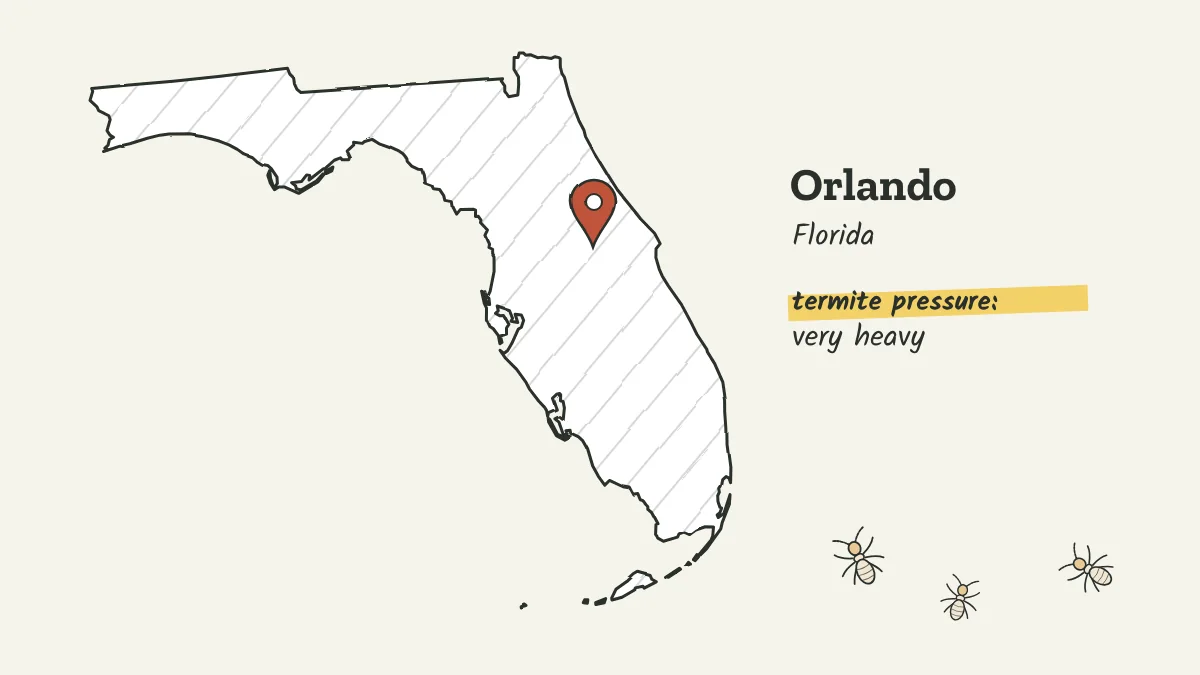
Orlando has very heavy termite pressure, mostly from native subterranean termites that swarm by day from about January to May. Formosan termites have been in Orlando since 1985 and swarm at dusk in late spring. The Asian subterranean termite hadn't been confirmed in Central Florida's inland counties as of UF's 2026 survey. Drywood termites can turn up anywhere in the state.
Orlando at a glance
- Termite pressure
- Very heavy
- Termites to know
- Eastern subterranean, Formosan subterranean, West Indian drywood, Southeastern drywood
- Why termites like it here
- Inland humid subtropical, with native subterranean termites swarming from midwinter and Formosans present since 1985.
- Who licenses pest control
-
Florida Department of Agriculture and Consumer Services (FDACS)
Check a company's license - Inspection report for home sales
- FDACS-13645 Wood-Destroying Organisms Inspection Report
On this page
Central Florida's termites
UF/IFAS records show Florida's two common native subterranean termites, the eastern and the dark southern subterranean termite, statewide, and in Orlando they're the termites you're most likely to meet. They nest in the soil, reach wood through mud tubes and swarm in daylight. Their flights start in winter: UF dates the eastern species from early January and the dark southern one from February, with the last of them in late May. Look for them on a calm, warm afternoon, typically the day after a rain.
That early start surprises newcomers. A January swarm isn't a sign of anything unusual in Orlando. It's the calendar.
UF/IFAS also lists the Florida darkwinged subterranean termite in limited areas of central Florida. It isn't one of the big structural pests, and you may never see it, but it's one more reason to have swarmers identified rather than guessed at.
Formosans arrived in 1985
The Formosan subterranean termite isn't just a coastal problem. A 1999 UF/IFAS report records Formosans being found in Orlando in 1985, after their first Florida identifications in Dade and Broward counties in 1980. UF's species distribution guide says that while they're mainly in coastal cities, they're now also found in some large cities in central and northern Florida, and UF's 2026 study expects them to be detected statewide before 2050.
Formosans swarm at dusk, mostly from late April into June, and fly toward lights. Their colonies run to millions and can live inside large trees, so a swarm around an Orlando porch light deserves a professional inspection. Their biology, and why they're treated differently, is on the Formosan termites page.
Inland vs coastal Florida
Here's how Orlando's termite list compares with the coastal metros, based on UF/IFAS distribution records. It's a snapshot; the invasive species are moving.
| Termite | Orlando area | South Florida coast |
|---|---|---|
| Native subterranean termites | Statewide, the main day-swarming termites | Present, but share the spring with invasives |
| Formosan subterranean termite | Present since 1985 | Present since 1980, widespread |
| Asian subterranean termite | Not on UF's 2026 list of established counties | Established from the Keys up the coast to Brevard County |
| West Indian drywood termite | Possible; UF says it has spread to many cities statewide | Common, especially in older buildings |
| Conehead termite | Not present | Small eradication zone in Broward County |
Sources: UF/IFAS EDIS IN1360, IN369 and IN236, and UF news releases from 1999 and 2026. The Asian termite's northern edge was Brevard County on the Atlantic side and Hillsborough County on the Gulf in UF's 2026 report.
Swarm months in Orlando
| Termite | J | F | M | A | M | J | J | A | S | O | N | D |
|---|---|---|---|---|---|---|---|---|---|---|---|---|
| Eastern subterranean Daytime, often after a warm rain | some swarms | peak | peak | common | some swarms | |||||||
| Formosan subterranean Dusk, in big clouds around lights | some swarms | peak | peak | some swarms | ||||||||
| West Indian drywood Night, toward lights | common | peak | common | |||||||||
| Southeastern drywood Night, toward lights | common | peak |
Historic districts: matching repairs and the minor review
Orlando's older neighborhoods have the wood porches, siding and windows that subterranean termites love to reach from the soil. Six of them are city historic preservation districts: Downtown, Lake Cherokee, Lake Copeland, Lake Eola Heights, Lake Lawsona and Colonialtown South.
According to the city, exterior changes in these districts generally need a certificate of appropriateness, but the process depends on the district and the work:
- In Lake Cherokee and Lake Eola Heights, matching repairs go through the Historic Preservation Board's Minor Review Committee. Major work, such as additions, relocation or demolition, needs a board hearing.
- Lake Eola Heights exempts emergency repairs, landscaping, paint color, and patios or walkways not visible to the public.
- Lake Copeland exempts structures built after 1940, work that doesn't need a building permit, and features not visible from public streets or parks.
- Downtown uses an appearance review instead of the preservation board.
For termite damage, the practical rule is simple: if the repair matches what was there, expect the faster minor review; if you want to change materials or remove features, expect a hearing. Ask the city's Historic Preservation Officer at 407-246-3416 before work starts.
Newer subdivisions
Much of metro Orlando is newer construction on slabs, built under the Florida Building Code's termite protection rules. That means a preventive treatment at construction and a builder's warranty that Florida rules require to last at least one year, with yearly extensions available for at least four more. If you're buying a newer house, ask whether that warranty was extended and is transferable, and look for the treatment notice the company had to post. The statewide rules are on the Florida termite guide.
Two habits matter more than anything for slab houses: don't let landscaping, irrigation or mulch bury the inspection gap at the bottom of the walls, and keep sprinkler heads aimed away from the foundation. More in how to prevent termites.
For Orlando homeowners
Do
- Expect native swarms as early as January, on sunny afternoons
- Treat a dusk swarm around lights in May as a likely Formosan flight
- Send swarmers to UF's free termite ID service if you're unsure
- Call historic preservation before repairing exterior features in a historic district
- Keep the builder's termite paperwork for a newer home
Don't
- Assume coastal termite news always applies inland
- Let mulch and sod creep up over the slab edge
- Swap original wood features for new materials without asking the city
- Skip identification; inland species lists still differ from street to street
Questions people ask
When do termites swarm in Orlando?
Native subterranean termites swarm by day from about January to May, usually on warm afternoons after rain. Formosan termites swarm at dusk from late April into June. Drywood termites can add flights in spring and summer.
Are there Formosan termites in Orlando?
Yes. UF/IFAS records Formosan termites in Orlando since 1985, and UF says they're now found in some large cities in central and northern Florida, not just on the coast.
Are Asian subterranean termites in Orlando?
They weren't on UF's 2026 list of counties where the species is established, which ran north to Brevard County on the Atlantic side and Hillsborough County on the Gulf. The species is spreading, so check UF's distribution map for updates.
Do I need approval to fix termite damage in Lake Eola Heights?
Usually, for exterior work. Matching repairs go through the Historic Preservation Board's Minor Review Committee, and larger changes need a board hearing. Emergency repairs are exempt. Call the city's Historic Preservation Officer at 407-246-3416.
More in Florida
- Termites in Florida
- Fort Lauderdale
- Fort Myers
- Jacksonville
- Miami
- Pensacola
- Sarasota
- Tampa
- West Palm Beach
Keep reading
Sources
- UF/IFAS EDIS IN369: Native subterranean termites
- UF/IFAS EDIS IN1360: Termite species distribution in Florida
- UF/IFAS News (1999): Formosan termite found in Palm Beach, Martin and St. Lucie counties
- UF News (February 2026): Invasive termites spreading farther than predicted
- UF/IFAS EDIS IN278: Formosan subterranean termite
- UF/IFAS EDIS IN236: West Indian drywood termite
- City of Orlando: Historic preservation districts
- Florida Administrative Code 5E-14.105: Contracts for wood-destroying organism treatment