Termites in Jacksonville, FL: Riverside's Formosan Problem
Jacksonville's termite story has a specific address: the old neighborhoods along the St. Johns River, where Formosan termites took down a historic clubhouse and moved into the oaks. Here's what the city learned, which termites swarm when, and what to do if you own an older house nearby.
The short version
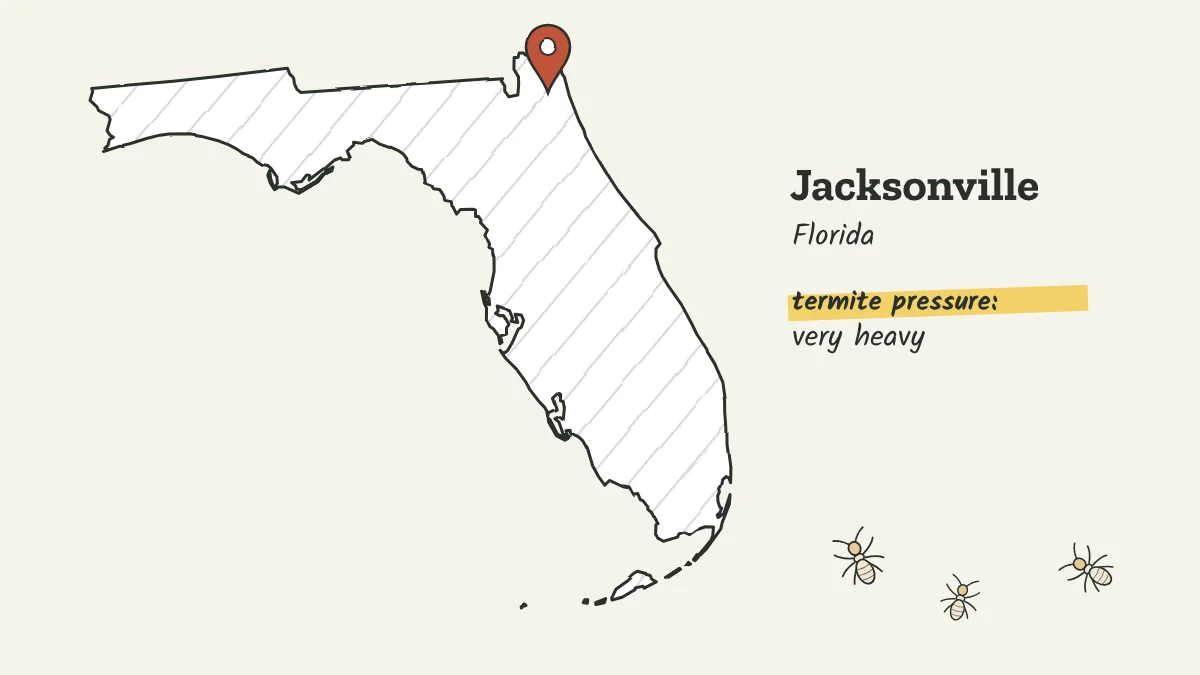
Jacksonville has very heavy termite pressure. Native subterranean termites swarm citywide from about December to April, mid-morning to early afternoon. Formosan termites, in Jacksonville since 2005, are concentrated in Riverside and the urban core, where they infest buildings and large trees and swarm at dusk in late spring. The Asian subterranean termite hasn't been confirmed this far north.
Jacksonville at a glance
- Termite pressure
- Very heavy
- Termites to know
- Eastern subterranean, Formosan subterranean, West Indian drywood
- Why termites like it here
- Humid subtropical northeast Florida with cooler winters than the south, native subterranean termites citywide and Formosans concentrated in the older riverfront neighborhoods.
- Who licenses pest control
-
Florida Department of Agriculture and Consumer Services (FDACS)
Check a company's license - Inspection report for home sales
- FDACS-13645 Wood-Destroying Organisms Inspection Report
On this page
The building that started the conversation
In 2015, Formosan termites were found eating the Woman's Club of Jacksonville building, a property on the National Register of Historic Places owned by the Cummer Museum of Art and Gardens. According to WJCT's reporting, the infestation was severe enough that the building was voted to be demolished, and colonies were found in four of the Cummer's oak trees.
The case got the city's attention. In 2016, UF/IFAS Extension in Duval County held a public meeting that led to the Jacksonville Formosan Termite Task Force, bringing together city officials, JEA, pest control specialists and homeowners. Its stated mission is education about Formosan termite identification, prevention and control, and it looked at how New Orleans manages its own Formosan problem.
That same year, extension staff reported Formosan termites at nine more locations in Riverside, with a cluster west of Margaret Street and south of Park Street.
How Formosans got here, and where they are now
WJCT's 2016 reporting dates the Formosan termite's arrival in Jacksonville to 2005. Statewide, UF/IFAS says the species is now established in most coastal counties and most large cities, and expects it to be found statewide before 2050.
In Jacksonville, it has stayed tied to the older neighborhoods. After Hurricanes Helene and Milton in 2024, UF entomologist Thomas Chouvenc told First Coast News that confirmed sightings were in Riverside and the urban core, that the termites could reach other parts of the city, and that homes surrounded by trees were at higher risk. His advice was to check tree bark for mud tubes and have a professional or arborist inspect both the trees and the house.
What makes Formosans different from the native termites, including carton nests that let them live in trees and walls, is on the Formosan termites page.
Jacksonville's termites at a glance
Northeast Florida's list is shorter than South Florida's. Here's what's here and what isn't, based on UF/IFAS and Duval County Extension sources.
| Termite | Status in Jacksonville | When it swarms |
|---|---|---|
| Native subterranean termites | Citywide, the most common | Mostly December to April, sometimes into May, mid-morning to early afternoon |
| Formosan subterranean termite | Since 2005, concentrated in Riverside and the urban core | Dusk, late spring, toward lights |
| West Indian drywood termite | Possible; UF/IFAS says it has spread to many Florida cities | Mostly April to June |
| Asian subterranean termite | Not confirmed this far north as of UF's 2026 study | (South Florida, Tampa and Brevard County) |
| Formosan-Asian hybrid | Duval County Extension: not currently in North Florida | (Fort Lauderdale) |
Native swarm timing is from UF/IFAS Extension Duval County. For the full picture across the state, see the Florida termite guide.
Swarm months in Jacksonville
Northeast Florida's native subterranean termites fly earlier than the national chart suggests. Duval County Extension puts them from December through April, sometimes into May in good weather.
| Termite | J | F | M | A | M | J | J | A | S | O | N | D |
|---|---|---|---|---|---|---|---|---|---|---|---|---|
| Eastern subterranean Daytime, often after a warm rain | some swarms | peak | peak | common | some swarms | |||||||
| Formosan subterranean Dusk, in big clouds around lights | some swarms | peak | peak | some swarms | ||||||||
| West Indian drywood Night, toward lights | common | peak | common |
Riverside, Avondale and other historic districts
The neighborhoods where Formosans are concentrated are also some of Jacksonville's protected historic districts. That matters when termite damage needs repair.
The City of Jacksonville's Riverside Avondale design guidelines say a certificate of appropriateness is required to obtain a building permit for alterations in a historic district, and that deteriorated historic features should be repaired rather than replaced. When replacement is unavoidable, the material should match the original in size, shape and texture, based on evidence of what was there. A few useful details:
- Routine maintenance and interior work don't require review, and neither does paint color.
- Exterior work not visible from a public right-of-way may get immediate staff approval.
- The guidelines warn that artificial siding can trap moisture and encourage decay and insect infestation, and they recommend sealing holes, caulking cracks and treating for wood fungus as routine care.
Before a contractor pulls termite-damaged siding, trim or porch parts on a historic house, check with the city's Planning and Development Department. Riverside Avondale Preservation, the neighborhood group, keeps a craftsmen referral list.
For Jacksonville homeowners
Do
- Check the bark of big trees near the house for mud tubes, especially in Riverside and the urban core
- Have an arborist or pest professional look at a hollow or mud-covered oak
- Turn off outdoor lights on still, humid evenings in late spring
- Keep wood and mulch from touching the house
- Ask the city before replacing historic exterior features
Don't
- Assume a dusk swarm in May is "just the usual" native termites
- Leave storm-damaged trees and wood debris lying near the house
- Cover old wood siding with vinyl to hide damage
- Sign a contract without asking whether Formosan termites are covered
Questions people ask
Are there Formosan termites in Jacksonville?
Yes. They arrived around 2005 and are concentrated in Riverside and the urban core, where they've infested buildings and large trees. A 2015 infestation led to the planned demolition of the historic Woman's Club building and the creation of the Jacksonville Formosan Termite Task Force.
When do termites swarm in Jacksonville?
Native subterranean termites swarm from about December to April, mid-morning to early afternoon. Formosan termites swarm at dusk in late spring and fly toward lights. Drywood termites can add flights from April to June.
Are Asian subterranean termites in Jacksonville?
Not as of UF/IFAS's 2026 study, which placed the species' northern limit at Brevard County on the Atlantic coast and Hillsborough County on the Gulf. Duval County Extension also lists the Formosan-Asian hybrid as not currently in North Florida.
Can termites live in trees in Jacksonville?
Formosan termites can. They build carton nests inside large trees, and Jacksonville's infestations have been found in oaks as well as buildings. Mud on the bark or hollow trunks near the house are worth an inspection.
More in Florida
- Termites in Florida
- Fort Lauderdale
- Fort Myers
- Miami
- Orlando
- Pensacola
- Sarasota
- Tampa
- West Palm Beach
Keep reading
Sources
- WJCT News (June 2016): Termites continue to worry Riverside homeowners
- PCT: Formosan termite found in Jacksonville neighborhood
- UF/IFAS Extension Duval County: Termites in Florida
- UF/IFAS Extension Duval County: 'Tis the season for swarming
- First Coast News: Experts sound alarm on invasive termite species in Jacksonville after Hurricanes Helene and Milton
- UF News (February 2026): Invasive termites spreading farther than predicted
- UF/IFAS EDIS IN1360: Termite species distribution in Florida
- City of Jacksonville: Riverside Avondale design guidelines