Termites in Fort Lauderdale, FL: Hybrids, Boats and Coneheads
Fort Lauderdale is the place termite scientists watch most closely in America. It's where Formosan and Asian subterranean termites now interbreed in the wild, where an exotic tree-nesting termite landed, and where boats bring new ones in. Here's what that means for your house and your dock.
The short version
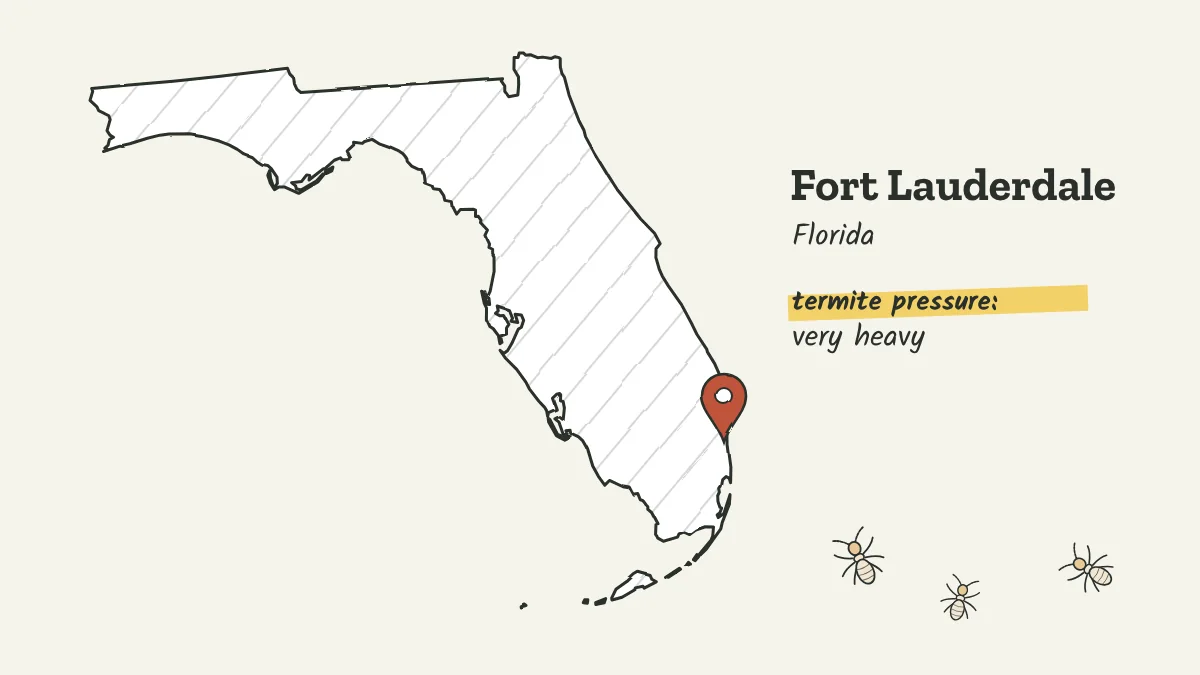
Fort Lauderdale has very heavy termite pressure. Asian subterranean termites have been established here since at least 2005, Formosans since 1980, and since 2021 scientists have collected hybrids of the two in the city. Both swarm at dusk in spring. Boats are a known route for termites into the area, and conehead termites have been found nearby in Broward County.
Fort Lauderdale at a glance
- Termite pressure
- Very heavy
- Termites to know
- Asian subterranean, Formosan subterranean, West Indian drywood, Eastern subterranean
- Why termites like it here
- Tropical and humid, a hub for boat traffic, with Asian, Formosan and hybrid subterranean termites all recorded in the city.
- Who licenses pest control
-
Florida Department of Agriculture and Consumer Services (FDACS)
Check a company's license - Inspection report for home sales
- FDACS-13645 Wood-Destroying Organisms Inspection Report
On this page
The town where termite science happens
A short drive west of downtown, in Davie, is the University of Florida's Fort Lauderdale Research and Education Center. It's where UF entomologist Nan-Yao Su developed the hexaflumuron termite bait system, and its termite lab keeps a collection of more than 6,500 Florida termite samples and runs the state's free termite identification service. When national news reports on new termite threats, the quote usually comes from Davie.
That's useful to you in two ways. Local termite records are unusually good, so the facts below are specific to this area. And you can mail a sample to the lab yourself; the address and steps are on the Florida termite guide.
Hybrid termites, first found in a city park
For years, Fort Lauderdale researchers watched Formosan and Asian subterranean termites swarm on the same spring evenings. In 2015 they reported that Asian males actually preferred Formosan females, and that hybrid colonies grew roughly twice as fast as either parent in the lab.
Then the hybrids showed up outside the lab. According to UF/IFAS:
- Starting in 2021, researchers began collecting winged termites in Fort Lauderdale that matched neither parent. Genetic tests showed each carried half its genes from each species. Hybrid swarms have been confirmed every year since, including April 2025.
- In October 2024, a routine survey of a Fort Lauderdale city park found a tree holding an established hybrid colony, likely there for more than five years.
- The researchers think hybridization is probably ongoing in many colonies across urban South Florida and can't be stopped.
What hybrids mean for damage is still unknown. What it means for you right now is simpler: the same inspection and treatment approach applies, and the dusk swarms you see in spring could be any of three termites.
Swarm months in Fort Lauderdale
The two invasive subterranean termites, and their hybrids, swarm at dusk and head for lights. Asian subterranean flights come first, Formosans follow.
| Termite | J | F | M | A | M | J | J | A | S | O | N | D |
|---|---|---|---|---|---|---|---|---|---|---|---|---|
| Asian subterranean Dusk, around lights | some swarms | common | peak | common | some swarms | |||||||
| Formosan subterranean Dusk, in big clouds around lights | some swarms | peak | peak | some swarms | ||||||||
| West Indian drywood Night, toward lights | common | peak | common | |||||||||
| Eastern subterranean Daytime, often after a warm rain | some swarms | peak | peak | common | some swarms |
Boats bring termites, and take them away
UF/IFAS researchers led by Thomas Chouvenc published a study in 2025 showing that recreational boats are an effective way for invasive termites to travel. Yachts, cabin cruisers and sailboats can carry hidden colonies of Formosan, Asian subterranean and West Indian drywood termites. When those colonies swarm, the flying termites are drawn to city lights on shore and can start new colonies on land, which can then infest other boats.
The study calls South Florida the "yachting capital of the world" and Fort Lauderdale a known hotspot for termites arriving by boat. UF/IFAS's species guide adds that Asian subterranean termites are often intercepted in infested boats in Florida ports.
If you own a boat here:
- Inspect it as seriously as the house: wood trim, cabinetry, anywhere moisture collects.
- Watch for swarmers aboard at night in spring, and for pellets under wooden trim.
- Mention the boat when you have the house inspected. A colony aboard and a swarm at your porch light can be the same story.
Conehead termites in Dania Beach
Just south of the city, Broward County has a termite most Americans will never see. The conehead termite (Nasutitermes corniger) is a tropical species introduced, according to the extension network's Pests in the Home guide, by a boat that docked in Dania Beach around 2001. It was later found in Pompano Beach too, and FDACS runs an eradication program for it.
Conehead termites are easy to tell from anything else in Florida:
- Nests above ground: hard, dark, bumpy masses up to about 3 feet across, at the base of trees, in branches or on structures.
- Tunnels on the surface: mud tubes running up tree trunks, fences and walls, not hidden underground.
- Soldiers with a pointed, cone-shaped head, which FDACS notes no other Florida termite has.
UF/IFAS reports that the Pompano Beach infestation hasn't been seen since a treatment campaign and that the remaining population is limited to areas of Dania Beach. If you think you've found one, don't treat it yourself. Report it to the FDACS Division of Plant Industry helpline at 1-888-397-1517. Ordinary termite treatments don't work on them anyway.
Fort Lauderdale's termite timeline
Here's how the area's termite list grew, using dates from UF/IFAS and FDACS.
| Year | What happened |
|---|---|
| 1980 | Formosan termites first identified in Dade and Broward counties |
| About 2001 | Conehead termites introduced in Dania Beach |
| 2005 | Established Asian subterranean termite colonies found in Fort Lauderdale |
| 2015 | UF/IFAS reports Asian and Formosan termites swarming together in South Florida |
| 2021 | Hybrid winged termites first collected in Fort Lauderdale |
| 2024 | Established hybrid colony found in a tree in a city park |
For the biology of the two parent species, see Formosan termites.
For Fort Lauderdale homeowners and boat owners
Do
- Have the boat checked alongside the house in termite season
- Look at big trees on your lot for mud on the bark or hollow spots
- Report any above-ground carton nest to FDACS at 1-888-397-1517
- Mail a swarmer sample to UF's free ID service in Davie
- Keep your termite contract current; reinfestation pressure here is high
Don't
- Assume a spring swarm is "just Formosans"
- Treat a suspected conehead nest yourself
- Store an infested wooden boat part or furniture in the garage
- Ignore swarmers inside a boat cabin
Next steps
If you've found termites, the rules for contracts, licenses and inspection notices are on the Florida termite guide. To compare liquid treatments with baits for subterranean termites, see termite treatment options. Selling or buying? The state form is explained in Florida WDO inspection.
Questions people ask
Are there hybrid termites in Fort Lauderdale?
Yes. UF/IFAS has collected hybrid Formosan and Asian subterranean swarmers in Fort Lauderdale every year since 2021 and found an established hybrid colony in a tree in a city park in 2024. Scientists believe hybridization is ongoing across urban South Florida.
Can termites live on boats?
Yes. A 2025 UF/IFAS study found that boats can carry hidden colonies of Formosan, Asian subterranean and West Indian drywood termites, and that swarmers from those colonies can fly to shore and infest buildings. Inspect wooden parts of your boat regularly.
What do conehead termites look like?
Soldiers have a dark, pointed, cone-shaped head. Colonies build hard, dark, bumpy nests above ground, up to about 3 feet across, and run mud tunnels up the outside of trees and walls. Report suspected conehead termites to FDACS at 1-888-397-1517.
When do termites swarm in Fort Lauderdale?
Asian subterranean termites swarm at dusk from early March, and Formosan termites from late April into June. Hybrids fly in the same spring window. West Indian drywood termites swarm mostly from April on, and native subterranean termites by day in winter and early spring.
More in Florida
Keep reading
Sources
- UF News (May 2025): UF/IFAS scientists confirm hybrid termites established in Florida
- UF News (April 2025): Termite stowaways, boats as vessels for termite spread
- UF/IFAS News (2015): Two destructive termite species forming superswarms in South Florida
- UF/IFAS EDIS IN285: Asian subterranean termite
- UF/IFAS EDIS IN1360: Termite species distribution in Florida and UF termite identification services
- UF/IFAS News (1999): Formosan termite found in Palm Beach, Martin and St. Lucie counties
- UF/IFAS News (2021): As Florida enters termite swarm season
- Pests in the Home (Extension): Conehead termites
- FDACS, via FNGLA (2019): Help FDACS win the battle against invasive conehead termites