Termites in West Palm Beach, FL: The Invasive Frontier
For years, the line on the map where Asian subterranean termites stopped ran right through Palm Beach County. It doesn't stop there anymore, and West Palm Beach now has the full South Florida set. Here's what's here, and what owners of the city's older homes should do before the first board comes off.
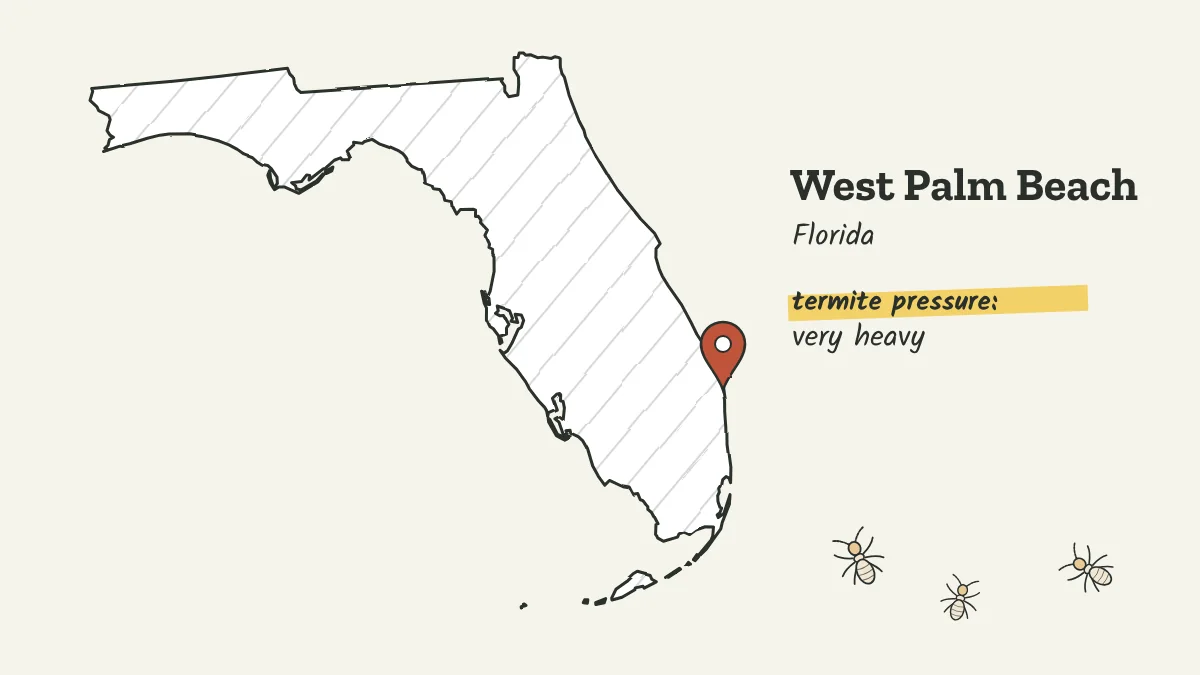
The short version
West Palm Beach has very heavy termite pressure. Asian subterranean termites, established next door in Riviera Beach since 2005, swarm at dusk from early March; Formosan termites, in the county since at least 1999, follow in spring. Drywood termites infest older buildings. In the city's historic districts, exterior repairs to termite-damaged wood can need a certificate of appropriateness.
West Palm Beach at a glance
- Termite pressure
- Very heavy
- Termites to know
- Asian subterranean, Formosan subterranean, West Indian drywood, Eastern subterranean
- Why termites like it here
- Subtropical and humid, at what was long the northern edge of the Asian subterranean termite's range, with Formosans in the county since the 1990s.
- Who licenses pest control
-
Florida Department of Agriculture and Consumer Services (FDACS)
Check a company's license - Inspection report for home sales
- FDACS-13645 Wood-Destroying Organisms Inspection Report
On this page
Where the map line used to be
In early 2005, UF/IFAS researchers found established, land-based colonies of the Asian subterranean termite in Fort Lauderdale and in Riviera Beach, West Palm Beach's northern neighbor. UF's species profile called them the northernmost established colonies of the species anywhere in the world at the time.
Sixteen years later, a 2021 UF/IFAS consumer guide described the Asian subterranean termite as common from Key West to West Palm Beach. By 2026, UF reported it established as far north as Brevard County. The frontier moved on. West Palm Beach is now well inside it.
Like its Formosan cousin, the Asian subterranean termite builds colonies that can number in the millions and forage around a hundred feet from the nest. It swarms at dusk, and in South Florida UF expects large swarms starting in early March.
Formosans, and why your neighbors matter
Formosan termites reached Palm Beach County before the Asian species did. In March 1999, UF/IFAS reported new Formosan infestations in Palm Beach Gardens, about 45 miles north of the nearest known sites in Fort Lauderdale, along with others farther up the coast. UF entomologist Nan-Yao Su said they were most likely spread by people moving infested materials.
His advice then is still the most useful thing a West Palm Beach homeowner can hear: treat subterranean termites like a contagious disease. These colonies travel far from their nests, so a single treated house in an untreated neighborhood can be reinfested. That's an argument for talking to your neighbors when one of you finds termites, and for being wary of free mulch, old timbers and secondhand wood from unknown places.
Swarm months in West Palm Beach
The 1999 UF/IFAS report put the local Formosan swarm season at April through July. Asian subterranean swarms come earlier, from early March.
| Termite | J | F | M | A | M | J | J | A | S | O | N | D |
|---|---|---|---|---|---|---|---|---|---|---|---|---|
| Asian subterranean Dusk, around lights | some swarms | common | peak | common | some swarms | |||||||
| Formosan subterranean Dusk, in big clouds around lights | some swarms | peak | peak | some swarms | ||||||||
| West Indian drywood Night, toward lights | common | peak | common | |||||||||
| Eastern subterranean Daytime, often after a warm rain | some swarms | peak | peak | common | some swarms |
Historic houses: repair before you replace
The City of West Palm Beach has 18 locally designated historic districts and 46 individually designated historic sites. The city's historic preservation office says exterior changes to a historic structure must comply with its preservation ordinance and design guidelines, and sorts projects into three levels:
- Staff level 1: reviewed by staff along with your building permit.
- Staff level 2: needs a minor certificate of appropriateness, which staff can approve administratively, any time.
- Board level: needs a major certificate of appropriateness and a hearing before the Historic Preservation Board, which meets on the fourth Tuesday of each month, with applications due two months ahead.
Termite treatment itself doesn't change the building's appearance. Repairs often do: replacing windows, doors, rafter tails, trim or siding. Before you sign a repair contract, find your property on the city's historic property map and call the planner on call at (561) 822-1461 to ask which level your work falls under. A two-month board timeline is much easier to live with when you know about it before demolition starts.
Old-house termite checkpoints
Older West Palm Beach houses tend to have more wood exposed to the weather and more years for drywood colonies to settle in. Here's where to look, and the trade-off at each spot.
| Spot | Look for | Ask the city first? |
|---|---|---|
| Rafter tails and eaves | Soft wood, pellets on the ground below | Yes, it's exterior |
| Original windows and frames | Pellet piles on sills, blistered paint | Yes, especially before replacing |
| Exterior doors and jambs | Hollow sound, kick-out holes | Yes, if the door or trim changes |
| Attic framing | Pellets on insulation, mud tubes from below | Usually not; it's not visible outside |
| Additions and porches | Mud tubes where a newer slab meets the old wall | Yes, if anything visible changes |
Pellets and kick-out holes point to drywood termites, which UF/IFAS says are most common in older buildings in South Florida. See drywood termites.
A rare termite with a local address
UF/IFAS lists the West Indian subterranean termite (Heterotermes cardini) in small pockets in only two places in Florida: Miami and West Palm Beach. It isn't one of the headline structural pests. It does show why identification matters in this area: there are more termite species within a few miles of downtown than in most entire states.
If you find swarmers or soldiers, collect a few. UF's termite ID service in Davie identifies samples for free; the steps are on the Florida termite guide.
For West Palm Beach homeowners
Do
- Check your property's historic status before any exterior repair
- Ask the inspector which termite they found, by name
- Talk to neighbors when Formosan or Asian termites turn up on your street
- Keep wood mulch and firewood away from the foundation
- Verify the company's license on the FDACS database
Don't
- Replace historic windows or trim before asking the city
- Bring in old timbers or secondhand wood of unknown origin
- Assume a spring swarm is native termites
- Let a termite contract lapse
Next steps
The statewide rules, including what every Florida termite contract must say on its first page, are on the Florida termite guide. For the inspection report used in Palm Beach County home sales, see Florida WDO inspection. If repairs are already on the table, read termite damage repair before choosing between repair and replacement.
Questions people ask
Are Asian subterranean termites in West Palm Beach?
Yes. Established colonies were found in neighboring Riviera Beach in 2005, and by 2021 UF/IFAS described the species as common from Key West to West Palm Beach. It swarms at dusk, starting in early March.
When do termites swarm in West Palm Beach?
The year opens with native subterranean swarms on sunny winter days. Asian subterranean termites follow at dusk from early March, then Formosans from April into July, with West Indian drywood flights mixed in from April.
Do I need permission to repair termite damage on a historic house in West Palm Beach?
Treatment usually doesn't, but exterior repairs can. The city requires exterior changes to historic structures to follow its preservation ordinance, with staff or board review depending on the work. Call the planner on call at (561) 822-1461 before you start.
Why should I care if my neighbor has termites?
Subterranean termites, especially Formosans, forage far from their nests. UF/IFAS entomologist Nan-Yao Su has argued for treating them at the neighborhood level, because a single treated house can be reinfested from untreated properties nearby.
More in Florida
Keep reading
Sources
- UF/IFAS EDIS IN285: Asian subterranean termite
- UF/IFAS News (2021): As Florida enters termite swarm season
- UF News (February 2026): Invasive termites spreading farther than predicted
- UF/IFAS News (1999): Formosan termite found in Palm Beach, Martin and St. Lucie counties
- UF/IFAS EDIS IN1360: Termite species distribution in Florida
- UF/IFAS EDIS IN236: West Indian drywood termite
- City of West Palm Beach: Regulations for historic properties