Termite Damage Repair: What Can Be Saved
Not every piece of termite-eaten wood has to come out. Some can be patched, some reinforced and some replaced in sections. The skill is telling which is which, and doing it in an order that doesn't waste the repair. Here's how preservation specialists and extension entomologists approach it.
The short version
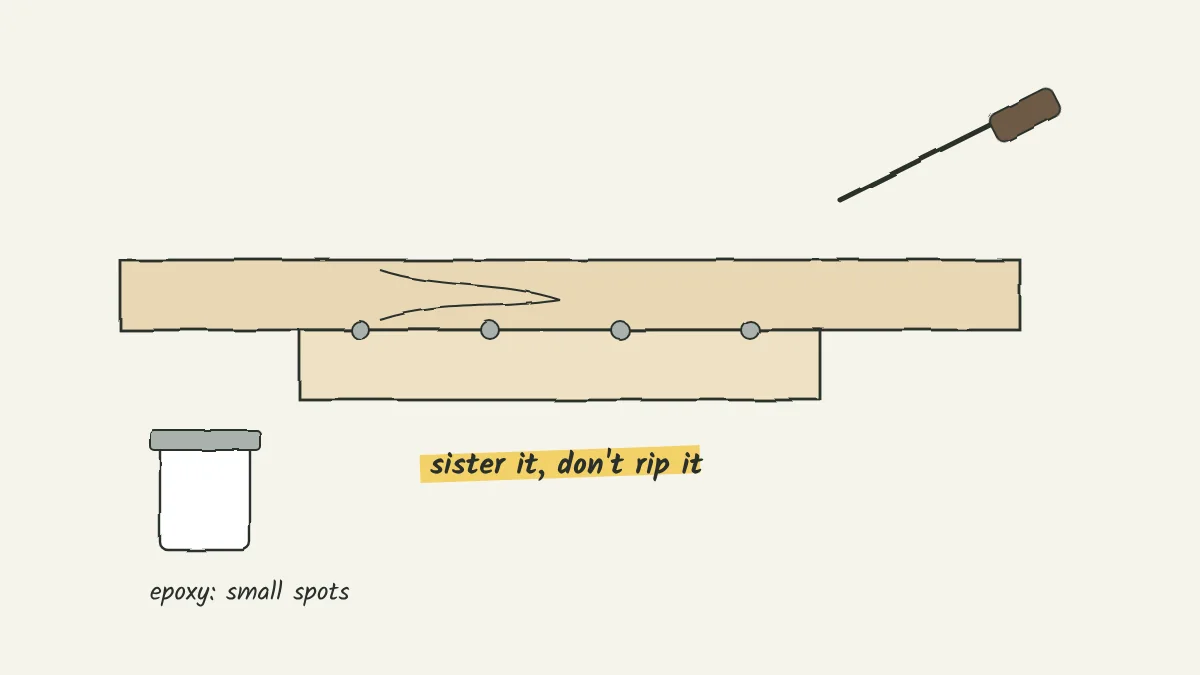
Treat the termites and fix the moisture first. Then probe the wood to find where sound wood begins. Cosmetic pieces like trim are usually replaced; damaged structural members are reinforced or replaced in sections, with a contractor's or engineer's input. Epoxy consolidants suit small areas of decay in decorative or historic wood, not members in tension.
On this page
First, make sure it's over
Repairs come last. Texas A&M AgriLife Extension notes that you can't tell how old wood damage is just by looking at it, so have a licensed inspector confirm whether termites are still active and treat if they are. Repairing first gives the colony fresh wood.
Then fix the water. HUD's residential rehabilitation guide calls water a building's biggest enemy and says a dry building generally won't have problems with decay or subterranean termites. Leaks, wet soil against the foundation and a damp crawlspace caused the problem or made it worse, and they'll ruin new wood the same way. If you're not sure whether the damage is from insects or rot, see termite damage vs water damage.
How to judge what's left
Termite damage is usually worse than it looks from the outside, because subterranean termites eat along the grain and leave the surface. The University of Kentucky describes damaged wood as hollowed along the grain and lined with mud. Three simple tests tell you where it ends:
- Tap it. University of Arizona Extension suggests tapping wood every few inches with a screwdriver handle; damaged wood sounds hollow.
- Probe it. Push an awl or screwdriver into suspect wood and see where it stops going in easily.
- The pick test. The General Services Administration's preservation procedure: insert an ice pick at a slight angle and lift. If the wood splinters in long pieces, it's sound. If it snaps where the pick lifts, it's decayed.
Mark where sound wood starts. That line decides whether a piece gets patched, reinforced or cut back.
Repair options by piece
General guidance from preservation and extension sources. Anything that carries load deserves a contractor's or engineer's look before you choose.
| Piece | Usual approach | Notes |
|---|---|---|
| Baseboard, trim, casing | Replace the damaged length | Cheap and fast; match the profile |
| Drywall paper and paint | Patch | Termites eat the paper, not the gypsum |
| Subfloor | Cut out and replace the damaged section | Check the joists underneath while it's open |
| Floor joist | Sister a new board alongside, or replace | Sistering keeps the old joist in place; a pro decides |
| Sill plate | Replace damaged sections | May require supporting or lifting the wall |
| Porch post or column base | Cut out the bottom and splice in new wood | Keeps the rest of the original post |
| Decorative or historic woodwork | Epoxy consolidation and filler | Only for small areas in otherwise sound wood |
Costs for each of these are in termite damage repair cost.
For sizing up the damage
As an Amazon Associate I earn from qualifying purchases.
-
View on Amazon
Awl or flat-head screwdriver
Press it into suspect wood. Healthy wood fights back. Eaten wood gives way like a stale cracker.
-
View on Amazon
Pin-type wood moisture meter
Wood that reads above about 20% is wet enough to invite rot and termites. Great for sills and subfloors.
-
View on Amazon
Bright LED flashlight, 1,000+ lumens
The one tool that really matters. A tight, bright beam shows mud tube texture and wing piles in dark corners.
Structural pieces need a second opinion
Joists, beams, sill plates, posts and rafters hold the house up. Decide how to fix them with a contractor or structural engineer who isn't selling the termite treatment. Termite inspection reports won't make that call for you: Hawaii's PC-9 form, for example, says plainly that it gives no opinion on structural integrity, repair necessity or cost, and North Carolina's WDIR doesn't report the extent of damage at all.
Reinforcing is often possible. A joist with damage along part of its length can usually be sistered, with a new board fastened alongside it, rather than pulled out. A sill plate can often be replaced in sections. Where damage is widespread, replacement is the safer answer. Building permits are usually needed for structural work, and in a historic district the city may review exterior repairs; city pages like New Orleans and Memphis explain local rules.
When epoxy repairs make sense
Epoxy consolidants and fillers can save wood that would otherwise be replaced, and preservation agencies have studied them for decades. A 1978 National Park Service report found consolidation suits small areas of decay in otherwise sound wood and costs less than replacing the piece, and that consolidated wood can regain enough strength to carry loads in some cases.
The limits are just as clear:
- Not for members in tension. GSA's preservation procedure says epoxy has adequate compression strength but isn't the best choice for a member in tension; replacement is usually better.
- Dry first. GSA says to dry the wood completely and eliminate the moisture source, or the epoxy can trap moisture and speed decay.
- It's permanent. The Park Service report notes cured epoxy can't be dissolved or removed.
- It shows on bare wood. GSA recommends replacing sections of unpainted wood instead, since epoxy looks different.
Epoxy is best for decorative trim, window sills, column bases and other pieces where the original matters and the load is light.
Repairing termite damage
Do
- Confirm the termites are treated before repairing
- Fix the moisture source while the wood is exposed
- Probe to find where sound wood starts
- Get a structural opinion on load-bearing pieces
Don't
- Replace a whole member when a section or sister will do
- Use epoxy on a wet piece or a member in tension
- Cover the damage back up before photographing it
- Let the termite company be the only one judging the structure
Questions people ask
Can termite-damaged wood be repaired?
Often, yes. Trim and subfloor are usually replaced in sections, damaged joists can often be sistered, and small areas of decay in decorative or historic wood can be consolidated with epoxy. Load-bearing pieces with heavy damage should be replaced.
How do I know how bad termite damage is?
Tap and probe the wood to find where it turns sound. A preservation test is to lift an ice pick from the wood: long splinters mean sound wood, a clean snap means damaged wood. Have a contractor assess anything structural.
Should I repair termite damage before or after treatment?
After. Have the termites confirmed and treated first, and fix the moisture problem, so the new wood isn't attacked.
Is epoxy good for termite-damaged wood?
For small areas in otherwise sound, dry wood, especially decorative or historic pieces. GSA's preservation guidance says it isn't the best choice for structural members in tension, where replacement is usually better.
Keep reading
Termites in your state
Sources
- General Services Administration: Epoxy repair for deterioration and decay in wooden members
- National Park Service: Epoxies for wood repairs in historic buildings (Phillips and Selwyn, 1978)
- HUD: Residential rehabilitation inspection guide (2000)
- Texas A&M AgriLife Extension: Subterranean termites (E-368)
- University of Kentucky Entomology: Protecting your home from termites (EF605, 2018)
- University of Arizona Cooperative Extension AZ1356: Termite management for homeowners (2005)
- Hawaii Pest Control Board: Termite Inspection Report form PC-9
- NCDA&CS: Homeowner's guide to the wood destroying insect report