Termites in Sarasota, FL: On the Asian Termite's Path
Sarasota is in the gap on the map: south of the Asian subterranean termite colonies confirmed in Tampa, north of the long-established ones in South Florida, with boats moving along the coast between them. Add a direct hit from Hurricane Milton and a town full of prized mid-century houses, and the local termite picture has a few twists.
The short version
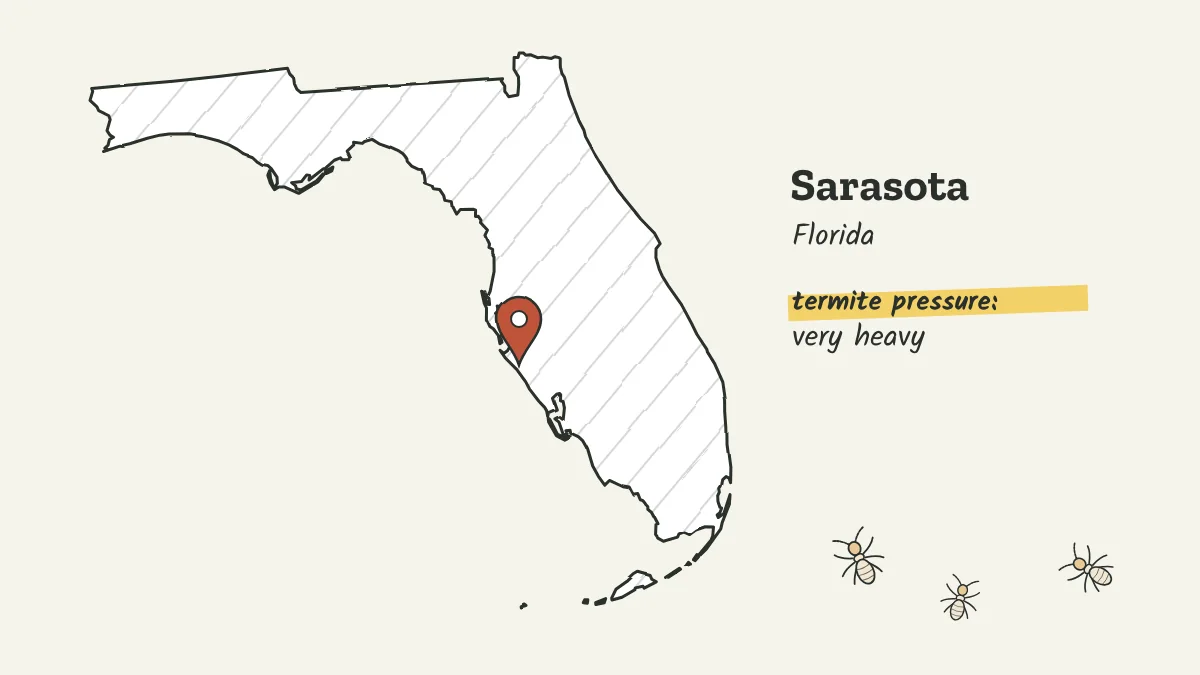
Sarasota has very heavy termite pressure from native subterranean termites, Formosans and drywood termites. Asian subterranean termites are established in Tampa to the north and in South Florida, and UF/IFAS expects them in Sarasota County before 2040. Hurricane Milton's 2024 landfall nearby left wet wood and fallen trees, both termite risks. Historic properties need city approval for exterior changes.
Sarasota at a glance
- Termite pressure
- Very heavy
- Termites to know
- Eastern subterranean, Formosan subterranean, Asian subterranean, West Indian drywood
- Why termites like it here
- Subtropical central Gulf coast between two known Asian subterranean termite areas, hit directly by Hurricane Milton in 2024.
- Who licenses pest control
-
Florida Department of Agriculture and Consumer Services (FDACS)
Check a company's license - Inspection report for home sales
- FDACS-13645 Wood-Destroying Organisms Inspection Report
On this page
Between two termite fronts
For most of the last thirty years, Florida's Asian subterranean termites lived in the southeast, from Key West up the Atlantic side. Then, in 2023, UF/IFAS confirmed an established population in South Tampa, about an hour north of Sarasota, and warned that Gulf Coast cities south of Tampa may already have infestations that haven't been found. The species had also been caught on private boats in St. Petersburg, Fort Myers and Naples, both directions from here.
By 2025, UF/IFAS was describing detections in multiple Central Florida cities "from Tampa to Melbourne," and its 2026 study expects the species in all 24 of Florida's southernmost counties before 2040. Sarasota County is one of them.
What that means for you is mostly about identification. A spring swarm at dusk around a light could be Formosans, which are already established along the coast, or the earlier-flying Asian species. If you see one, collect a few swarmers and send them to UF's free termite ID service; you'd be helping put Sarasota on the map. The steps are on the Florida termite guide.
Milton and the trees
Hurricane Milton made landfall on the evening of October 9, 2024, about 5 miles west of Siesta Key, as a Category 3 storm with winds estimated at 120 mph, according to the National Hurricane Center.
Within a week, UF/IFAS urban entomologist Thomas Chouvenc was pointing Floridians at their fallen trees. Invasive subterranean termites, Formosan and Asian, can live inside large trees, and a storm that snaps the trunks open shows you who's been living there. His advice: inspect trees regularly for mud tubes, know which species are recorded near you, and have trees on your property inspected and treated where needed.
Two other storm effects linger:
- Damp structures. UF/IFAS warns that subterranean termites readily attack water-damaged wood, so moisture control after a storm is a termite step, not just a mold step.
- Debris. Wood left lying on the ground near the house is an invitation. Move it, and don't bury it.
The tree side of this is covered in termites in trees.
Swarm months in Sarasota
| Termite | J | F | M | A | M | J | J | A | S | O | N | D |
|---|---|---|---|---|---|---|---|---|---|---|---|---|
| Eastern subterranean Daytime, often after a warm rain | some swarms | peak | peak | common | some swarms | |||||||
| Asian subterranean Dusk, around lights | some swarms | common | peak | common | some swarms | |||||||
| Formosan subterranean Dusk, in big clouds around lights | some swarms | peak | peak | some swarms | ||||||||
| West Indian drywood Night, toward lights | common | peak | common |
Historic and mid-century houses
Sarasota is known for the Sarasota School of Architecture, the mid-century modern houses that put the city on the design map. The City of Sarasota's historic preservation office says it has encouraged owners of Sarasota School structures to apply for local designation even before they reach the usual 50-year threshold.
Designation brings rules worth knowing before termite repairs start:
- Changing a locally designated structure requires a certificate of appropriateness: a building COA for exterior changes, filed with the building permit, and separate COAs for moving or demolishing the structure.
- Work must follow the Secretary of the Interior's Standards, and applications are reviewed by staff and scheduled for a Historic Preservation Board hearing.
- The city also has a historic conservation district in Newtown.
If termite damage means replacing visible exterior wood, siding, windows or trim on a designated house, call the city's historic preservation senior planner at (941) 263-6585 before the contractor starts. Interior framing repairs are a simpler conversation.
A Sarasota termite check, by house type
Sarasota has older historic houses, mid-century modern ones and newer subdivisions, and each has its own soft spots. This is a starting checklist, not a substitute for an inspection.
| House type | Look first at | Paperwork to find |
|---|---|---|
| Older and historic houses | Window frames, trim, porches and attic framing, for pellets and soft wood | Any past treatment records or contract |
| Mid-century houses | Exposed wood beams and trim, and where wood meets slab or glass | Designation status before exterior repairs |
| Newer subdivisions | The slab edge, where landscaping and mulch may have covered the inspection gap | The builder's termite certificate and warranty |
| Any house near big trees | Bark for mud tubes, stumps for hollow centers | None, just a flashlight |
Not sure what you found? Start with signs of termites, or read about drywood termites if you see pellets.
For Sarasota homeowners
Do
- Look at fallen or cut trees on your street for hollow, mud-packed centers
- Send swarmers to UF's free ID service, especially early-spring dusk swarms
- Dry out and repair anything that got wet in the 2024 storms
- Check designation status before exterior repairs on an older or mid-century house
- Ask whether your termite contract covers Formosan and Asian subterranean termites
Don't
- Leave storm wood piled against the house
- Assume a dusk swarm in March is Formosans; it may be the Asian species
- Replace original exterior features on a designated house without a COA
- Let landscaping bury the bottom of the walls
Questions people ask
Are there Asian subterranean termites in Sarasota?
UF's published reports haven't named Sarasota specifically, but the species is established an hour north in South Tampa and throughout Southeast Florida. UF's 2026 forecast puts Sarasota County on the list of counties expected to have it before 2040, so treat early-spring dusk swarms as worth identifying.
When do termites swarm in Sarasota?
Native subterranean termites swarm by day from about January into spring. Where Asian subterranean termites are present, they fly at dusk from early March. Formosans swarm at dusk from late April into June, and drywood termites mostly from April on.
Did Hurricane Milton make termite problems worse?
It created conditions termites like. Water-damaged wood attracts subterranean termites, storm debris left on the ground can become infested, and fallen trees have revealed invasive termite colonies. Drying, cleanup and a tree inspection all help.
Do I need approval to repair termite damage on a historic Sarasota house?
If the house is locally designated and the repair changes the exterior, yes. The city requires a certificate of appropriateness for exterior changes to designated structures. Call the historic preservation planner at (941) 263-6585.
More in Florida
- Termites in Florida
- Fort Lauderdale
- Fort Myers
- Jacksonville
- Miami
- Orlando
- Pensacola
- Tampa
- West Palm Beach
Keep reading
Sources
- UF/IFAS News (2023): Asian subterranean termites confirmed in Tampa
- UF/IFAS News (March 2025): Is your neighborhood a termite hot spot?
- UF News (February 2026): Invasive termites spreading farther than predicted
- FOX 6 Milwaukee, citing the National Hurricane Center: Hurricane Milton makes landfall
- UF/IFAS News (October 2024): Fallen trees can reveal hidden termites
- UF/IFAS News (September 2024): Pest control tips for hurricane season
- City of Sarasota: Historic Preservation Program
- UF/IFAS EDIS IN369: Native subterranean termites