Termites in Austin, TX: The City's Least-Toxic Playbook
Austin has something most cities don't: its own written termite advice, from the city's Grow Green program, built around preventing termites with as little chemistry as possible and choosing treatment carefully when you need it. Here's that playbook, plus when Austin's termites swarm and who to ask locally.
The short version
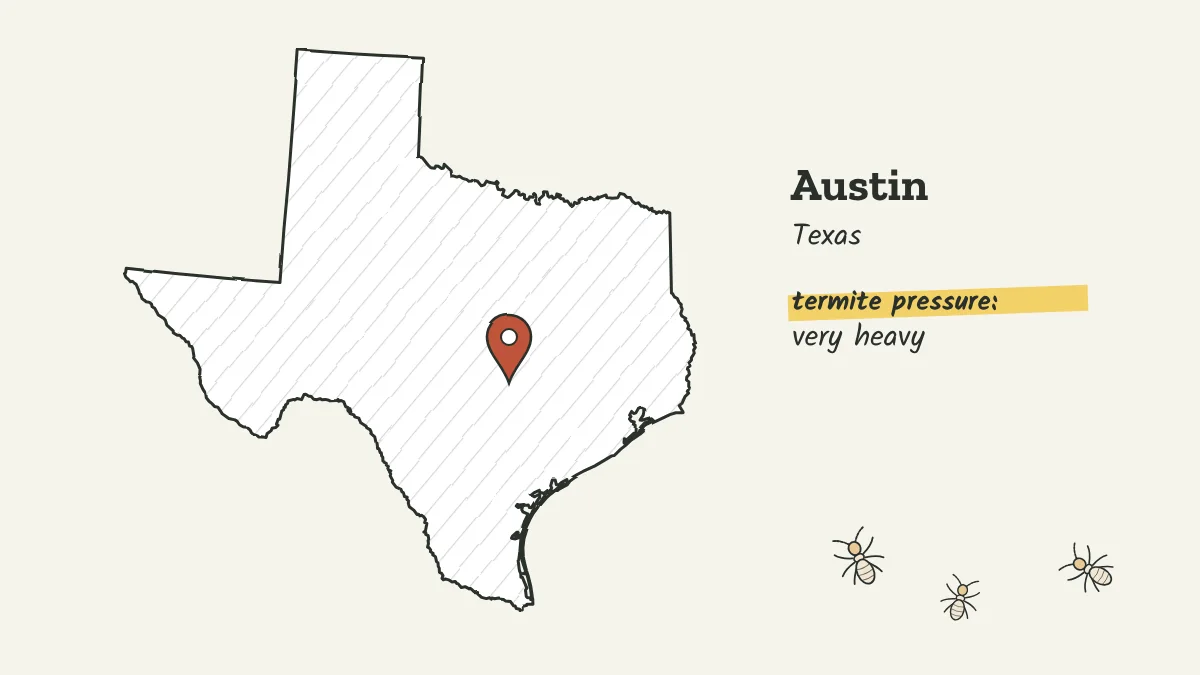
Austin has very heavy termite pressure, mostly from native subterranean termites. The City of Austin's Grow Green guide says they typically swarm in February and March, during the day. Formosan termites rarely occur here and swarm on May evenings. The city recommends prevention first, non-repellent products if you treat, and keeping yearly warranty renewals under 20% of the treatment cost.
Austin at a glance
- Termite pressure
- Very heavy
- Termites to know
- Eastern subterranean, Formosan subterranean
- Why termites like it here
- Hot Central Texas with mild winters, native subterranean termites swarming as early as February, and Formosans present but rare.
- Who licenses pest control
-
Texas Department of Agriculture, Structural Pest Control Service
Check a company's license - Inspection report for home sales
- Texas Official Wood Destroying Insect Report, on the form prescribed by TDA
On this page
Austin's termite calendar
The City of Austin's Grow Green fact sheet gives a clear local picture:
- Native subterranean termites can show up any time of year, but typical swarms happen between February and March, during the day. Swarmers are dark brown to black and about a quarter to three-eighths of an inch long.
- Formosan subterranean termites rarely occur in the Austin area, the city says. When they do swarm, it's in May, in the evening and early night, and they head for lights. Their swarmers are brown to gold.
Texas A&M AgriLife's Travis County office adds what sets swarms off: warm temperatures and a significant rain, and sometimes simply an irrigation system left running. That last one is worth knowing in a city with a lot of automatic sprinklers.
Swarm months in Austin
The chart shows the national pattern for these two termites. Austin's natives typically fly a little earlier, in February and March, according to the city.
| Termite | J | F | M | A | M | J | J | A | S | O | N | D |
|---|---|---|---|---|---|---|---|---|---|---|---|---|
| Eastern subterranean Daytime, often after a warm rain | some swarms | peak | peak | common | some swarms | |||||||
| Formosan subterranean Dusk, in big clouds around lights | some swarms | peak | peak | some swarms |
The city's least-toxic prevention list
Grow Green is a City of Austin program, run through its watershed department, on low-impact landscape and pest care. Its termite guide leads with prevention. Here's the list, with the reason each item works.
| Step | Why it helps |
|---|---|
| Cover crawlspace soil with 6-mil polyethylene (pier-and-beam homes) | Cuts the moisture termites need |
| Remove form stakes, wood scraps and stumps before pouring concrete | Leaves no buried food next to the slab |
| Consider a stainless steel or polyethylene physical barrier when building | Blocks entry without chemicals |
| Slope soil away from the house on every side | Keeps the foundation dry |
| Seal and caulk openings for plumbing and utilities | Closes common entry points |
| Keep soil, debris and stacked wood away from the foundation | Removes cover and food |
| Set posts on masonry or use exterior-grade treated wood | Breaks wood-to-soil contact |
| Check the foundation for mud tubes, perhaps quarterly | Catches activity early |
The guide also covers borates, which give only partial protection and need a sealer coat to prevent leaching, and says beneficial nematodes haven't proven effective in structures.
If you do need treatment
The city doesn't pretend prevention is always enough. Its guide gives straightforward advice for when you need a termiticide:
- Ask about non-repellent products such as fipronil, imidacloprid and chlorfenapyr. The city notes they're effective on subterranean termites and may work better in heavy, alkaline clay soils. See liquid termite treatment.
- Compare warranties and service agreements, and choose a company on service, reputation and warranty, not just on the product name.
- Keep annual warranty renewals under 20% of the original treatment cost.
- Protect the most sensitive people. Plan for kids and anyone pregnant to be out of the house on treatment day, and to come back only after an hour or two of airing out, as the guide recommends.
For a lower-chemistry option, bait stations are worth a look; see termite bait stations. The Texas rules every company must follow, including the written diagram and product label before treatment, are on the Texas termite guide.
Local help with identification
Texas A&M AgriLife Extension in Travis County helps residents identify insects. Its entomologist, Wizzie Brown, has published a simple checklist for telling ant swarmers from termite swarmers: ants have elbowed antennae and pinched waists, and their front wings are bigger than their hind wings, while termites have straight antennae, broad waists and wings of similar size. When termites shed their wings, little scales stay on the body; ants leave no stub. The office is at 1600-B Smith Road, and the phone number is 512-854-9600.
Historic districts and landmarks
Austin's Historic Preservation Office reviews exterior changes to historic landmarks and properties in local historic districts. According to the city's certificate of appropriateness guidance:
- A certificate is required for non-routine exterior work, and the building permit isn't released without it.
- Ordinary maintenance and routine repairs with like materials usually don't need Historic Landmark Commission review, and neither does repainting in existing colors.
- Deteriorated features should be repaired rather than replaced where possible, and replacements should match the original.
So matching repairs to termite-damaged trim or siding are usually straightforward. Replacing original windows, porches or siding with something different is the kind of change that needs review. Check with the Historic Preservation Office if you're unsure.
For Austin homeowners
Do
- Expect swarms as early as February, especially after rain
- Turn off irrigation that keeps the foundation wet
- Follow the city's prevention list before reaching for chemicals
- Ask for non-repellent products if you treat
- Check renewal fees against the city's 20% guideline
Don't
- Assume termite season starts in summer
- Rely on beneficial nematodes to protect the house
- Pile mulch or stack wood against the foundation
- Replace original exterior features in a historic district without asking
Questions people ask
When do termites swarm in Austin?
The City of Austin's Grow Green guide says native subterranean termites typically swarm in February and March during the day, though swarmers can appear year-round. Formosan termites, which are rare here, swarm in May in the evening.
Are there Formosan termites in Austin?
They're present but, according to the City of Austin, rarely occur in the area. They swarm in May evenings and fly toward lights, which helps tell them apart from the daytime native swarms in late winter.
How much should a termite warranty renewal cost in Austin?
The City of Austin's guide says annual warranty renewals should not exceed 20% of the original treatment cost. A $2,000 treatment would point to a renewal of $400 a year or less.
Who can identify termites in Austin?
Texas A&M AgriLife Extension in Travis County helps identify insects; call 512-854-9600. Texas A&M also offers online and mail-in identification statewide.