Termites in San Antonio, TX: Which Swarms Matter
San Antonio gets two very different termite swarms. One comes in spring and means a colony may be eating a house. The other boils out of lawns after big summer rains and, according to the county's extension entomologist, doesn't damage plants or buildings at all. Knowing which is which saves a lot of worry, and some money.
The short version
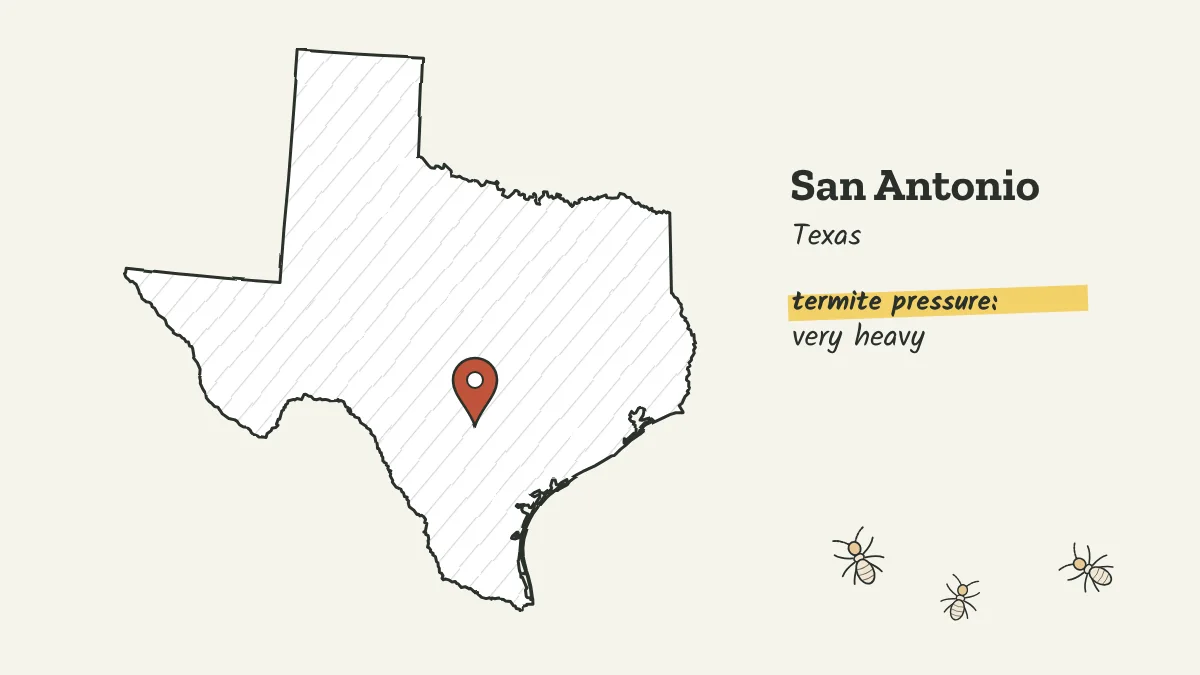
In San Antonio, the native subterranean termite is the main threat to homes, and it swarms early, from as soon as January or February. Formosan termites have been found in Bexar County too. The big swarms that pour out of lawns after heavy summer rain are usually desert termites, which Texas A&M AgriLife says don't damage plants or structures. Historic-district repairs need city approval.
San Antonio at a glance
- Termite pressure
- Very heavy
- Termites to know
- Eastern subterranean, Formosan subterranean
- Why termites like it here
- Hot and semi-humid South Central Texas, with native subterranean termites the main structural pest and harmless desert termites swarming after summer storms.
- Who licenses pest control
-
Texas Department of Agriculture, Structural Pest Control Service
Check a company's license - Inspection report for home sales
- Texas Official Wood Destroying Insect Report, on the form prescribed by TDA
On this page
Two kinds of swarm, one city
Here's how to tell the swarm that matters from the one that doesn't. When in doubt, catch a few and have them identified.
| Desert (agricultural) termites | Subterranean termites | |
|---|---|---|
| When | After heavy summer rain | Late winter and spring, often after rain; Formosans at dusk in late spring |
| Where they come from | Lawns and open ground | Walls, baseboards, slab cracks, window frames, or soil right at the foundation |
| Threat to the house | None, according to Texas A&M AgriLife | Real; indoor swarms mean a colony in or under the house |
| Other effects | Wings everywhere; Keck notes possible damage to underwatered turf | Hidden wood damage |
| What to do | Sweep up the wings; water the lawn | Save a sample, find where they came out, get inspections |
Sources: Molly Keck, Texas A&M AgriLife Extension in Bexar County (KSAT, 2026), and the Texas A&M AgriLife Extension publications listed below.
The termite that does eat houses
The Bexar County AgriLife office has long described the native subterranean termite as the most common termite in San Antonio homes. It lives in the soil and reaches houses through cracks in slabs, plumbing openings, wood touching the ground and mud tubes on the foundation.
San Antonio is far enough south that it swarms early. Texas A&M AgriLife says native swarms start in January and February in South Texas, compared with April or May in the Panhandle. A sunny late-winter afternoon after rain, with winged insects at a window, is the classic sign. If that happens inside, follow termites swarming in your house.
Formosans in Bexar County
The Formosan subterranean termite reached Bexar County too. Keck wrote in the San Antonio Express-News in 2005 that it had recently been found here, and explained why Texas A&M researchers worried: unlike native termites, a Formosan colony cut off from the soil can keep living and feeding.
Her advice from that column still applies: don't use old railroad ties or shoring timbers in the garden, because they can carry Formosans in. Formosan swarms come at dusk in late spring, around lights, which makes them easy to tell from the summer desert termite flights. More in Formosan termites.
Swarm months in San Antonio
The chart shows the two structural termites. Desert termites, which don't damage buildings, swarm separately after heavy summer rain.
| Termite | J | F | M | A | M | J | J | A | S | O | N | D |
|---|---|---|---|---|---|---|---|---|---|---|---|---|
| Eastern subterranean Daytime, often after a warm rain | some swarms | peak | peak | common | some swarms | |||||||
| Formosan subterranean Dusk, in big clouds around lights | some swarms | peak | peak | some swarms |
Getting a swarm identified
Keck's instructions for sending a sample are practical: send more than one insect, include as many wings as you can, and make sure they're dead. The Bexar County AgriLife office and Texas A&M's online tools both identify insects; the statewide options are on the Texas termite guide. A quick photo of the waist and wings also helps, because ants swarm after rain too. See flying ants vs termites.
Historic districts: repairs need a certificate too
San Antonio's Office of Historic Preservation oversees about 30 historic districts, from King William to Monte Vista. Its rule is broader than many cities': all exterior modifications and repairs to a property with a historic zoning overlay require a certificate of appropriateness, including work on parts of the house not visible from the street.
- Minor projects can usually be approved by OHP staff.
- Requests that don't qualify for staff approval go to a public hearing before the Historic and Design Review Commission, with applications typically due 19 days before the meeting.
- Interior-only work doesn't need OHP approval, though a building permit may still apply.
Termite treatment doesn't change a house's exterior. Replacing termite-damaged porches, siding, windows or trim does. Call OHP at 210-207-0035 before a contractor starts.
For San Antonio homeowners
Do
- Check whether a swarm came from the lawn or from the house
- Keep shrubs and trees at least 2 feet from the house, as Bexar County AgriLife advises
- Clear fallen limbs, old lumber and wood touching the soil
- Get a sample of indoor swarmers identified before you buy treatment
- Call OHP before exterior repairs in a historic district
Don't
- Panic over a lawn full of wings after a summer storm
- Use salvaged railroad ties or shoring timbers in landscaping
- Let decking or steps rest directly on the soil
- Sign a treatment contract for a desert termite swarm
Questions people ask
What are the termites swarming in my yard after rain in San Antonio?
Often desert termites, also called agricultural termites. Bexar County AgriLife entomologist Molly Keck has said they don't damage plants or structures, though large swarms leave lots of wings and can harm underwatered turf.
When do house termites swarm in San Antonio?
Native subterranean termites swarm early in South Texas, starting in January and February according to Texas A&M AgriLife, usually on warm days after rain. Formosan termites swarm at dusk around lights in late spring.
Are there Formosan termites in San Antonio?
Yes. Texas A&M AgriLife Extension in Bexar County reported Formosan termites in the county in 2005. They're often spread in old railroad ties and shoring timbers, so avoid using those in landscaping.
Do I need approval to repair termite damage on a historic house in San Antonio?
Yes, if the property has a historic zoning overlay. San Antonio requires a certificate of appropriateness for all exterior modifications and repairs. Minor work is usually approved by staff; call the Office of Historic Preservation at 210-207-0035.
More in Texas
Keep reading
Sources
- KSAT (June 2026): What are those swarms of flying insects following rainstorms?
- Texas A&M AgriLife Extension, Bexar County: The ways and means of termites, part 1 (2005)
- Texas A&M AgriLife Extension, Bexar County: Termite control and prevention, part 2 (2005)
- Texas A&M AgriLife Extension: Subterranean termites (E-368)
- Texas A&M AgriLife Extension: Desert termites (E-258)
- City of San Antonio Office of Historic Preservation: Before getting started