Termites in Dallas, TX: Natives, Suburban Formosans and Old Districts
In Dallas, termites mostly mean the native subterranean kind, swarming on spring days after rain. But the Formosan termite has been turning up in the suburbs, carried in on old railroad ties, and the old neighborhoods have their own rules about fixing what termites eat. Here's the North Texas version.
The short version
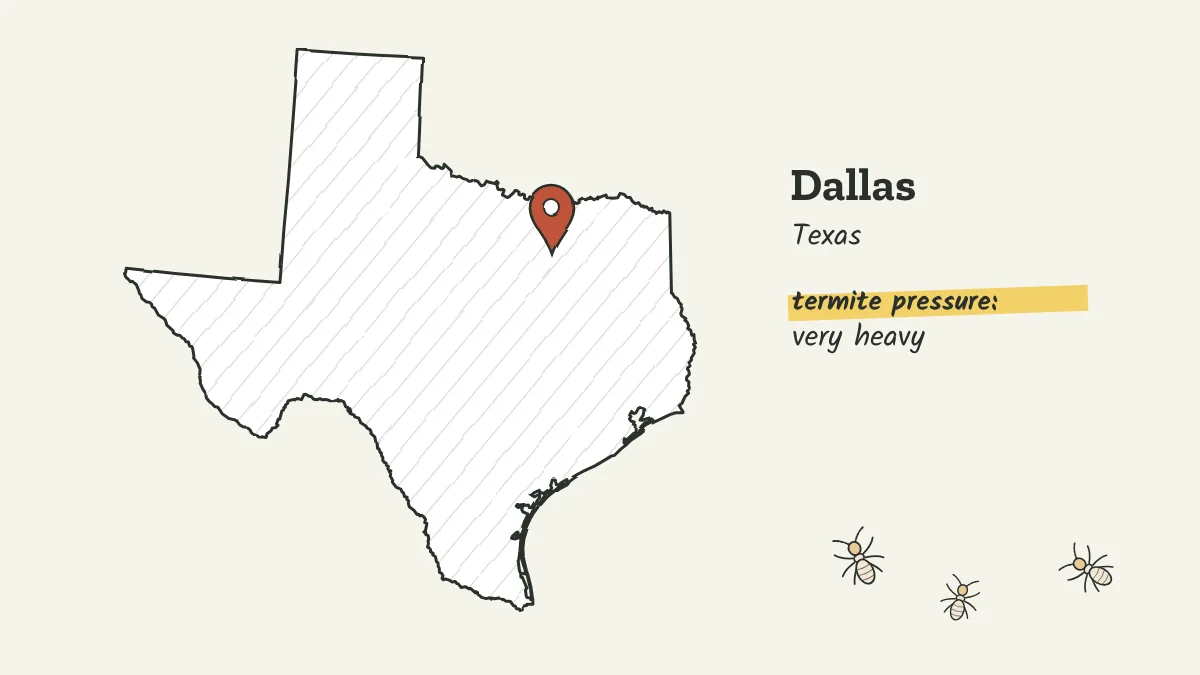
Dallas has very heavy termite pressure, almost all from native subterranean termites, which swarm on warm spring days, most often in March and April. Formosan termites have been found in DFW suburbs including Wylie, Grapevine, Flower Mound, Rockwall and Aledo, likely brought in on recycled railroad ties. In Dallas landmark districts, even routine exterior repairs need a certificate of appropriateness.
Dallas at a glance
- Termite pressure
- Very heavy
- Termites to know
- Eastern subterranean, Formosan subterranean
- Why termites like it here
- Hot summers, mild winters and spring storms, with native subterranean termites citywide and Formosan termites found in several DFW suburbs.
- Who licenses pest control
-
Texas Department of Agriculture, Structural Pest Control Service
Check a company's license - Inspection report for home sales
- Texas Official Wood Destroying Insect Report, on the form prescribed by TDA
On this page
Spring storms, spring swarms
North Texas termite season follows the weather. Texas A&M AgriLife's urban entomologist in Dallas, Mike Merchant, has said winged termites commonly appear in March and April, and AgriLife's Insects in the City blog describes warm, wet spring weather as the perfect trigger. Statewide, Texas A&M says swarms run later as you go north, from January in South Texas to April or May in the Panhandle, so Dallas sits in the middle.
What you'll see: small brown or black winged insects, about the size of an ant, with no pinched waist, crawling out of a wall, a baseboard or a window frame. If they're inside, a colony is in or under the house. The to-do list for the next hour is in termites swarming in your house.
Formosans in the suburbs
Houston has had Formosan termites since the 1950s. North Texas got them later, and in the suburbs rather than the city center. When a pest control company found Formosans in several homes in one Wylie neighborhood, in Collin County, Texas A&M AgriLife entomologists helped the community respond. According to that report, Formosans had already turned up since the 1990s in Aledo, Grapevine, Flower Mound and Rockwall.
Merchant's explanation for how they got here is the same one Texas A&M gives statewide: infested railroad ties used for backyard retaining walls and landscaping. He described the difference in damage bluntly. Native termites eat part of a beam; Formosans can hollow it out completely.
If you live in DFW and see a big evening swarm around a porch light in late spring, that's the one to get identified. Formosans swarm at dusk toward lights; native termites swarm by day. More in Formosan termites.
Swarm months in Dallas
| Termite | J | F | M | A | M | J | J | A | S | O | N | D |
|---|---|---|---|---|---|---|---|---|---|---|---|---|
| Eastern subterranean Daytime, often after a warm rain | some swarms | peak | peak | common | some swarms | |||||||
| Formosan subterranean Dusk, in big clouds around lights | some swarms | peak | peak | some swarms |
North Texas soil and slab houses
If your house sits on a concrete slab, termites reach it from the soil through cracks, joints and the openings around pipes. Texas A&M AgriLife says non-repellent termiticides appear to work better than older repellent products in Texas's heavy, alkaline clay soils. If you're comparing liquid treatment quotes, ask which product each company plans to use and whether it's repellent or not. How the treatment goes in around a slab is explained in liquid termite treatment.
Two habits that matter on a North Texas slab: keep soil and mulch a few inches below the top of the slab edge so the foundation stays visible, and send downspouts and AC condensate away from it. The full Texas prevention list is on the Texas termite guide.
Landmark districts: even routine work needs a certificate
Dallas protects its historic neighborhoods through Landmark Districts and individually listed Dallas Landmarks. According to the city's historic preservation office, a certificate of appropriateness is required before any exterior work on structures in a Landmark District.
- Routine maintenance still needs a certificate, but it's approved by staff. The city's examples include matching paint, window and door screens, skylights and solar panels.
- More substantial alterations, and all demolition, go to the Landmark Commission.
- The city advises calling the staff member assigned to your district before the deadline, because some work listed as routine may not qualify.
Termite treatment itself doesn't change how a house looks. Replacing a termite-damaged porch, siding, sills or trim does. Talk to the district's preservation staff before the contractor starts.
For Dallas homeowners
Do
- Look for dirt in odd places, like window frames and doorjambs, in March and April
- Have a big dusk swarm around a porch light identified
- Check railroad-tie walls and borders for hollowed or muddy wood
- Ask each company whether its liquid product is repellent or non-repellent
- Call landmark district staff before exterior repairs
Don't
- Bring salvaged railroad ties home for landscaping
- Bury the slab edge under new beds or mulch
- Assume homeowner's insurance will pay for termite damage
- Try to treat a slab house yourself
Questions people ask
When do termites swarm in Dallas?
Most often in March and April, on warm days, especially after spring rain, according to Texas A&M AgriLife's Dallas-based entomologists. Formosan termites, where present, swarm at dusk toward lights in late spring.
Are there Formosan termites in Dallas?
They've been found in several Dallas-Fort Worth suburbs, including Wylie, Grapevine, Flower Mound, Rockwall and Aledo. Texas A&M AgriLife believes they arrived in recycled railroad ties used for landscaping.
Does homeowner's insurance cover termite damage in Texas?
Typically not. Texas A&M AgriLife's Mike Merchant has noted that termite damage usually isn't covered by homeowner's insurance, which is one reason yearly inspections are worth it. Check your own policy.
Do I need approval to repair termite damage in a Dallas historic district?
If the house is in a Landmark District and the work is exterior, yes. Dallas requires a certificate of appropriateness before any exterior work; routine maintenance is approved by staff, and larger changes go to the Landmark Commission.
More in Texas
Keep reading
Sources
- PCT: Formosan termites found in North Texas community
- Texas A&M AgriLife Today: Expert warns of insect pests that can reduce your home's value (2016)
- Texas A&M AgriLife Insects in the City: Termite season begins now
- Texas A&M AgriLife Extension: Subterranean termite control FAQ
- Texas A&M AgriLife Extension: Subterranean termites (E-368)
- Texas A&M AgriLife Extension: Formosan subterranean termites (E-367)
- City of Dallas: Landmark review process