Termites in Houston, TX: Formosans, Drywoods and What to Do
Houston is where Formosan termites first turned up in Texas, and the city still has all three of the state's big termite problems. Here's when each one shows up, what Houston houses get wrong, and what to demand from a termite company.
The short version
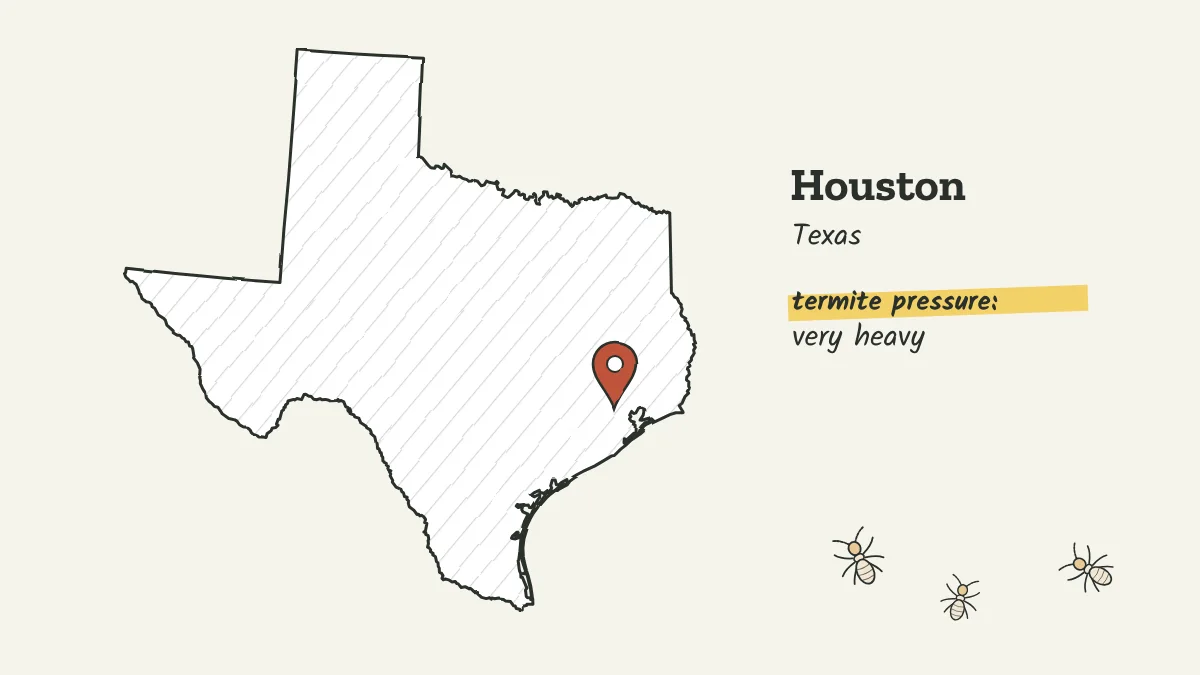
Houston has very heavy termite pressure from three groups: native subterranean termites that swarm by day early in the year, Formosan termites that swarm at night in May and June, and drywood termites that swarm in late summer. Formosans do the fastest damage and also attack trees. Texas companies must give you a written diagram and the product label before treating.
Houston at a glance
- Termite pressure
- Very heavy
- Termites to know
- Eastern subterranean, Formosan subterranean, Southeastern drywood
- Why termites like it here
- Hot, humid and wet most of the year, with Formosan termites established since the 1950s and drywood termites common along the Gulf Coast.
- Who licenses pest control
-
Texas Department of Agriculture, Structural Pest Control Service
Check a company's license - Inspection report for home sales
- Texas Official Wood Destroying Insect Report, on the form prescribed by TDA
On this page
Houston is Formosan ground zero
Formosan subterranean termites were discovered in Texas in 1956, around the Houston Ship Channel in Pasadena, probably carried in on wooden shoring timbers from the Far East. Texas A&M AgriLife Extension says they've since spread to more than 30 Texas counties and every major metro, but Harris County is where the Texas story starts.
Why Houstonians should care more than most:
- Size. Texas A&M says Formosan colonies are at least four times larger than native ones, and a new colony can pass a million individuals within five years.
- Speed. They eat wood faster than native termites.
- Carton nests. They can build nests of chewed wood, soil and saliva inside walls wherever there's moisture, and those nests can survive cut off from the ground.
- Trees. They attack more than 50 kinds of trees, including pecan, citrus, sweet gum, cedar, willow, Chinese elm and white oak. Texas A&M warns that weakened trees may blow over in strong winds, which is not what anyone wants near a Houston roof in hurricane season.
- Odd appetites. They chew through asphalt, plaster, rubber and plastic, and Texas A&M links that to electrical shorts and house fires.
More on the species in Formosan termites and on tree infestations in termites in trees.
When termites swarm in Houston
Houston gets three swarm seasons. Texas A&M says native swarms begin in January and February in South Texas, and Houston sits near that early end. Formosans swarm at night from early May through June, drawn to lights. Drywood termites swarm in late August and early September.
| Termite | J | F | M | A | M | J | J | A | S | O | N | D |
|---|---|---|---|---|---|---|---|---|---|---|---|---|
| Eastern subterranean Daytime, often after a warm rain | some swarms | peak | peak | common | some swarms | |||||||
| Formosan subterranean Dusk, in big clouds around lights | some swarms | peak | peak | some swarms | ||||||||
| Southeastern drywood Night, toward lights | common | peak |
Who's swarming at your porch light?
Time of day and time of year do most of the identification for you.
| What you see | Likely termite | What it means |
|---|---|---|
| Daytime swarm, late winter or spring, often after rain | Native subterranean | A colony in the soil nearby, maybe under the house |
| Huge swarm at dusk or night, May or June, around lights | Formosan subterranean | A large, fast colony close by. Get an inspection soon |
| Swarm at night in late August or September, plus tiny pellets | Drywood | A colony living inside the wood, often in attics, trim or furniture |
| Swarmers with pinched waists and bent antennae | Ants, not termites | Check with our termite or flying ant quiz |
Texas A&M describes Formosan swarmers as yellowish-brown, 12 to 15 millimeters long, with hairy, see-through wings. Their soldiers have teardrop-shaped heads and can ooze a white defensive liquid.
Slab houses and pier-and-beam houses
Houston has both, and termites use each one differently.
Pier-and-beam. The city's planning department describes most homes in the Houston Heights historic districts as built on pier-and-beam foundations, with the first floor raised a couple of feet. That crawlspace is where to look: mud tubes on piers, damp sill beams, wood skirting touching soil. Keep the crawlspace vented and dry, and keep stored lumber out of it.
Slab-on-grade. On a slab, termites come up through expansion joints, cracks and the gaps around plumbing that runs through the slab, then into the walls where you can't see them. Pay attention to bath traps, the garage wall, and anywhere a patio or addition was poured against the house.
Texas rules require a termite company's written estimate to define partial, spot, baiting and barrier treatments and how each applies to pier-and-beam and slab construction, so ask to see those definitions for your house type.
Houston's humidity is half the problem
Termites need moisture, and Houston supplies it. The fixes Texas A&M recommends are the ones that matter most here:
- AC condensate lines. Make sure they drain well away from the foundation. In a Houston summer they run constantly.
- Gutters and grading. Water should leave the house, not pool against the slab.
- Soil and mulch. Leave a visible band of foundation, 6 to 8 inches, between the soil line and the brick or siding.
- Leaks. Fix plumbing and roof leaks quickly. Formosan carton nests form inside walls where moisture is steady.
- After a flood. Get wet framing, insulation and flooring dried or removed, and have the house inspected once things settle. Damp wood is easy food.
Formosan treatment in Houston
Treating Formosans takes more than a quick perimeter spray. Texas A&M AgriLife notes a few things every Houston homeowner should know before signing:
- Liquid barriers count as partial. In Texas, a liquid barrier on an existing house is considered a partial treatment for Formosans. Only a pre-construction treatment counts as full.
- Baits are a real option. Bait stations placed in the ground can take months to work, while above-ground baits placed on active mud tubes can work faster.
- Carton nests may need to come out. If there's a nest in a wall, removing it is part of the job.
- Trees need their own plan. Bark sprays usually fail. Infested trees are treated by injecting insecticide, often foam, into the hollow heartwood.
Ask every company how its plan handles each of these. Our guides to Formosan termite treatment, termite bait stations and Sentricon vs. Termidor help you compare.
Drywood termites in Houston attics
Drywood termites don't need soil at all. Texas A&M says they're found statewide, with the highest concentrations along the Gulf Coast, and the southeastern drywood termite is the most common. The giveaway is small piles of six-sided pellets, each about 1/32 inch long and often the color of the wood, below tiny holes in trim, rafters, window frames or furniture.
Whole-structure fumigation is the most thorough treatment for widespread drywood infestations, and limited infestations can be treated locally or by replacing the wood. See termite droppings but no termites and drywood termite treatment.
Hiring a termite company in Houston
Every termite company in Houston needs a license from the Texas Department of Agriculture's Structural Pest Control Service. The City of Houston and Harris County don't replace that. Before treating, a Texas company must give you written disclosure documents: a diagram of the house showing activity and treated areas, the product label, the concentration or number of bait stations, warranty details and the state's consumer information sheet. A verbal quote can only give a general price range.
Get two or three of those proposals and lay them side by side. Our guide to choosing a termite company shows how, and the Texas termite guide explains the rules in full, including how to file a complaint.
Questions people ask
When do termites swarm in Houston?
Native subterranean termites swarm in daylight early in the year, often from late winter into spring. Formosan termites swarm at night from early May through June, drawn to lights. Drywood termites swarm at night in late August and early September.
Are Formosan termites in Houston?
Yes. They were first found in Texas in 1956 near the Houston Ship Channel in Pasadena, and Texas A&M AgriLife says they're now in every major Texas metro. Their colonies are much larger and faster than native termite colonies.
Can Formosan termites kill trees in Houston?
They attack more than 50 kinds of trees, including pecan, citrus, sweet gum, cedar, willow and white oak, and hollow them out from inside. Texas A&M warns weakened trees may blow over in strong winds. Treatment means injecting insecticide into the hollow heartwood; bark sprays usually fail.
Who licenses termite companies in Houston?
The Texas Department of Agriculture's Structural Pest Control Service. TDA publishes lists of current licensed businesses and applicators, and you can call 800-835-5832 to confirm a license.
What termite paperwork should I get in Houston?
Before treatment, Texas requires written disclosure documents with a diagram, the product label, the concentration or number of bait stations, the warranty and the state's consumer information sheet. For a home sale, the inspection goes on the Texas Official Wood Destroying Insect Report.
More in Texas
Keep reading
Sources
- Texas A&M AgriLife Extension: Formosan subterranean termites (E-367)
- Texas A&M Urban and Structural Entomology: Formosan termites
- Texas A&M AgriLife Extension: Subterranean termites (E-368)
- Texas A&M AgriLife Extension: Drywood termites (E-366)
- City of Houston Planning and Development: Houston Heights historic districts, defining features
- Texas Administrative Code, 4 TAC 7.174: Wood destroying insect treatment disclosure documents
- Texas Administrative Code, 4 TAC 7.176: Real estate transaction inspection reports
- Texas Department of Agriculture: Current structural pest control licenses
- Texas A&M AgriLife: Insect identification help