Termites in Utah: More in the South, Swarms by Zone
Utah termites are found statewide, but they're busiest in the warm southwest, and their swarm dates shift by months between St. George and the Wasatch Front. Here's what Utah's agriculture department and Utah State University say about which termites live where, when they fly and how treatment is regulated.
The short version
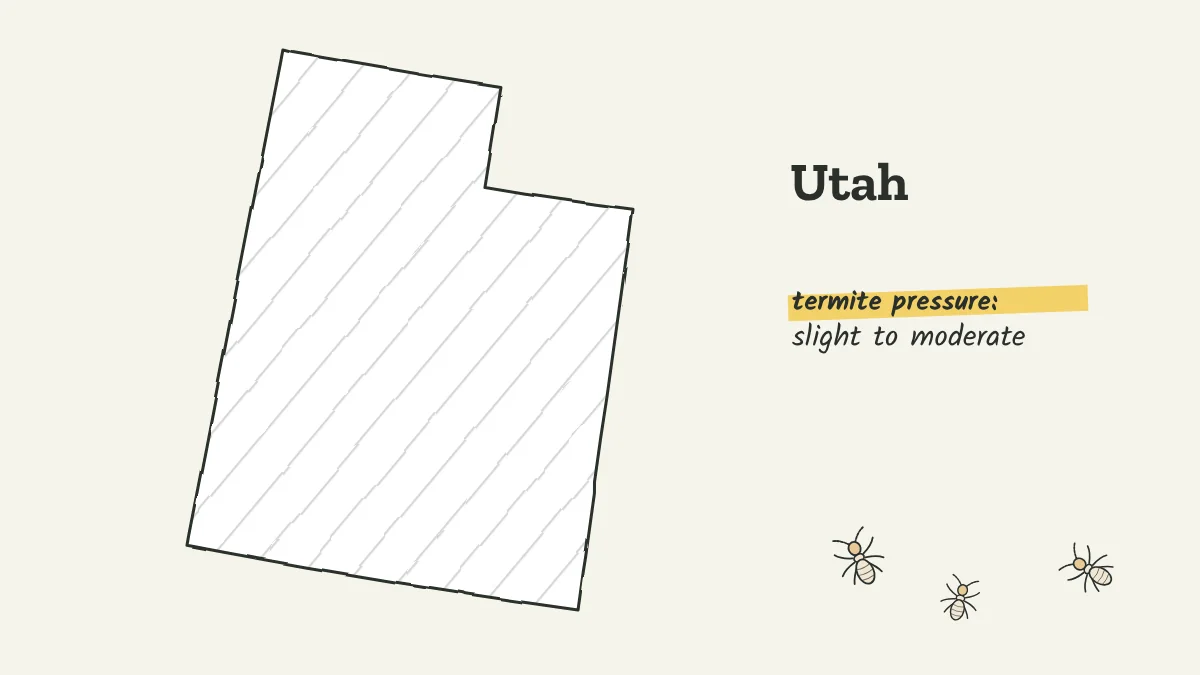
Termites live throughout Utah, with slight to heavy activity, and southwestern Utah has historically had more than the Wasatch Front. Two subterranean species and one drywood species can damage buildings. Subterranean swarms follow spring rain once soil passes 70°F, anywhere from early February to mid-May depending on the area. Utah strictly enforces one rule: termiticides can't be applied below the label's minimum rate.
Utah at a glance
- Termite pressure
- Slight to moderate
- Termites to know
- Eastern subterranean, Arid-land subterranean, Western drywood
- Why termites like it here
- Arid to semi-arid, with termite activity highest in southwestern Utah and swarm timing set by elevation and soil temperature.
- Who licenses pest control
-
Utah Department of Agriculture and Food, Division of Plant Industry (pesticide program)
Check a company's license - Inspection report for home sales
- NPMA-33 Wood Destroying Insect Inspection Report
On this page
Utah's termites
The Utah Department of Agriculture and Food's study guide for termite applicators says termites are found throughout Utah, with southwestern Utah historically more active than the Wasatch Front. Utah State University Extension's fact sheet agrees: statewide, but most common in the southern counties. Three species can cause serious structural damage:
- The eastern subterranean termite, the most common in Utah.
- The Rocky Mountain subterranean termite, also called the arid-land subterranean termite, less common and found mainly in desert areas, where it feeds on creosote bush and greasewood.
- The dark western drywood termite, which lives inside wood rather than soil and needs different treatment. See drywood termites.
Dampwood and other termites are rare in Utah.
When termites swarm in Utah
Utah's agriculture department says subterranean swarms follow spring rain once soil passes 70°F, earlier in the southwest and later up north and at elevation. Drywood termites fly at dusk in summer.
| Termite | J | F | M | A | M | J | J | A | S | O | N | D |
|---|---|---|---|---|---|---|---|---|---|---|---|---|
| Eastern subterranean Daytime, often after a warm rain | some swarms | peak | peak | common | some swarms | |||||||
| Arid-land subterranean Depends on elevation | common | common | common | common | common | |||||||
| Western drywood Warm, sunny afternoons | some swarms | peak | peak | some swarms |
Utah swarm timing, by species
From the Utah Department of Agriculture and Food's wood-destroying organism study guide.
| Termite | When |
|---|---|
| Subterranean termites | After spring rain with soil above 70°F; zones range from Feb. 1 to 15 up to May 5 to 19 |
| Rocky Mountain subterranean, below 4,000 ft | March |
| Rocky Mountain subterranean, above 4,000 ft | May be delayed to June or July |
| Dark western drywood | At dusk, May through August |
Swarmers in spring are usually subterranean; summer dusk flights point to drywood. See termite swarm season.
Signs to look for
USU's fact sheet, by Erin Hodgson and Alan Roe, lists winged swarmers, mud tubes across non-wood surfaces, droppings in or near wood, and cracked wood or blistered paint. An infestation can go unnoticed for 1 to 8 years, which is why the authors recommend regular inspections. A mature colony can top a million members and forage up to 125 feet from the nest, according to the state study guide.
Prevention numbers from the same sources: keep siding and stucco at least 6 inches from the soil, keep lumber at least 12 inches above soil, and keep mulch at least 4 inches below siding. More in signs of termites.
How deep Utah termites go
Utah's soils and cold winters push subterranean colonies deep. USU says some nests sit 18 to 20 feet below the surface, and the state study guide says subterranean termites can tunnel more than 30 feet down. That's one reason surface sprays and spot fixes rarely work: the colony is well out of reach, and treatment has to intercept termites where they come up to the house. Treatment trenches along the foundation are typically about 6 inches wide, and termiticide goes on at low pressure so it soaks into the soil rather than splashing. See liquid termite treatment.
Treatment and Utah's label rule
USU says inspections and treatments should be done by licensed professionals. Liquid termiticides create a treated zone around the house, and baits are usually slower and often cost more. Drywood termites need their own approach, such as heat: the state guide notes temperatures around 130°F held for several hours kill termites in wood. See termite treatment options and heat treatment for termites.
One Utah rule stands out. Most pesticides can legally be used below their label rate, but the state study guide says termiticides can't: commercial applicators may not apply a termiticide below the label's minimum rate, and the department strictly enforces it. Utah certifies termite applicators in a separate wood-destroying organism category, Category 15. Ask your company for its applicator's Utah license and category.
For Utah homeowners
Do
- Note when you see swarmers; the month hints at the species
- Keep stucco and siding 6 inches above soil
- Ask the applicator for the product label and rate
- Get regular inspections, especially in southern Utah
Don't
- Assume a cold winter means no termites
- Accept a "light" or diluted termiticide treatment
- Treat a drywood problem like a soil termite
- Pile soil or mulch against the stucco
Questions people ask
Where are termites most common in Utah?
Throughout the state, but southwestern Utah has historically had more activity than the Wasatch Front, and USU says they're most common in the southern counties.
When do termites swarm in Utah?
Subterranean termites swarm after spring rain once soil passes 70°F, from early February to mid-May depending on the area. Drywood termites swarm at dusk from May through August.
Does Utah have drywood termites?
Yes. The dark western drywood termite is the one drywood species Utah's agriculture department considers economically important.
Can a company use less termiticide than the label says in Utah?
No. Utah's agriculture department says termiticides may not be applied below the label's minimum rate, and it strictly enforces that.