Termites in Pennsylvania: Basements, Swarms and the Seller's Disclosure
Pennsylvania's termites don't get the headlines that Gulf Coast termites do, but they're in every corner of the state, and they have a favorite spot: the basement, near the furnace and the water heater. Here's what Penn State's entomologists say about finding them, keeping them out and hiring someone when you can't.
The short version
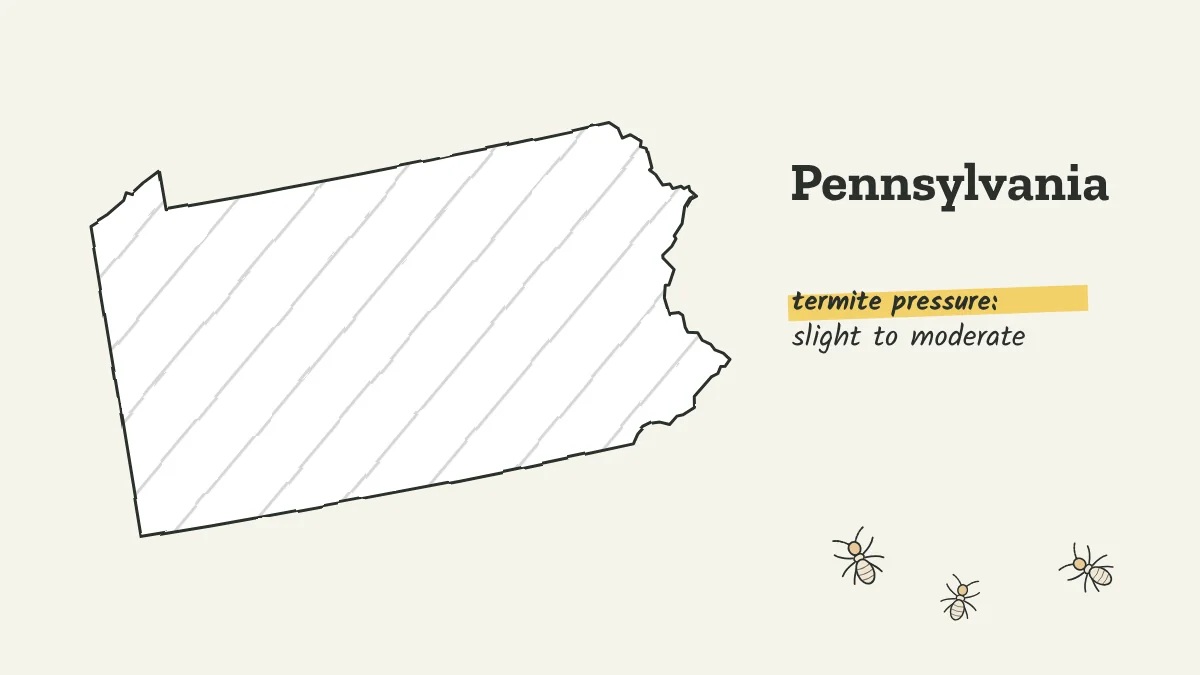
Pennsylvania's termite is the native eastern subterranean termite, found statewide, and it usually swarms between February and June. Infestations are most often found in basements and the framing above cellar walls, especially near furnaces, chimneys and water heaters. Sellers must disclose known termite problems, and pesticide businesses are licensed by the state Department of Agriculture.
Pennsylvania at a glance
- Termite pressure
- Slight to moderate
- Termites to know
- Eastern subterranean
- Why termites like it here
- Cold winters and warm, humid summers, with native subterranean termites statewide and many older houses on basements and cellars.
- Who licenses pest control
-
Pennsylvania Department of Agriculture, Pesticide Programs
Check a company's license - Inspection report for home sales
- NPMA-33 Wood Destroying Insect Inspection Report
On this page
One termite, every county
Penn State Extension entomologist Steve Jacobs describes the eastern subterranean termite as native to Pennsylvania and found throughout the state. Outdoors, colonies live underground and feed mainly on old roots, stumps and fallen limbs. A house is just more wood.
Swarmers are dark brown or black, up to half an inch long, with two pairs of wings that break off after the flight. Penn State says they usually emerge between February and June, mostly in spring, and that a swarm or a pile of shed wings is sometimes the only visible sign of termites. If you're not sure what you caught, compare it with our flying ants vs termites guide.
When termites swarm in Pennsylvania
Penn State puts Pennsylvania's swarms between February and June, with spring the main season. University of Tennessee Extension notes swarms can also come at odd times from colonies inside heated buildings.
| Termite | J | F | M | A | M | J | J | A | S | O | N | D |
|---|---|---|---|---|---|---|---|---|---|---|---|---|
| Eastern subterranean Daytime, often after a warm rain | some swarms | peak | peak | common | some swarms |
Why the basement
In Pennsylvania, termite stories often start in the basement. Penn State says infestations are found mainly in basements and in the structural timbers just above cellar walls, plus wooden posts, steps and door frames set into earth or concrete. Termites favor the warm, damp spots near furnaces, chimneys, water heaters and pipes.
The signs Penn State lists match: earth-colored mud tubes on cellar walls, wooden posts, exterior masonry and trim around doors and windows, and wood with soil-coated channels that looks hollowed or rotten. Probe suspicious wood; Penn State says workers may spill out of active galleries. More in signs of termites.
Penn State's prevention list
From Penn State Extension's guidance on eastern subterranean termites.
| Step | Why it helps |
|---|---|
| Keep wood at least 18 inches from soil where possible | Termites need soil contact or a tube to reach it |
| Replace wooden posts, steps and trellises in the soil | Use non-wood materials or pressure-treated lumber |
| Remove wood debris around the house | Debris feeds colonies next to the foundation |
| Ventilate and drain basements, cellars and crawlspaces | Damp spaces keep termites active and close |
| Seal foundation cracks and voids | Fewer hidden routes into the framing |
| Keep gutters and downspouts working | Divert water away from the foundation |
The full prevention checklist is in how to prevent termites.
Slow damage, and what to do about it
Penn State is reassuring on timing. Termite damage isn't a sudden onslaught that brings a building down in a few days; structural damage usually reflects years of feeding, and problems generally show up 10 years or more after a house is built.
Its hiring advice is practical: get estimates from at least three licensed pest control operators, inspect thoroughly before treatment and before renewing a warranty, and keep warranties for at least the first one to two years. Penn State notes warranty renewals often run about 10 percent of the original treatment price a year, and that treatment failure rates of 20 to 30 percent have been reported in some areas, which is a good argument for a warranty. See termite bond.
Licenses and the seller's disclosure
Every business that applies pesticides for others in Pennsylvania needs a pesticide application business license from the state Department of Agriculture, with at least one certified applicator and proof of insurance naming the department. The department publishes a searchable report of licensed businesses by category, county and region, and its online applicator search lets you check an individual's certification. More in how to check a pest control license.
When you sell, Pennsylvania's Real Estate Seller Disclosure Law requires the disclosure form to cover "termites/wood destroying insects, dry rot and pests." The seller isn't required to investigate, but can't fail to disclose a known material defect. Some transfers are exempt, including those by an estate's fiduciary. Buyers usually rely on a wood-destroying insect report as well; VA loans require one in certain Pennsylvania counties. See termite disclosure laws.
For Pennsylvania homeowners
Do
- Check the basement near the furnace, water heater and chimney
- Keep wood 18 inches from soil where you can
- Get estimates from three licensed companies
- Keep the warranty for at least the first year or two
Don't
- Ignore shed wings on a basement windowsill
- Set wooden posts or steps directly in soil or concrete
- Leave wood debris along the foundation
- Leave known termite damage off the seller's disclosure
Questions people ask
When do termites swarm in Pennsylvania?
Penn State says swarmers usually emerge between February and June, mostly in spring.
Where do termites usually show up in Pennsylvania houses?
In basements and the framing just above cellar walls, especially near furnaces, chimneys, water heaters and pipes, and in wooden posts, steps and door frames set into soil or concrete.
Are there Formosan termites in Pennsylvania?
No. Penn State's Steve Jacobs has said that even if Formosans arrived, they couldn't survive Pennsylvania winters to establish colonies.
Do Pennsylvania sellers have to disclose termites?
Yes, known problems. The Real Estate Seller Disclosure Law requires the disclosure form to cover termites and other wood-destroying insects, dry rot and pests, though the seller doesn't have to investigate.
Keep reading
Sources
- Penn State Extension: Eastern subterranean termites
- Penn State News: Tropical termites not a threat in Northeast, but native ones are (2006)
- Pennsylvania Real Estate Seller Disclosure Law, 68 Pa.C.S. Chapter 73
- Pennsylvania Department of Agriculture: Pesticide application businesses
- Pennsylvania Department of Agriculture: Pesticide applicator search
- Veterans United: VA termite and pest inspections (updated 2026)
- UT Extension PB1344: Subterranean termite control