Termites in Arizona: Monsoon Swarms, Desert Species and State Rules
In most of the country, termites swarm in spring. In the Arizona desert, the big flights come at dusk after a summer monsoon storm. Arizona's termites are different species with different habits, and the state tracks termite work closely. Here's what that means for a house on a slab in the Sonoran Desert.
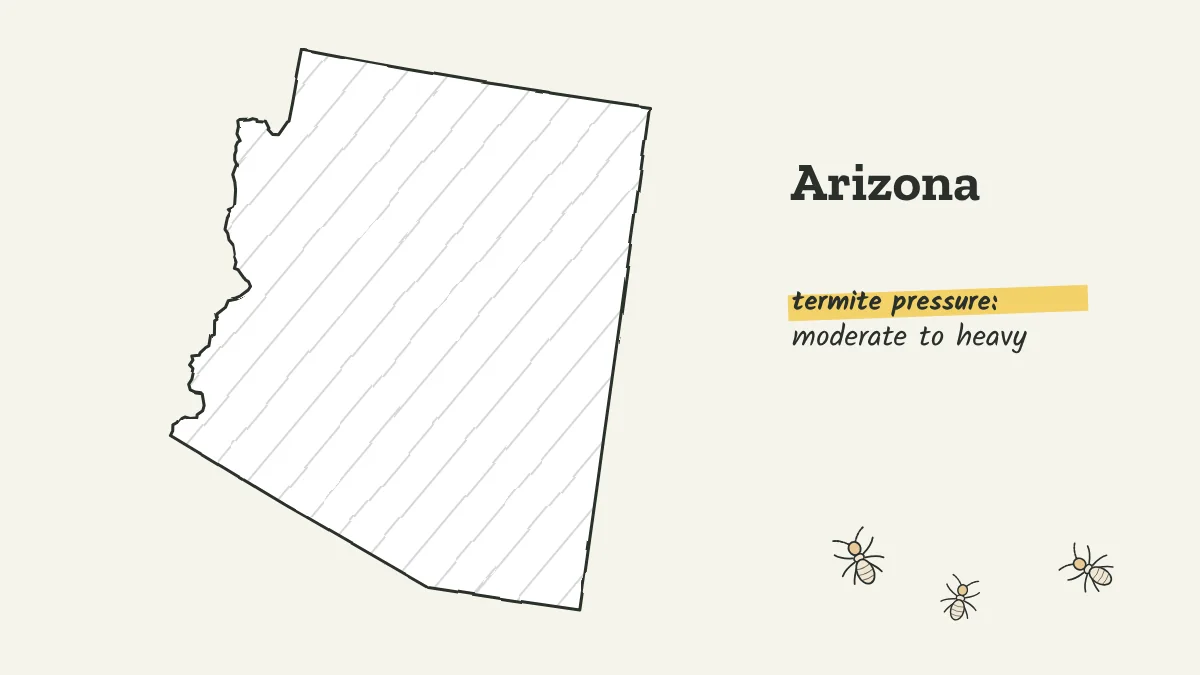
The short version
Arizona's most destructive termite is the desert subterranean termite, which swarms at dusk after monsoon rain from July to September. The arid-land subterranean termite swarms by day, in late winter at low elevations and in early summer higher up. Drywood termites fly in summer. Arizona's agriculture department regulates termite work, and lenders, not state law, require the WDIIR for most sales.
Arizona at a glance
- Termite pressure
- Moderate to heavy
- Termites to know
- Desert subterranean, Arid-land subterranean, Western drywood
- Why termites like it here
- Hot desert at low elevations and cooler uplands, with summer monsoon rains that trigger subterranean termite swarms.
- Who licenses pest control
-
Arizona Department of Agriculture, Pest Management Division
Check a company's license - Inspection report for home sales
- Wood-Destroying Insect Inspection Report (WDIIR)
On this page
Desert termites, desert timing
University of Arizona Cooperative Extension calls termites Arizona's number one urban pest problem. The state has about 17 or 18 termite species, and only a handful damage buildings. The rest live on dead desert plants and stay out of the way.
The two subterranean pests:
- The desert subterranean termite is the most common and most destructive. It swarms at dusk after monsoon rains, July through September. Its free-standing mud tubes can rise more than 24 inches off the ground.
- The arid-land subterranean termite swarms in daylight on sunny days, and its season depends on elevation: January to March below 4,000 feet, and June and July above it. It's known to attack structures built where creosote and other desert shrubs were cleared.
A third, the tube-building desert termite, is everywhere in the desert but generally isn't a pest unless it gets inside a building. University of Arizona researchers have warned that some homeowners and companies treat these harmless species just because they're near a house.
Arizona's termites that matter
From University of Arizona Extension publications AZ1356 and AZ1369.
| Termite | Type | When it swarms |
|---|---|---|
| Desert subterranean | Subterranean | Dusk after monsoon rain, July to September |
| Arid-land subterranean | Subterranean | Sunny days; January to March below 4,000 ft, June and July above |
| Western drywood | Drywood | Bright sunny days, June to August, not tied to rain |
| Light western drywood | Drywood | Dusk, June to September, up to 20 flights; lower and middle elevations between Phoenix and Tucson |
| Desert dampwood | Dampwood | Dusk, late May to September, often after a summer storm |
Drywood termites leave piles of hard pellets and are often found around door and window frames. See drywood termites.
When termites swarm in Arizona
The chart shows the three main pests. Below 4,000 feet, expect arid-land swarms in late winter and the desert subterranean termite after monsoon storms.
| Termite | J | F | M | A | M | J | J | A | S | O | N | D |
|---|---|---|---|---|---|---|---|---|---|---|---|---|
| Desert subterranean Evenings after monsoon rain | peak | peak | some swarms | |||||||||
| Arid-land subterranean Depends on elevation | common | common | common | common | common | |||||||
| Western drywood Warm, sunny afternoons | some swarms | peak | peak | some swarms |
Slabs, stucco and the stem wall
Most Arizona houses sit on a slab, and University of Arizona Extension says floating and monolithic slabs are the most common types. Termites reach them through cracks, joints, plumbing penetrations and by tubing up the stem wall. The state agriculture department says a crack as narrow as 1/64 inch can give termites hidden access.
The Extension's practical advice centers on that stem wall:
- Look twice a year, in spring and near the end of monsoon season, for mud tubes along the stem wall.
- Keep the stem wall dry. Reduce soil moisture within a foot of it, and keep plants and irrigation at least 18 inches away.
- Keep stucco off the dirt. The Extension advises stucco about 4 inches above the soil and never below grade, so tubes can't hide behind it.
- Clear cellulose. Remove stumps, roots and wood debris within 25 feet of a new house.
How slabs are breached and protected is in can termites go through concrete.
Who regulates termite work
Termite work in Arizona is regulated by the Pest Management Division of the Arizona Department of Agriculture. It licenses applicators and businesses, and consumers can check a license on the department's online search. Complaints are filed with the division, which forwards a copy to the company; the company has 20 days to respond, an inspector investigates, and violations can lead to a settlement or a hearing. The division's inspector on duty is at (602) 542-4373.
Arizona also keeps track of termite work house by house. Companies must file a Termite Action Registration Form with the department within 30 days of an inspection report, a pretreatment, a new-construction treatment, a final-grade treatment or an initial corrective treatment. The department says it maintains a database of inspection reports and post-construction treatments on Arizona homes.
What Arizona's rules give you
From the Arizona Department of Agriculture's guidance for the termite industry and Arizona Administrative Code R3-8-307.
| Rule | What it means for you |
|---|---|
| Termite Treatment Proposal | Before any work, you get a written proposal with the evidence found, a diagram, the method, the pesticide, the price and the inspector's license number |
| Treatment filed with the state | The company files a registration form within 30 days of most termite treatments and inspection reports |
| Final grade | After a pretreatment, the final-grade soil treatment must follow within 12 months |
| Pretreatment rate | Critical areas get 4 gallons per 10 linear feet, which can be stricter than some labels |
| Uninspected areas | The inspection report must list every area and structure not inspected, and why |
| Supplemental inspection | Within 30 days of the original, to confirm corrective treatment or a fixed condition |
Ask for the Termite Treatment Proposal in writing before anyone drills or trenches. It's the document that shows what you agreed to buy.
The WDIIR for home sales
Arizona's sale report is the Wood-Destroying Insect Inspection Report, or WDIIR. The department notes that no state law requires a WDIIR for a home sale; lenders do, and so do many purchase contracts.
Under rule R3-8-307, a WDIIR is done by an applicator certified in wood-destroying organism management who works for a licensed business. The inspector must look at all visible and accessible areas, including crawlspaces, and must specifically check any area with evidence of termites or with a conducive condition: faulty grade, crawlspace areas with less than 24 inches of clearance, excessive cellulose debris, earth-to-wood contact or excessive moisture. Areas behind permanent coverings, built-ins or stored furniture can be excluded, but each one has to be listed with the reason. The national picture is in WDI inspection.
For Arizona homeowners
Do
- Check the stem wall in spring and after monsoon season
- Get a written Termite Treatment Proposal before treatment
- Keep irrigation and plants 18 inches from the foundation
- Keep every treatment proposal and inspection report
Don't
- Let stucco or soil cover the bottom of the stem wall
- Treat harmless desert termites just because they're near the house
- Assume a spring-only termite season; monsoon swarms are the big ones
- Skip the final-grade treatment on a new house
Questions people ask
When do termites swarm in Arizona?
The desert subterranean termite swarms at dusk after monsoon rains, July through September. The arid-land subterranean termite swarms on sunny days, January to March below 4,000 feet and June and July above it. Drywood termites fly in summer.
What is a WDIIR in Arizona?
It's the Wood-Destroying Insect Inspection Report used in Arizona home sales. State law doesn't require one for a sale, but lenders usually do. It must list uninspected areas and conducive conditions like earth-to-wood contact and excess moisture.
Does Arizona keep records of termite treatments?
Yes. Companies file a Termite Action Registration Form with the Department of Agriculture within 30 days of most treatments and inspection reports, and the department keeps a database of them.
How do I check a pest control license in Arizona?
Use the Arizona Department of Agriculture's online license search, or call the Pest Management Division's inspector on duty at (602) 542-4373.
Keep reading
Sources
- University of Arizona Cooperative Extension AZ1356: Termite management for homeowners (2005)
- University of Arizona Cooperative Extension AZ1369: Arizona termites of economic importance (2005)
- University of Arizona Cooperative Extension AZ1357: Liquid termiticides costs (2005)
- University of Arizona: Statewide termite survey (Baker)
- Arizona Department of Agriculture: Termite industry guidance
- Arizona Department of Agriculture: Wood-destroying insect inspection reports
- Arizona Administrative Code R3-8-307: Performing a wood-destroying insect inspection; WDIIRs
- Arizona Department of Agriculture: What is the Pest Management Division?