Termites in Iowa: Spotty, Southern and Slow
Iowa termites are a patchwork. One neighborhood has them and the next doesn't, and the southern half of the state has far more than the north. Iowa State University has been tracking them since the 1930s. Here's what that record shows and what to do if they turn up at your house.
The short version
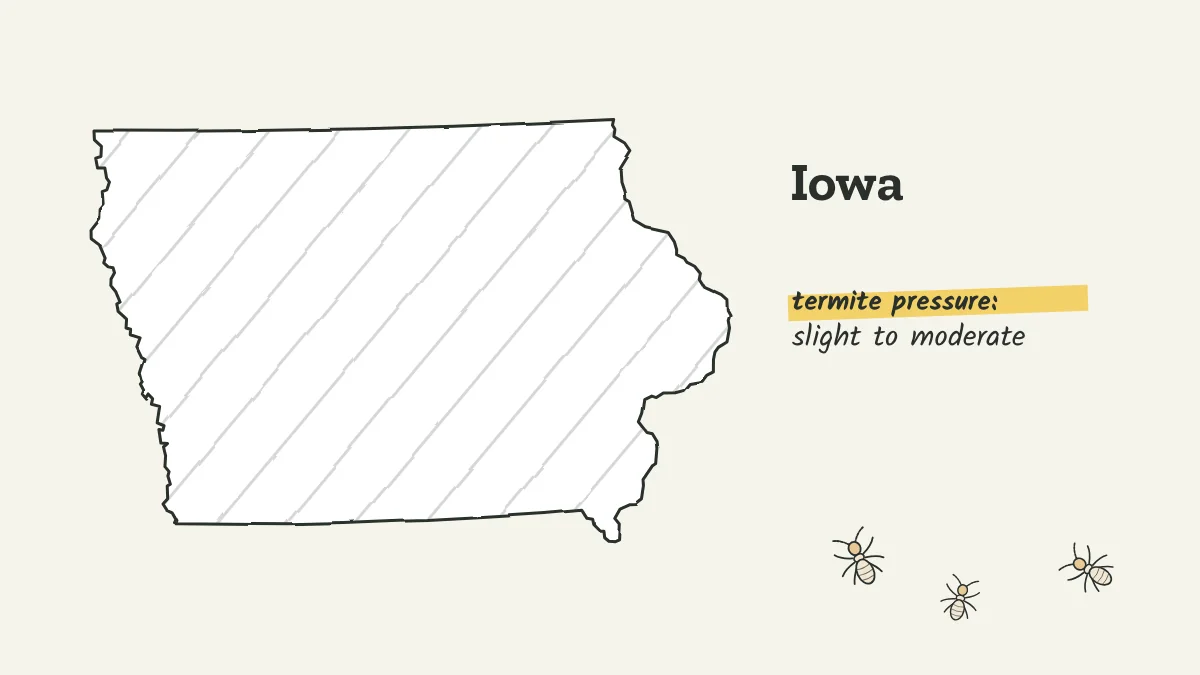
Termites have been reported in nearly every Iowa county, but Iowa State University says they're most common in the southern half and are spotty and highly localized. The species is the eastern subterranean termite, and swarms come in spring. Iowa requires both termite treatment and real estate termite inspections to be done under Category 7B, Termite Control.
Iowa at a glance
- Termite pressure
- Slight to moderate
- Termites to know
- Eastern subterranean
- Why termites like it here
- Cold winters and warm, humid summers, with termites more common in the southern half and largely inactive in winter.
- Who licenses pest control
-
Iowa Department of Agriculture and Land Stewardship, Pesticide Bureau
Check a company's license - Inspection report for home sales
- NPMA-33 Wood Destroying Insect Inspection Report
On this page
Where Iowa's termites are
Iowa State University Extension's Donald Lewis summarized the state's termite records in 2010. They start with Harold "Tiny" Gunderson, ISU's extension entomologist from 1936 until 1971, include a 1988 statewide survey, and have been updated since with reports from county offices, pest control professionals and homeowners.
The record shows eastern subterranean termites reported at some point in all but five of Iowa's 99 counties. They're most common in the southern half. The U.S. Forest Service rated the northern half low, but some northern counties with large cities and major rivers have moderate to high activity. And four south-central counties, Clarke, Lucas, Monroe and Wayne, report little or none.
Lewis's key word is spotty. A county with termite records doesn't mean every house there has them.
When termites swarm in Iowa
Iowa State says mass flights of several hundred or more swarmers happen most often in spring, and swarmers are the stage people usually notice.
| Termite | J | F | M | A | M | J | J | A | S | O | N | D |
|---|---|---|---|---|---|---|---|---|---|---|---|---|
| Eastern subterranean Daytime, often after a warm rain | some swarms | peak | peak | common | some swarms |
Signs Iowa State tells you to look for
From Iowa State University Extension and Outreach's Yard and Garden.
| Sign | Where to look |
|---|---|
| Swarmers | Indoors in spring, often near windows |
| Mud tubes | Foundation walls, floor joists, foundation cracks, under flooring, behind siding and baseboards |
| Soft or blistered wood | Wood or drywall that crushes easily |
| Galleries along the grain | Softer springwood eaten, lined with gritty brown material |
Iowa State says termites work slowly in Iowa's climate and are generally inactive in winter. More in signs of termites.
Treatment, Iowa State's way
Iowa State advises against do-it-yourself termite control, including store-bought baits for whole-house protection. Get inspections from at least three companies licensed by the Iowa Department of Agriculture and Land Stewardship, with written estimates and references. Multiple inspections confirm the infestation and let you compare proposals, and Iowa State says no single method is "best."
Liquid soil barriers typically last about 5 to 10 years before retreatment may be needed and can take hundreds of gallons injected 3 to 5 feet deep along the foundation and under slabs. Baits have been available since about 1995 and need ongoing monitoring. Compare the first-year price and the renewal fees. See termite treatment options.
Drywood termites are rare in Iowa, found occasionally in furniture shipped from the Southwest or Southeast. Iowa State says heating such pieces to 120°F for several hours or freezing them can kill the termites.
Prevention, Iowa State's list
Iowa State's prevention advice is short and practical. Repair structural and plumbing leaks, since termites need moisture. Keep mulch and landscaping at least 6 inches from the foundation so the wall stays dry and visible. Remove dead stumps near the house, stack firewood several feet away from it, and grade the soil so water drains away from the foundation. None of these will remove an established colony, but they make the house a poorer target and make tubes easier to spot. Iowa State puts mature colonies at several hundred thousand to a million or more termites, so a single colony can reach a lot of foundation. See firewood and termites and landscaping to prevent termites.
Inspections and licensing
Iowa's pesticide certification categories put termites under 7B, Termite Control. The category covers treating wood-destroying insects and also people who inspect for them to issue a wood-destroying insect report for real estate transactions, and the current rule includes refinance transactions too. Certification is by exam, category by category. In 2020 the state launched an online pesticide portal with a public search to confirm applicators are licensed. See WDI inspections.
For Iowa homeowners
Do
- Get three inspections and written estimates
- Keep mulch and plantings at least 6 inches from the foundation
- Stack firewood several feet from the house
- Remove dead stumps near the house
Don't
- Assume your county's record means your house has termites
- Rely on store-bought baits for the whole house
- Forget renewal fees when comparing prices
- Ignore spring swarmers inside
Questions people ask
Are there termites in Iowa?
Yes. Eastern subterranean termites have been reported in all but five Iowa counties, most commonly in the southern half of the state. Activity is spotty and highly localized.
Where in Iowa are termites least common?
The northern half is rated low, though some northern counties with cities and rivers have moderate to high activity. Clarke, Lucas, Monroe and Wayne counties report little or none.
How long does a termite treatment last in Iowa?
Iowa State says liquid soil barriers typically last about 5 to 10 years before retreatment may be needed.
Who can do a termite inspection for an Iowa home sale?
Someone certified in Iowa's Category 7B, Termite Control, which covers wood-destroying insect reports for real estate transactions.
Keep reading
Sources
- Iowa State University Extension: Termite distribution in Iowa (Lewis, 2010)
- Iowa State University Extension and Outreach: Termites (reviewed 2020)
- Iowa State University Extension and Outreach: Termite control in Iowa (reviewed 2020)
- Iowa Department of Agriculture and Land Stewardship: Certification categories description
- Iowa Administrative Code 21-45.22: License and certification standards (via Cornell LII)
- Iowa Department of Agriculture and Land Stewardship: Online pesticide self-service portal (2020)