Landscaping That Keeps Termites Away From Your House
The strip of yard right against your house does more termite work than anything you'll ever spray. Planted and watered one way, it's damp, shaded cover that hides mud tubes. Planted another way, it's dry ground an inspector can read at a glance. Here's how extension specialists say to lay it out.
The short version
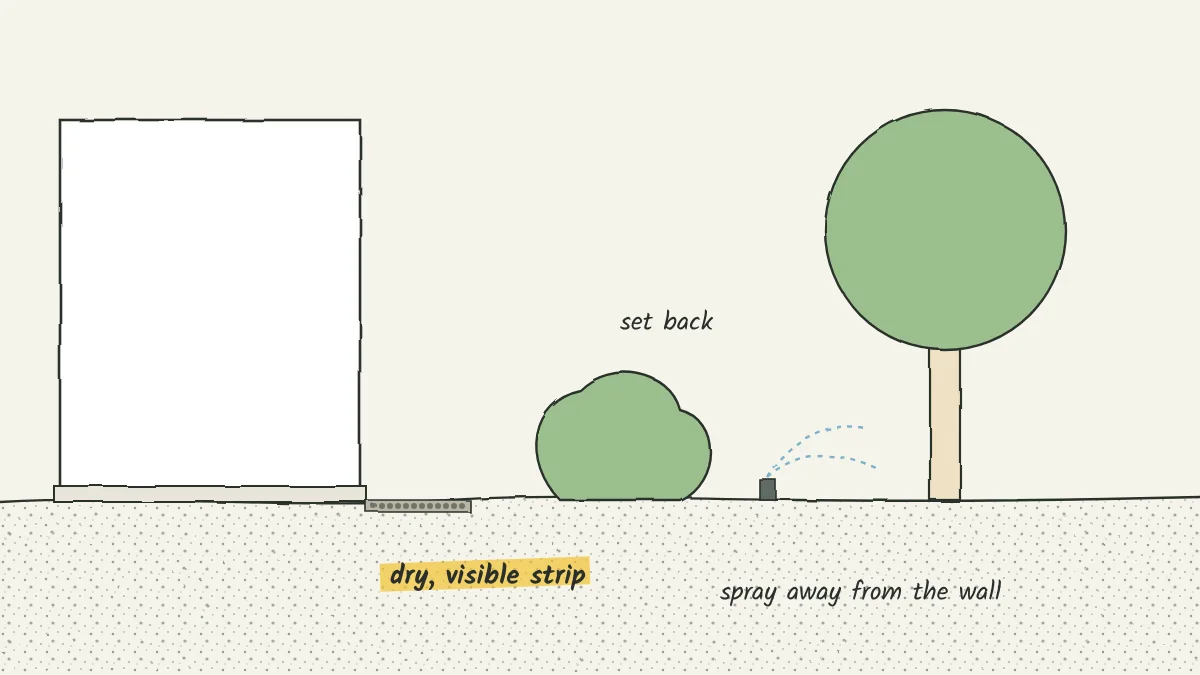
Keep the first foot or so next to the foundation dry, thinly covered and visible. Don't dig or add soil there if the house has had a soil treatment. Aim sprinkler heads away from the wall and set them at least 1 foot out. Plant shrubs for their size in 10 to 15 years, keep vines off the walls, and plant large trees well away so roots don't crack the foundation.
On this page
The foundation strip
Think of the first 12 inches out from the wall as a separate zone. It's where a soil termite treatment usually sits, where termites have to cross to reach the house, and where an inspector looks for mud tubes.
NC State Extension advises not digging in the soil within 12 inches of the house, since that's the treated area, and not adding topsoil there either. Mississippi State University Extension puts it the same way: leave the band your termite company treated undisturbed, because digging, tilling or adding soil can leave the house vulnerable. On a slab house, MSU says you should be able to see the edge of the slab all the way around.
The University of Florida's guidance for mulch in that zone is specific: under 2 inches thick within 12 inches of the foundation, so the soil can dry, and a gap of at least 6 inches between mulch and siding so mud tubes can be seen. Our mulch guide covers which mulches to use.
Landscaping numbers from extension services
Each comes from a university extension source. They're starting points, not code.
| Advice | Number | Source |
|---|---|---|
| Don't dig or add soil next to a treated house | Within 12 inches | NC State Extension |
| Mulch thickness near the foundation | Under 2 inches within 12 inches | University of Florida IFAS |
| Gap between mulch and siding | At least 6 inches | University of Florida IFAS |
| Sprinkler heads from the wall | At least 1 foot | University of Florida IFAS |
| Siding above the soil line | At least 6 inches, higher is better | NC State Extension |
| Plan shrub size for | 10 to 15 years of growth | NC State Extension |
Ohio State adds keeping mulch at least 6 inches below the top of the foundation.
Water: aim it away
Irrigation is the most overlooked termite risk in a yard. The University of Florida says irrigation heads should sit at least 1 foot from the building wall, and counts heads that spray the wall as a conducive condition. In Colorado, a dry state, Colorado State University names over-irrigation near buildings and poor downspout drainage among the main reasons termite infestations have increased.
Drip lines are easy to forget because they're hidden. Run them to plants, not along the siding, and check them for leaks each spring. If a bed by the house needs daily water, it may be the wrong plant for that spot.
For checking the foundation strip
As an Amazon Associate I earn from qualifying purchases.
-
View on Amazon
Pin-type wood moisture meter
Wood that reads above about 20% is wet enough to invite rot and termites. Great for sills and subfloors.
-
View on Amazon
Bright LED flashlight, 1,000+ lumens
The one tool that really matters. A tight, bright beam shows mud tube texture and wing piles in dark corners.
Plants: plan for the grown-up size
The common mistake is planting for the size on the nursery tag. NC State Extension says to plan for how big shrubs will be in 10 to 15 years, including width, and not to plant them too close to the foundation. Keep beds and plants from covering the siding and foundation, and prune shrubs back from crawlspace vents so air can move.
University of Kentucky entomologist Michael Potter adds vines, ivy and dense plantings that touch the house to the list to avoid. They hold moisture against the wall and hide mud tubes. A shrub set a few feet out, trimmed so you can walk behind it, lets you and an inspector see the foundation.
Trees, stumps and edging
Mississippi State Extension recommends planting large trees a safe distance from the house, because big roots can grow under the foundation and crack it, opening a path for termites. Old stumps and dead roots near or under the house are termite food; Potter recommends removing them where practical. See termites in trees.
Watch the materials, too. Wooden landscape timbers, railroad ties and wood bed edging against the house put wood in soil right at the foundation. Colorado State University lists buried wood, like old fence posts and firewood piles, among the human habits behind infestations. Use stone, concrete or metal edging near the house, and keep wooden raised beds well out in the yard. The same logic applies to fences and decks.
Landscaping near the foundation
Do
- Keep the first foot next to the wall thin, dry and visible
- Aim and set sprinklers at least a foot from the wall
- Space shrubs for their mature size
- Remove stumps and wood edging near the house
Don't
- Pile new topsoil against the foundation
- Let ivy or vines climb the siding
- Build wooden raised beds against the house
- Plant big trees close to the foundation
Questions people ask
What is the best landscaping to prevent termites?
A dry, visible strip next to the foundation: thin mulch or gravel, no soil piled on, sprinklers aimed away, and shrubs set back far enough that you can see the wall.
How far should plants be from the house to prevent termites?
Far enough for their size in 10 to 15 years, as NC State Extension suggests, so mature shrubs don't touch the siding or cover vents. Vines and ivy shouldn't touch the house at all.
Can I plant right next to my foundation if it was treated for termites?
Be careful. NC State Extension advises against digging or adding soil within 12 inches of a treated house, and Mississippi State says disturbing the treated band can leave the house vulnerable.
Do sprinklers cause termites?
They don't attract them from far away, but wet soil at the foundation helps termites. The University of Florida says to keep irrigation heads at least 1 foot from the wall.
Keep reading
Termites in your state
Sources
- NC State Extension: Termites, preventing problems in existing homes (Waldvogel, Alder and Hayes, revised 2022)
- University of Florida IFAS ENY-832: The facts about termites and mulch (Oi and Wheeler, 2006)
- Mississippi State University Extension: 3 tips to protect your home from termites when landscaping
- University of Kentucky Entomology Entfact-605: Protecting your home from termites (Potter, 2018)
- Colorado State University Extension PlantTalk 1400-3: Termites in Colorado
- Iowa State University Extension: Does landscape mulch lead to termites in your home? (Lewis, 2001)
- Ohio State University Plant and Pest Diagnostic Clinic (BYGL): Eastern subterranean termite (2024)