Termites in Kansas: Swarms After the First Warm Rain
Every spring, K-State's entomologists field calls about winged insects on Kansas windowsills. Some are ants and some are termites, and the difference is worth a lot of money. Here's when Kansas termites swarm, how K-State tells them apart, and what Kansas law says you should get in writing.
The short version
The eastern subterranean termite is Kansas's main termite. K-State says swarms usually come about 10 days after the first warm spring rains, typically in April, though they've been seen from late February to early June. Termite firms are licensed by the Kansas Department of Agriculture under Category 7A, and Kansas law requires a written statement of services, with a diagram, before you pay.
Kansas at a glance
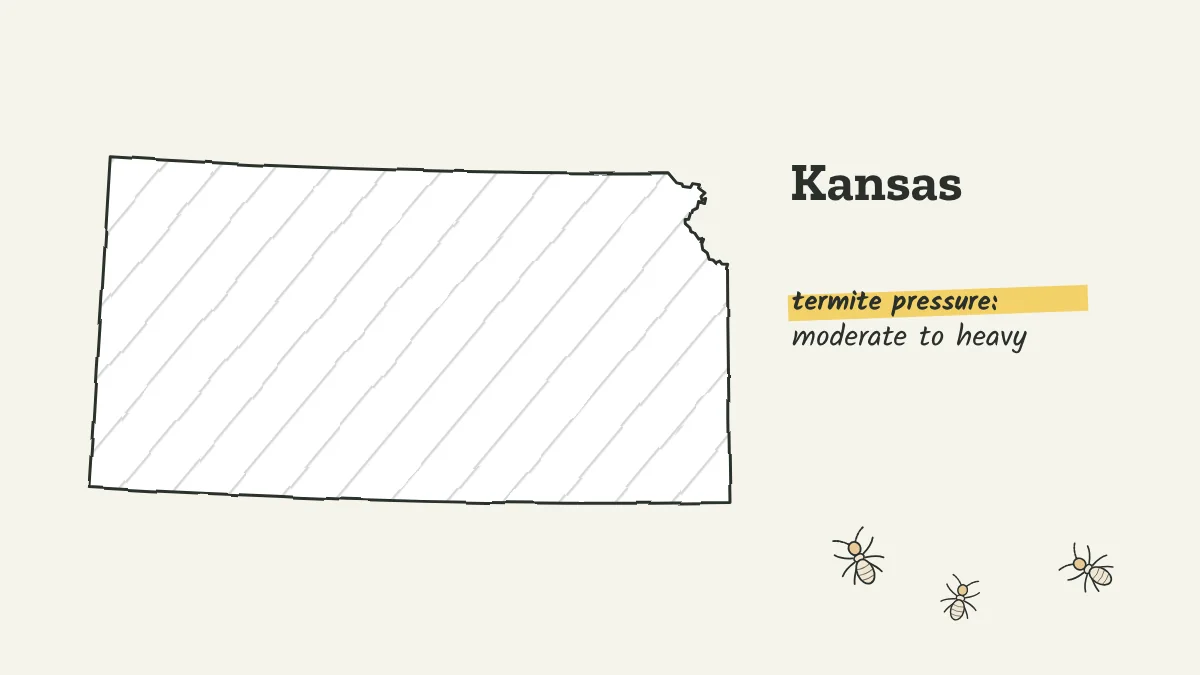
- Termite pressure
- Moderate to heavy
- Termites to know
- Eastern subterranean
- Why termites like it here
- Continental, with hot summers, cold winters and spring rains that set off swarms.
- Who licenses pest control
-
Kansas Department of Agriculture, Pesticide and Fertilizer Program
Check a company's license - Inspection report for home sales
- NPMA-33 Wood Destroying Insect Inspection Report
On this page
Kansas's termite and its timing
K-State Research and Extension's Termites: Structural Pests (MF722) calls the eastern subterranean termite the most common and problematic species in Kansas. Swarmers show up most often in early spring and only infrequently in late fall.
Whitworth's newsletter adds the timing rule: swarms usually follow the first warm spring rains by about 10 days, typically in April, with a range from late February to early June depending on the weather. In 2015 K-State reported more swarm calls from south central and north central Kansas than in the previous two years combined, and wasn't sure whether that year's weather or the previous year's was responsible.
When termites swarm in Kansas
K-State says swarms usually come about 10 days after the first warm spring rains, most often in April.
| Termite | J | F | M | A | M | J | J | A | S | O | N | D |
|---|---|---|---|---|---|---|---|---|---|---|---|---|
| Eastern subterranean Daytime, often after a warm rain | some swarms | peak | peak | common | some swarms |
Termite or ant? K-State's checklist
From K-State's Kansas Insect Newsletter and MF722.
| Feature | Termite | Ant |
|---|---|---|
| Wings | Four, equal in size | Hind wings smaller |
| Waist | Thick, cigar-shaped body | Narrow, pinched waist |
| Antennae | Straight | Bent, elbowed |
| Nearby | Often white workers or soldiers | No soft-bodied workers |
K-State says ant treatment is very different from, and less expensive than, termite treatment. More in flying ants vs termites.
Signs and slow damage
MF722 says termite damage happens slowly. Signs include swarmers or broken wings near windows and doors; mud tubes in crawlspaces, concrete cracks and foundations and around pipes and ducts; mud-filled joints in framing, paneling and trim; and soft or hollow-sounding wood near the foundation, which you can probe with an ice pick or screwdriver. A mature colony eats only about a fifth of an ounce of wood a day. Indoor swarmers can be vacuumed up and the bag thrown away outside. See signs of termites.
Treatment in Kansas
K-State generally recommends professional control. Barrier treatments use termiticide in the soil, and a whole house often takes several hundred gallons of diluted product, so be wary of a firm that quotes a price based only on gallons. Baits entered the Kansas market in 1995, and K-State notes they're often used where a water well or cistern limits soil treatment. Metal termite shields rarely give complete protection, because they're often installed wrong and termites can build tubes over them. Compare options in termite treatment options.
Prevention numbers from K-State
MF722 gives specific targets. Keep exterior woodwork 6 to 8 inches above grade and crawlspace beams at least 18 inches above the ground. Provide foundation ventilation of about 2 square feet per 25 running feet of outside foundation wall. Keep fencing, firewood and steps from touching the soil, and use preservative-treated lumber where wood must touch it. Termites can pass through cracks as narrow as 1/32 inch, so sealing gaps helps but won't do the job alone. See termites in fences and decks.
Licensing and what to get in writing
The Kansas Department of Agriculture licenses pest control businesses, and wood-destroying pest control is Category 7A. Each business must have a certified commercial applicator in that category, train its uncertified technicians, carry proof of financial responsibility and keep application records for three years. Its trucks must show the business name and license number. KDA's online business search shows current licenses.
MF722 adds a consumer rule: Kansas law requires a written statement of services before payment, listing the pesticide used, application dates, when the guarantee expires and a diagram of the structure. K-State says guarantees commonly run one year at a time or three to five years, so get the terms and any annual charges in writing. See termite bonds.
For Kansas homeowners
Do
- Check the business on KDA's license search
- Get the written statement of services and diagram
- Ask whether a well or cistern changes the treatment plan
- Compare written estimates from more than one firm
Don't
- Pay a price based only on gallons of chemical
- Count on metal shields alone
- Hire a firm that shows up unannounced
- Panic; termite damage develops slowly
Questions people ask
When do termites swarm in Kansas?
Usually about 10 days after the first warm spring rains, most often in April, according to K-State. Swarms have been seen from late February to early June.
What termites live in Kansas?
The eastern subterranean termite is the most common and problematic species, according to K-State Research and Extension.
How do I check a Kansas termite company's license?
Use the Kansas Department of Agriculture's online pesticide business search. Termite work falls under Category 7A, wood-destroying pest control.
What paperwork should I get after termite treatment in Kansas?
A written statement of services listing the pesticide, application dates, guarantee expiration and a diagram of the structure. K-State says Kansas law requires it before payment.
Keep reading
Sources
- K-State Research and Extension MF722: Termites, structural pests (Whitworth and others, 2022)
- K-State Extension Entomology, Kansas Insect Newsletter: Termites (Whitworth, May 2022)
- K-State Extension Entomology, Kansas Insect Newsletter: Termites (May 2015)
- Kansas Department of Agriculture: Pesticide business licensing guide
- Kansas Department of Agriculture: Pesticide business search