Termites in Arkansas: Contracts, Diagrams and the Plant Board
Arkansas regulates termite work more closely than most states. Every job needs a written contract with at least a one-year guarantee and a diagram of the house, and the state inspects completed work. Here's what lives in Arkansas soil, when it swarms, and what the rules mean for you.
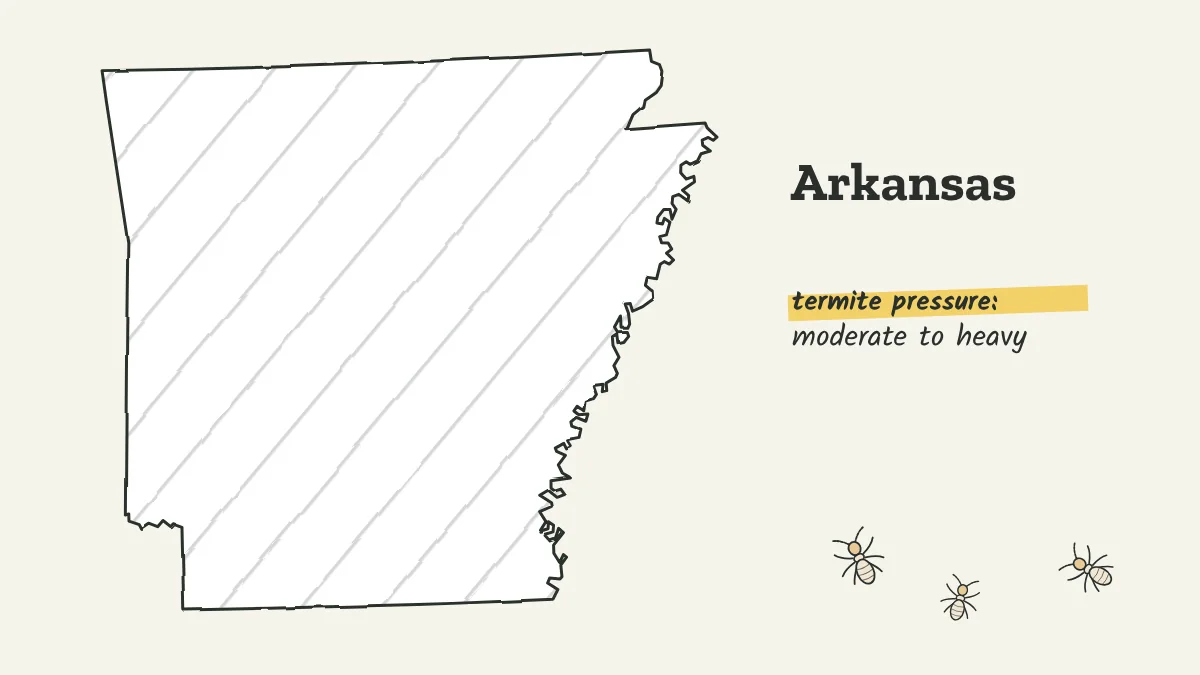
The short version
Arkansas has three native subterranean termites, all found statewide, and the University of Arkansas says they swarm in daylight from March through May, usually after rain. Termite firms are licensed through the Arkansas State Plant Board. Every termite job, including a real estate clearance letter, comes with a signed contract guaranteeing the work for at least a year and a diagram of the structure.
Arkansas at a glance
- Termite pressure
- Moderate to heavy
- Termites to know
- Eastern subterranean
- Why termites like it here
- Hot, humid summers and mild winters, with native subterranean termites statewide.
- Who licenses pest control
-
Arkansas Department of Agriculture, Plant Industries (Arkansas State Plant Board), Pest Control Program
Check a company's license - Inspection report for home sales
- HUD/NPMA-33 Wood Destroying Insect Infestation Inspection Report, with a contract and graph
On this page
Arkansas's termites
University of Arkansas extension entomologist John Hopkins lists three native subterranean termites in the state, all statewide: the eastern subterranean termite, the most common; the dark southern subterranean termite; and the light southern subterranean termite, the least common in structures.
Hopkins says winged swarmers emerge in daylight from March through May, usually after rain, and swarmers coming out indoors mean an existing infestation. Colonies take 6 to 7 years to mature and may send out their first swarms 2 to 6 years after they start, so a swarm is a sign of a colony that's been around a while. Large colonies can forage across an area the size of a football field.
When termites swarm in Arkansas
The University of Arkansas says swarms come in daylight from March through May, usually after rain.
| Termite | J | F | M | A | M | J | J | A | S | O | N | D |
|---|---|---|---|---|---|---|---|---|---|---|---|---|
| Eastern subterranean Daytime, often after a warm rain | some swarms | peak | peak | common | some swarms |
Is the Formosan termite in Arkansas?
Not confirmed. In 2025 the University of Arkansas System Division of Agriculture joined the North American Termite Survey, a 12-state effort based at the University of Georgia, to find out. Extension agents in counties along Arkansas's southern and eastern borders, the Delta and the tier next to Louisiana, set glue traps near streetlights to catch swarmers. Extension entomologist Jon Zawislak, the state coordinator, said the goal is to learn whether Formosans are present, because treatment methods differ. See Formosan termites.
What Arkansas requires of termite work
From the Arkansas Pest Control Law (Ark. Code 17-37) and the Plant Board's rules.
| Requirement | What it means for you |
|---|---|
| Written contract | Must guarantee the work for at least one year |
| Diagram of the structure | Shows damage, active or past infestation and the work; since 2013, with a legend |
| Product named | Contract lists the chemical name and EPA registration number |
| Repairs or retreatment | Contract says whether repairs are covered or retreatment only |
| Clearance letters | On the HUD wood-destroying insect report form, with a contract and graph |
| Bait systems | Contract states the starting number of stations and how often they're checked |
Contracts also go to the Plant Board, and firms report every termite job monthly.
The state checks the work
Arkansas doesn't just license termite firms; it inspects their jobs. If a Plant Board inspection finds active termites or work that misses the minimum standards, the company has 15 days to retreat or correct it and report back. A firm with 15 percent or more of its jobs failing inspection can have all of its prior-year jobs ordered inspected.
The minimum standards are specific. For existing houses they include an access opening at least 14 by 16 inches, removal of wood and debris from under the house, soil pulled back to at least 12 inches below floor joists, concrete or metal bases at least 3 inches high under wood piers, and drilling at no more than 18-inch intervals when a label doesn't say otherwise. Decks and patios are covered only if the contract includes them.
Signs and choosing a company
Hopkins calls exploratory mud tubes over foundations and walls one of the easiest signs to spot, along with working tubes from soil to wood, drop tubes hanging back down, and swarm tubes 4 to 8 inches tall that swarmers use as exits. A typical treatment can take more than 200 gallons of termiticide solution, which is one reason it's a professional job. More in signs of termites.
His advice on hiring: take your time, get inspections and estimates from two or three companies, check references, compare warranties, and avoid firms that push specials or scare tactics. All pest control firms must be licensed through the Plant Board's Pest Control Program, reachable at 501-225-1598. See termite letters.
For Arkansas homeowners
Do
- Get the contract and diagram for every termite job
- Check whether the guarantee covers repairs or only retreatment
- Ask whether decks and patios are included
- Keep clearance letters with their contract and graph
Don't
- Accept a termite letter with no contract attached
- Sign on the spot for a special price
- Assume a swarm in the yard means the house is infested
- Treat termites yourself
Questions people ask
When do termites swarm in Arkansas?
In daylight from March through May, usually after rain, according to the University of Arkansas.
Are there Formosan termites in Arkansas?
None have been confirmed. In 2025 extension agents began trapping swarmers in the Delta and along the Louisiana border as part of a national survey to find out.
What should come with an Arkansas termite letter?
A clearance letter on the HUD inspection form must come with a signed contract guaranteeing the work for at least one year and a graph of the structure.
Who regulates termite companies in Arkansas?
The Arkansas State Plant Board's Pest Control Program, part of the Arkansas Department of Agriculture. It licenses firms and inspects termite jobs.
Keep reading
Sources
- University of Arkansas Cooperative Extension FSA7061: Subterranean termite identification and biology (Hopkins)
- University of Arkansas System Division of Agriculture: Extension entomologist, agents to participate in invasive termite study (2025)
- Arkansas Pest Control Law Rules and Regulations, 209.02.19-004 (via Cornell LII)
- Arkansas Department of Agriculture, Plant Industries: Pest control program