Termites in Massachusetts: The State's Consumer Bulletin
Massachusetts hands homeowners a cheat sheet before any termite contract: a state-written Consumer Information Bulletin that every termite company must give you. It covers who's allowed to apply termiticide, what has to happen before anyone drills a slab, and who to call if something goes wrong. Here's what it says and how to use it.
The short version
In Massachusetts, anyone injecting termiticide into the soil must be certified in Category 43, termite control, or work under the direct supervision of someone who is. Before you sign a termite contract, the company must give you MDAR's Consumer Information Bulletin on Termite Applications. No termiticide can be injected under a slab until sub-slab ducts and pipes are located. You can check any applicator's license online through the state's ePLACE portal.
Massachusetts at a glance
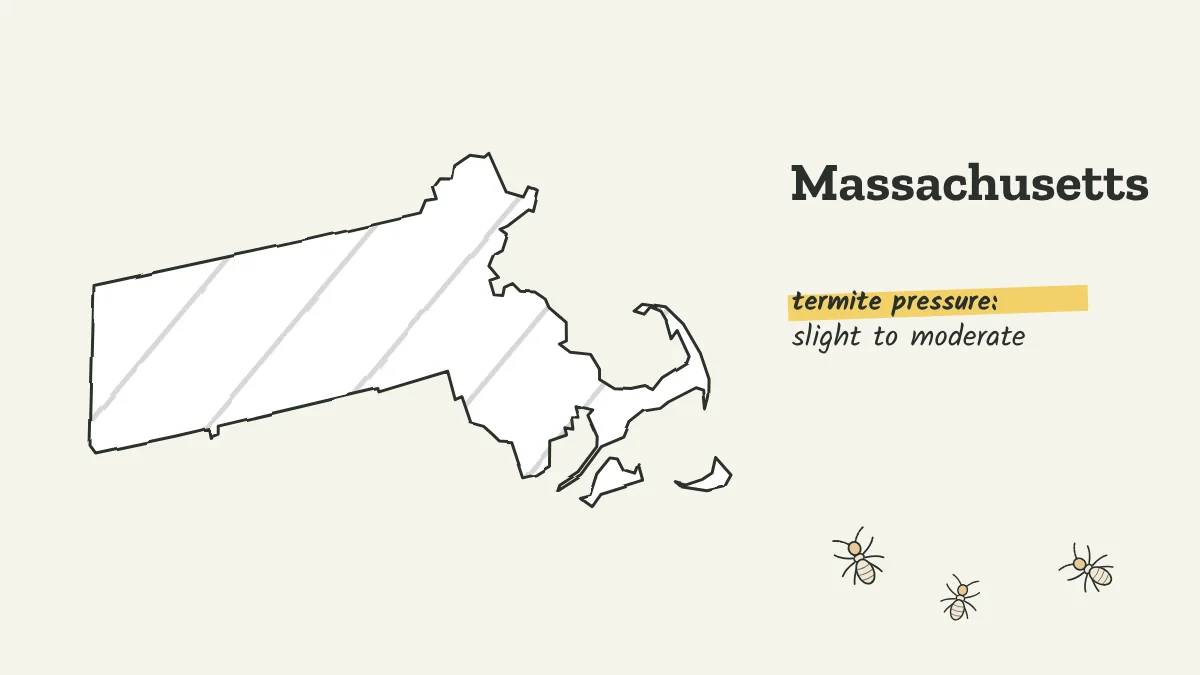
- Termite pressure
- Slight to moderate
- Termites to know
- Eastern subterranean
- Why termites like it here
- Cold winters and warm, humid summers, with many older homes on basements and the eastern subterranean termite statewide.
- Who licenses pest control
-
Massachusetts Department of Agricultural Resources (MDAR), Pesticide Program
Check a company's license - Inspection report for home sales
- NPMA-33 Wood Destroying Insect Inspection Report
On this page
Massachusetts's termite
The eastern subterranean termite is the termite of New England, living in soil colonies and reaching wood through mud tubes. In Massachusetts it typically swarms in spring, and winged termites indoors usually point to a colony in or under the house. Many Massachusetts homes have basements or crawlspaces, which is why the state's rules pay so much attention to foundations. See signs of termites.
When termites swarm in Massachusetts
Eastern subterranean termites in New England swarm in spring, from early spring into early summer.
| Termite | J | F | M | A | M | J | J | A | S | O | N | D |
|---|---|---|---|---|---|---|---|---|---|---|---|---|
| Eastern subterranean Daytime, often after a warm rain | some swarms | peak | peak | common | some swarms |
Category 43 and the bulletin
Massachusetts pesticide regulations, 333 CMR 13.05, cover subsurface termiticide applications. Applicators who inject termiticide into the soil must be certified in Category 43 or work under the direct supervision of someone certified. MDAR's bulletin explains that the supervisor must be readily available but doesn't have to be on site. If the person at your door isn't certified, ask for the supervising applicator's name and license number.
The same rule requires that, before you enter a termite contract, the applicator or company give you the Department-approved Consumer Information Bulletin on Termite Applications. The current version is dated May 2026. Read it before you sign, not after.
What the Massachusetts rules require
From 333 CMR 13.05 and MDAR's Consumer Information Bulletin.
| Rule | What it means for you |
|---|---|
| Category 43 certification | Soil termiticide work is done or directly supervised by a certified applicator |
| Bulletin before contract | You get MDAR's consumer bulletin before you sign |
| Sub-slab elements located | No injection under a slab until ducts, water and sewer lines are found |
| Foundation cracks filled | Cracks or holes are filled first, or the soil is treated above ground and replaced |
| Saturated soil | No liquid application when soil is saturated by flooding or rain |
The bulletin also says to keep vegetable gardens at least five feet from a foundation treated with liquid termiticide.
Ducts, cracks and basements
Two rules protect the inside of your house. First, termiticide can't be injected beneath a slab or other flooring until the locations of sub-slab heating ducts, water lines and sewer lines are known. MDAR's bulletin adds that if the duct locations can't be determined, no termiticide may be injected through the slab. Ducts buried in a slab can carry product into the living space.
Second, for houses with basements or crawlspaces below outside grade, the applicator must make sure significant amounts of termiticide won't seep into the basement through holes, cracks or voids. The bulletin says visible cracks must be filled before outside treatment, or the crew must dig a trench, treat the removed soil above ground and put it back. If a bid skips these steps, ask why. See liquid termite treatment.
Wells, baits and alternatives
MDAR says liquid termiticides are relatively immobile in soil, but if you have a well nearby, talk to the company first; labels include well precautions. The bulletin calls baits the lowest-risk option because they sit in locked stations in the ground, and lists foam, dust and bait as alternatives where liquid treatment raises concerns. It also encourages asking about non-chemical steps you can take to reduce the problem. See termite bait stations.
Checking a license and complaining
Massachusetts lets you check a pesticide license yourself through the state's ePLACE public portal: search pesticide use licenses by name and look for an active status. Ask to see the applicator's license and the product label on the day. To report an unlicensed applicator or misuse, MDAR has an online complaint form and an enforcement line at 617-626-1782. Contract disputes go to the Attorney General's Office of Consumer Affairs at 617-727-8400. See how to file a complaint against a pest control company.
For Massachusetts homeowners
Do
- Read MDAR's bulletin before signing
- Ask who holds the Category 43 certification
- Ask how sub-slab ducts and pipes were located
- Check the license on the ePLACE portal
Don't
- Let anyone drill a slab with unknown ducts under it
- Allow liquid treatment on flooded or saturated soil
- Plant vegetables in treated soil at the foundation
- Sign before you've seen the consumer bulletin
Questions people ask
What license does a Massachusetts termite applicator need?
Category 43, termite control, under 333 CMR 13.05. An uncertified applicator may work only under the direct supervision of someone holding it.
What is the Massachusetts termite Consumer Information Bulletin?
A state-approved handout from MDAR that termite companies must give you before you enter a contract. It explains treatment types, safety, license checks and who to call with problems.
Can a company drill my slab for termite treatment in Massachusetts?
Only after the locations of sub-slab heating ducts, water lines and sewer lines are known. If duct locations can't be determined, no termiticide may be injected through the slab.
How do I check a pesticide license in Massachusetts?
Use the state's ePLACE public portal, search pesticide use licenses by name, and look for an active license status.