Termites in Tennessee: Three Native Species and the State's Contract Rules
Tennessee writes some of its most useful termite protections into the contract itself: a one-year retreatment warranty, a yearly inspection and a graph of your house. Here's what the state's three native termites do, and what the rules give you when you hire a company.
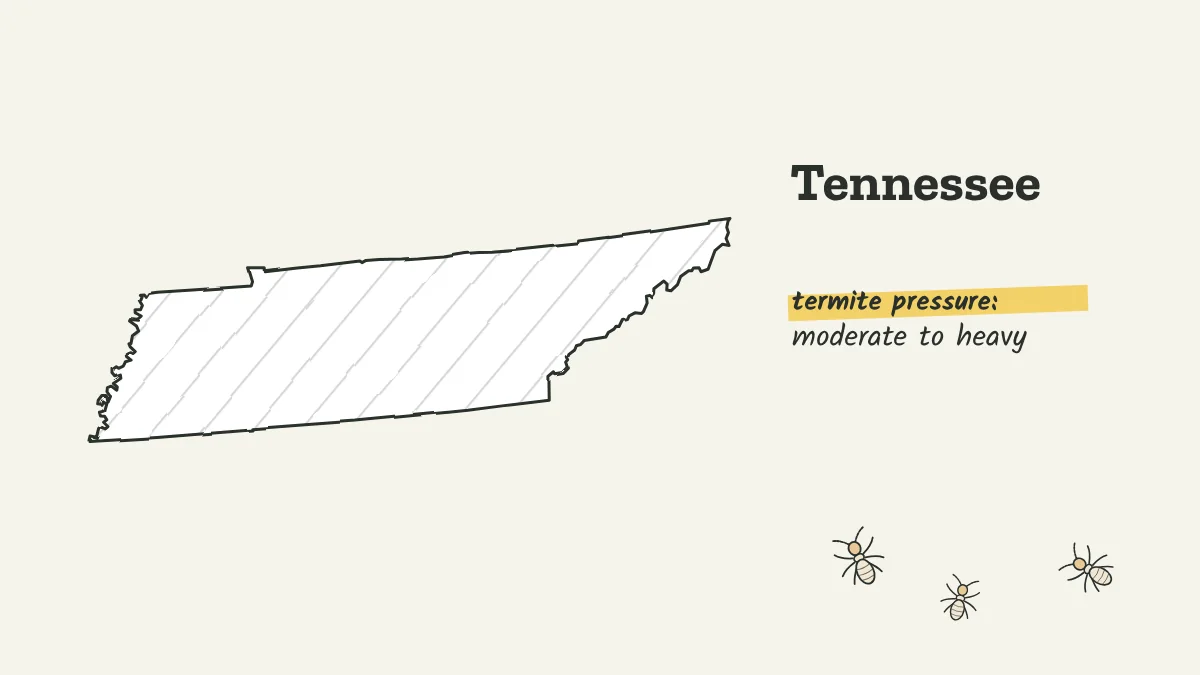
The short version
Tennessee's termites are native subterranean species that live in the soil statewide. The eastern subterranean termite swarms from March to May, a second species from April to June or in fall, and a third from August to October. Termite contracts must include a one-year retreatment warranty and a yearly inspection, and companies need a state charter.
Tennessee at a glance
- Termite pressure
- Moderate to heavy
- Termites to know
- Eastern subterranean
- Why termites like it here
- Hot, humid summers and cool winters, with native subterranean termites statewide and heavy clay soils in many areas.
- Who licenses pest control
-
Tennessee Department of Agriculture, Regulatory Services, Pesticide Section
Check a company's license - Inspection report for home sales
- Wood Destroying Insect Infestation Inspection Report (clearance letter)
On this page
- Three native termites, three seasons
- Tennessee's native termites
- When the eastern subterranean termite swarms
- Formosans in Tennessee
- Clay soil and treatment
- Charters, licenses and the truck in your driveway
- What Tennessee's termite contract rules give you
- Clearance letters for home sales
- When something goes wrong
- Questions
Three native termites, three seasons
Most states have one termite that matters. University of Tennessee Extension's termite guide lists three native subterranean species in Tennessee, and they don't swarm at the same time:
- The eastern subterranean termite swarms from March to May.
- The southeastern subterranean termite swarms from April to June, or in the fall.
- The light southeastern subterranean termite, a pale-brown species, swarms from August to October.
All three live in the soil and reach wood through mud tubes. UT adds that swarms can happen at other times, especially from colonies inside heated buildings, and that colonies usually don't produce swarmers until they're more than three years old. For identification, UT asks for 10 to 15 swarmers or soldiers in rubbing alcohol. The ant-or-termite question is in flying ants vs termites.
Tennessee's native termites
From UT Extension PB1344, Subterranean Termite Control.
| Termite | Scientific name | Swarm months |
|---|---|---|
| Eastern subterranean | Reticulitermes flavipes | March to May |
| Southeastern subterranean | Reticulitermes virginicus | April to June, or fall |
| Light southeastern subterranean | Reticulitermes hageni | August to October |
Drywood termites aren't established in Tennessee. UT says they're occasionally brought in with infested furniture or other wooden items.
When the eastern subterranean termite swarms
The chart shows the eastern subterranean termite, the most familiar of the three. The southeastern species extends swarms into June and fall, and the light southeastern species flies from August to October.
| Termite | J | F | M | A | M | J | J | A | S | O | N | D |
|---|---|---|---|---|---|---|---|---|---|---|---|---|
| Eastern subterranean Daytime, often after a warm rain | some swarms | peak | peak | common | some swarms |
Formosans in Tennessee
The Formosan subterranean termite isn't established in Tennessee. UT Extension says it was introduced to the Memphis area in the past but didn't establish, and asks that suspected Formosans be reported to the Tennessee Department of Agriculture. Mississippi's Formosan quarantine rule still lists Shelby County among infested areas. The Memphis story is on our Memphis page, and the species profile is in Formosan termites.
Clay soil and treatment
Tennessee's heavy clay soils change how liquid treatments go in. UT notes that clay may not absorb the standard volume of diluted termiticide, so product labels allow a lower volume at a higher concentration, as long as the same amount of active ingredient goes into the soil. If a company proposes that, it's a label option, not a shortcut, and the product label should say so.
UT's prevention list is practical: keep a 12- to 18-inch mulch-free zone against the foundation, keep 30 inches of crawlspace clearance, cover about 80 percent of crawlspace soil with polyethylene, and fix leaking faucets and irrigation that wets the foundation. More in how to prevent termites.
Charters, licenses and the truck in your driveway
Tennessee licenses pest control businesses through a charter, a permit from the Department of Agriculture, with a separate charter for each location. A company doing termite work needs a licensee in the wood destroying organisms category, which requires commercial certification in structural pest control. Firms with a termite licensee must also carry errors and omissions insurance of at least $100,000 per incident and $300,000 total, and new companies offering termite work post a $50,000 bond.
The department's consumer advice is to look for the company name and charter number on the vehicle and in its ads, ask to see the applicator's certification or license card, and ask for a solicitor's card from a salesperson. Applying pesticides for hire without a license or charter is a Class A misdemeanor. You can look up a charter on the department's public charter list. More in how to check a pest control license.
What Tennessee's termite contract rules give you
From Tennessee's wood destroying organism rule, 0080-09-04-.08.
| Rule | What it means for you |
|---|---|
| Written contract first | A contract in duplicate before any treatment; you keep a copy |
| Inspection date and graph | The contract shows the inspection date and a drawing of the property |
| Transfer | The contract must provide for transfer to later owners or renters during its term |
| One-year warranty | Every termite contract includes at least a one-year retreatment warranty |
| Damage guarantee disclosure | If there's no damage guarantee, the contract must say so in half-inch letters on the front |
| Annual inspection | The company inspects each contracted property every year |
| Partial treatment | Allowed only if you're told the possible outcomes, accept in bold type with your initials, and it's marked on the graph |
| Records | Copies of inspection and treatment records within 48 hours of a request |
The rule also limits mixing and application to no more than a 10% variance from the label and requires new-construction pretreatments within 90 days after backfill. Contract clauses to read closely are in termite contract red flags.
Clearance letters for home sales
In Tennessee, the termite report for a home sale is called a Wood Destroying Insect Infestation Inspection Report, often known as a clearance letter. The Department of Agriculture regulates who can issue one and how the inspection is done. Its consumer guidance says the report is issued when real estate is sold or transferred and must be warranted for 90 days for the accuracy of what it says. Tennessee isn't on HUD's list of states with their own required form, so the national NPMA-33 is common. See WDI inspection.
When something goes wrong
The department can investigate substandard termite treatments when there's a current contract, a company's failure to issue a termite contract, and failure to retreat an active infestation. It can't settle pricing, payment disputes or claims for property damage; for those it points to the state's Division of Consumer Affairs at 1-800-342-8385.
Complaints go in writing on a Pesticide Investigation Request form, with copies of contracts, service tickets, canceled checks, diagrams or photos. An inspector from your area contacts you before the investigation starts. The pesticide section's number is 615-837-5148, or 1-800-628-2631 from outside the local calling area. The general approach is in how to file a complaint.
Questions people ask
When is termite season in Tennessee?
It's longer than most people expect. The eastern subterranean termite swarms from March to May, the southeastern subterranean termite from April to June or in fall, and the light southeastern subterranean termite from August to October.
Are there Formosan termites in Tennessee?
They aren't established. UT Extension says Formosans were introduced to the Memphis area in the past but didn't establish. Suspected Formosans should be reported to the Tennessee Department of Agriculture.
What does a Tennessee termite contract have to include?
A written contract with the inspection date, a graph of the property, a transfer provision, a unique contract number and a one-year retreatment warranty. If it doesn't cover damage, it must say so in half-inch letters on the front.
How long is a Tennessee clearance letter good for?
The Department of Agriculture says a wood destroying insect report for a sale must be warranted for 90 days for the accuracy of its findings.
How do I check a pest control company in Tennessee?
Look up its charter on the Department of Agriculture's public charter list, check for the charter number on its trucks and ads, or call the pesticide section at 615-837-5148.
City guides in Tennessee
Keep reading
Sources
- UT Extension PB1344: Subterranean termite control
- Tennessee Rule 0080-09-04-.08: Requirements of specific categories and pesticides
- Tennessee Department of Agriculture: Certification, licensing and charters
- Tennessee Department of Agriculture: Pesticide charters
- Tennessee Department of Agriculture: Pesticide consumer tips
- Tennessee Department of Agriculture: Pesticide investigation request form
- Tennessee Department of Agriculture: TDA urges consumers to check pesticide credentials (2010)
- HUD: HOC reference guide, wood destroying insect inspections
- Mississippi Administrative Code 2-1-3-01-135: Formosan subterranean termite quarantine