Termites in Nebraska: Only One Kind to Worry About
Nebraska's termite story is simpler than most states'. There's one type of termite to deal with, and University of Nebraska–Lincoln entomologists have studied it right in Nebraska towns. Here's what they found, how to spot an infestation and how to hire help without getting rushed.
The short version
Nebraska has only subterranean termites. University of Nebraska–Lincoln says drywood, Formosan and dampwood termites aren't established in the state, and the eastern subterranean termite is the most destructive. Damage builds slowly, so there's time to get two or three quotes. Anyone treating homes for hire needs a commercial pesticide license from the Nebraska Department of Agriculture.
Nebraska at a glance
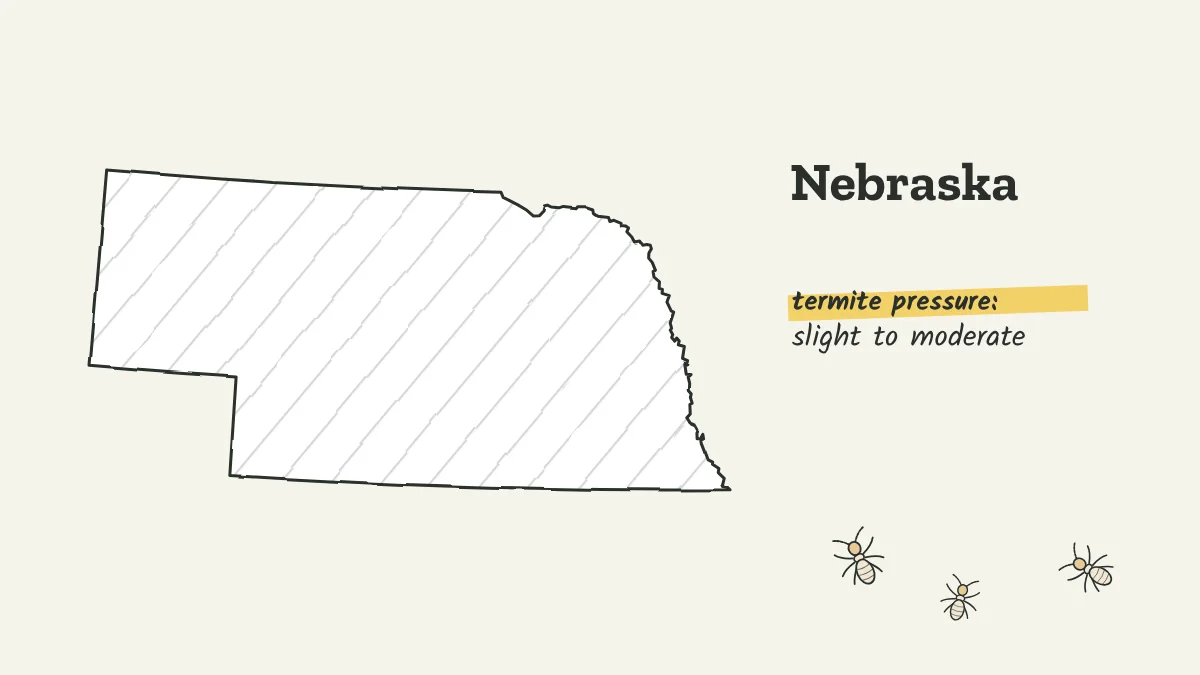
- Termite pressure
- Slight to moderate
- Termites to know
- Eastern subterranean
- Why termites like it here
- Cold winters and hot summers, with subterranean termites the only termites established in the state.
- Who licenses pest control
-
Nebraska Department of Agriculture, Pesticide Program
Check a company's license - Inspection report for home sales
- NPMA-33 Wood Destroying Insect Inspection Report
On this page
Nebraska's termites
UNL extension urban entomologist Shripat Kamble wrote that Nebraska has only subterranean termites: drywood, Formosan and dampwood termites are not established in the state. His NebGuide on termites names two subterranean species living in similar habitats, and the 2018 study calls the eastern subterranean termite the most destructive subterranean termite on urban buildings in Nebraska.
That narrows things down. Every Nebraska infestation starts in the soil, and every treatment aims at the soil or a bait. If you've read about drywood termites and tenting, that's a problem for other states. See subterranean termites.
What the DNA study found
The study, published in Sociobiology in 2018 by Ah Ab Majid, Shripat Kamble and H. Chen, sampled termites from 20 infested structures across Nebraska. In 17 of them, the termites came from a simple family colony, the offspring of one king and queen. The other three were mixed families. Colonies far apart were genetically quite different, and the reproductive pairs were monogamous.
For a homeowner, the practical point is that most infestations in the study came from one colony. A treatment that reaches that colony, whether a soil treatment or a bait, deals with the problem. See termite bait stations.
When termites swarm in Nebraska
Eastern subterranean termites swarm in spring, usually on a warm day after rain. Indoor swarmers point to a colony in or under the house.
| Termite | J | F | M | A | M | J | J | A | S | O | N | D |
|---|---|---|---|---|---|---|---|---|---|---|---|---|
| Eastern subterranean Daytime, often after a warm rain | some swarms | peak | peak | common | some swarms |
There's no rush
Kamble's guide to selecting a pest control company is blunt: extensive termite damage takes a long time to develop, and a house won't collapse overnight or within a couple of months. Old damage also doesn't always mean you need treatment, since the termites may be long gone. That's your license to slow down.
He also says termite control generally requires a licensed commercial company with the tools, products and training, and that homeowners shouldn't try it alone. Ask the inspector to point out conditions around the house that favor termites and what it would take to fix them.
UNL's checklist for hiring
From UNL NebGuide G1647, How to Select a Pest Control Company.
| Ask for | Why |
|---|---|
| Two to three quotes | Prices and plans vary between companies |
| A written treatment plan | So you know exactly what will be done |
| The termiticide label | Shows the product and how it must be applied |
| Price and warranty in writing | So you can compare offers fairly |
| Conducive conditions to fix | Prevention keeps termites from coming back |
Questions about pesticide rules go to the Nebraska Department of Agriculture's pesticide program, 402-471-2394. More in questions to ask a termite company.
Where to look in a Nebraska house
Because every Nebraska termite comes up from the soil, inspections start low. Check basement walls, sill plates and rim joists for mud tubes, look along the foundation outside where soil, mulch or a patio meets it, and probe soft or blistered wood with a screwdriver. Spring swarmers near basement windows or a heat source are the other giveaway. Our how to inspect for termites guide walks through it room by room, and termite swarm season explains what a swarm does and doesn't tell you.
Licensing in Nebraska
The Nebraska Department of Agriculture certifies and licenses pesticide applicators. Its licensing guide says anyone applying pesticides at structural sites, such as homes, for hire needs a commercial license; employees treating only their employer's property generally need a non-commercial one. Ask a termite company for its applicator's license before work starts. See how to check a pest control license.
For Nebraska homeowners
Do
- Get two or three quotes and written plans
- Ask to see the termiticide label
- Ask what conditions around the house to fix
- Confirm the applicator's commercial license
Don't
- Let anyone pressure you into signing today
- Assume old damage means live termites
- Worry about drywood tenting; it's not a Nebraska problem
- Treat termites yourself
Questions people ask
What kind of termites are in Nebraska?
Only subterranean termites. UNL says drywood, Formosan and dampwood termites aren't established in Nebraska, and the eastern subterranean termite is the most destructive.
Is termite damage in Nebraska an emergency?
Usually not. UNL entomologist Shripat Kamble says extensive damage takes a long time to develop, so there's time to compare two or three quotes.
Who licenses termite companies in Nebraska?
The Nebraska Department of Agriculture. Applying pesticides to homes for hire requires a commercial applicator license.
Does old termite damage need treatment?
Not always. UNL notes old damage doesn't always mean termites are still active. An inspection should show whether they are.
Keep reading
Sources
- University of Nebraska–Lincoln NebGuide G1647: How to select a pest control company (Kamble, 2006)
- University of Nebraska–Lincoln NebGuide G91-1062: Termites (Kamble, revised 2002)
- Majid, Kamble and Chen: Breeding patterns and population genetics of eastern subterranean termites in urban environment of Nebraska, Sociobiology 65(3), 2018
- Nebraska Department of Agriculture: Pesticide applicator license information