Termites in Maryland: Native Swarms, Form MD-1 and State Rules
Maryland has one termite, and it's everywhere: the native eastern subterranean termite. What sets the state apart is the paperwork. Maryland requires its own inspection form for home sales, sets out what the inspector must check, and even certifies the dogs some companies use to sniff out termites.
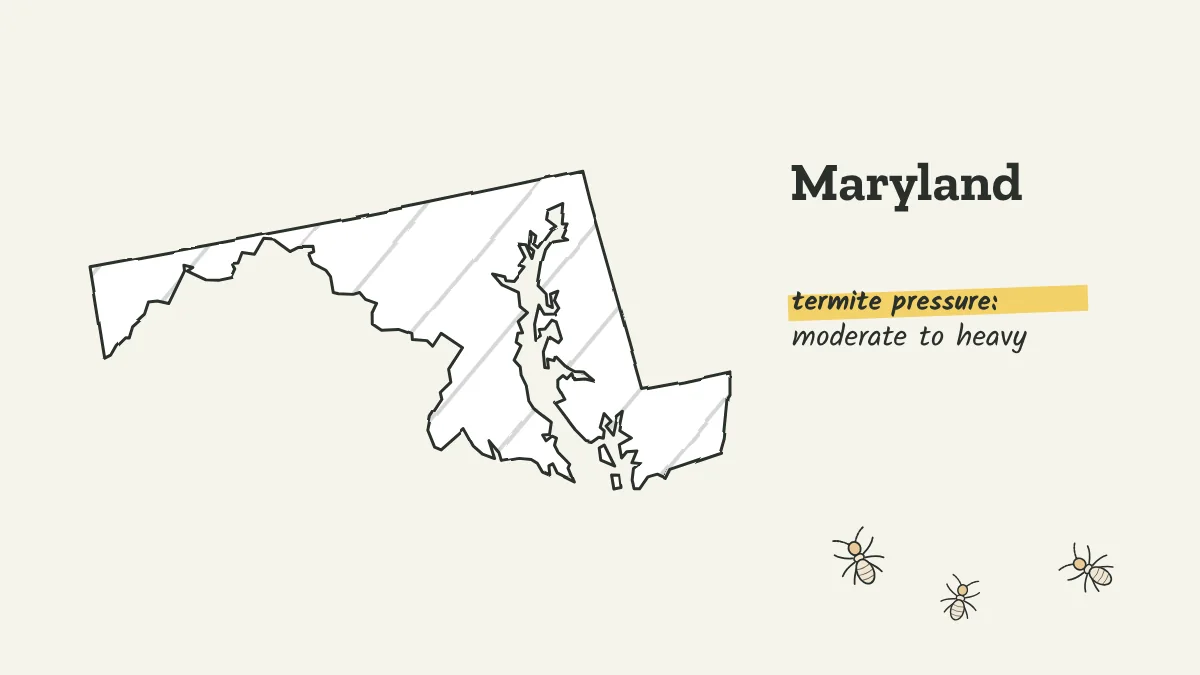
The short version
Maryland's termites are native eastern subterranean termites, which live in the soil statewide and swarm in spring. Home sales and real estate loans use the state's own Form MD-1, and Maryland doesn't accept a changed version. Companies are licensed by the Maryland Department of Agriculture, and you can check a business or applicator in its online database.
Maryland at a glance
- Termite pressure
- Moderate to heavy
- Termites to know
- Eastern subterranean
- Why termites like it here
- Hot, humid summers and cold winters, with native subterranean termites statewide and many older houses on basements and crawlspaces.
- Who licenses pest control
-
Maryland Department of Agriculture, Pesticide Regulation Section
Check a company's license - Inspection report for home sales
- Maryland Wood Destroying Insect Inspection Report (Form MD-1)
On this page
One termite, statewide
University of Maryland Extension says Maryland's native termites are subterranean termites in the genus Reticulitermes, the eastern subterranean termite. Colonies can reach several million termites and can use food sources more than 200 feet apart, which is why a colony under a neighbor's yard can be the one in your sill plate.
Mature colonies periodically send out swarmers, winged termites about a quarter inch long. Extension's answer to that 2022 question explains what they mean: alates aren't a danger to the house by themselves, and most that fly indoors die of dehydration, but a flight shows a colony nearby, and swarmers found indoors are worth investigating. In the Northeast and Mid-Atlantic, Rutgers says swarmers usually leave on warm, sunny days from April to June.
Signs Maryland Extension tells you to look for
From University of Maryland Extension's termite guide.
| Sign | Where you'll see it |
|---|---|
| Mud shelter tubes, about a quarter inch wide | Foundation walls, exposed wood, even ceilings |
| Soil packed into cracks | Crevices in wood and masonry |
| Piles of shed wings | Floors, windowsills and spider webs |
| Settling cracks or sagging floors | Over damaged joists and sills |
| Dark or blistered paneling, blistered or peeling paint on wood | Walls with feeding behind them |
Extension's advice is that damage is usually slow, so there's time to evaluate before treating. See how fast termites damage a house.
When termites swarm in Maryland
Maryland's one termite swarms mainly in spring, by day, often after a warm rain.
| Termite | J | F | M | A | M | J | J | A | S | O | N | D |
|---|---|---|---|---|---|---|---|---|---|---|---|---|
| Eastern subterranean Daytime, often after a warm rain | some swarms | peak | peak | common | some swarms |
Form MD-1: Maryland's own sale report
For a property transfer or a real estate loan, Maryland doesn't use the national NPMA-33. Its regulation, COMAR 15.05.01.14, requires the Maryland Wood Destroying Insect Inspection Report, Form MD-1. The Maryland Department of Agriculture says the form can't be altered; using a changed form is treated as false and fraudulent and can bring an automatic civil penalty and action against the company's license. The department also hasn't adopted NPMA's later changes to the national form.
The rule sets out what the inspection includes:
- Sounding or probing readily accessible structural members.
- The exterior below eye level without ladders, the interior and readily accessible attic, the basement and the crawlspace.
- A diagram showing where visible evidence and damage were found.
The report has to list inaccessible areas and why, whether wood-destroying insects or their evidence are present, visible damage and whether it has been or will be corrected or evaluated, past treatment evidence, and a department-required statement on conditions conducive to infestation. Companies keep inspection reports for two years. The national picture is in WDI inspection.
Licensing, and how to check
Termite work in Maryland is regulated by the Pesticide Regulation Section of the Maryland Department of Agriculture. Inspections are done by licensed pesticide businesses, through their certified applicators or registered technicians, or by licensed pest control consultants. In fiscal 2021 the department counted 1,527 licensed commercial pesticide businesses and nearly 4,000 certified commercial applicators.
You can look up a business or an applicator in the department's online database, by name, license number, category or location. UMD Extension's hiring advice adds the basics: get plans, prices and warranties from several companies, ask which chemicals they use, and check for an active Maryland Department of Agriculture certification. After a termite problem, it suggests a contract with annual inspections and retreatment as needed. More in how to check a pest control license.
Sniffer dogs need a state certificate
Maryland writes rules for termite-detection dogs, too. Under the same regulation, a canine pest detection team must be certified every year. The test uses at least four search areas, each with two distractors and three hidden targets, a 20-minute search limit and two evaluators who each have at least five years of documented experience. Training and certification records are kept for two years. If a company offers a dog inspection, ask for the team's current certificate. More in termite sniffing dogs.
Disclosure, disputes and complaints
Sellers in Maryland deliver either a property condition disclosure statement or a disclaimer statement on a State Real Estate Commission form. The disclosure version covers infestation of wood-destroying insects among its listed items; the disclaimer version only requires disclosing known latent defects that threaten health or safety. A buyer who doesn't get the statement on time can rescind within limits set by law. See termite disclosure laws.
If you disagree with an inspection, the department's advice is to start with the company that did it, then get a second opinion from another licensed firm. The department investigates inspection disputes that those steps don't resolve, and other complaints, through its Pesticide Regulation Section at 410-841-5710, by letter, fax or email. In 2021 it carried out 251 routine business inspections and cited 73 businesses.
For Maryland homeowners
Do
- Ask for Form MD-1 by name in a home sale
- Read the inaccessible areas and the conducive conditions statement
- Look up the company in the state's online database
- Ask for a second opinion before filing a complaint about an inspection
Don't
- Accept an NPMA-33 or an altered form for a Maryland sale
- Panic over a swarm outdoors; investigate swarmers indoors
- Hire a dog team without a current certificate
- Skip the annual inspection after treatment
Questions people ask
What termites live in Maryland?
The native eastern subterranean termite. University of Maryland Extension says Maryland's native termites are subterranean and live in the soil, with colonies that can reach several million.
What is Form MD-1?
It's the Maryland Wood Destroying Insect Inspection Report, required for termite inspections tied to a property transfer or real estate loan. The state says it can't be altered, and it includes a diagram of where evidence and damage were found.
How do I check a pest control company in Maryland?
Search the Maryland Department of Agriculture's online pesticide database for the business or the applicator, or call the Pesticide Regulation Section at 410-841-5710.
Do Maryland sellers have to disclose termites?
If the seller uses the disclosure statement, it covers wood-destroying insect infestation. A seller can choose a disclaimer instead, which still requires disclosing known latent defects that threaten health or safety.
Keep reading
Sources
- University of Maryland Extension: Eastern subterranean termite (2024)
- University of Maryland Extension via Ask Extension: Termite swarm question (2022)
- Rutgers Cooperative Extension FS338: Termites (2019)
- COMAR 15.05.01.14: Standards for inspection for pests
- Maryland Department of Agriculture: Form MD-1 advisory
- Maryland Department of Agriculture: Answers to questions realtors should know about pesticides
- Maryland Department of Agriculture: Pesticide regulation ag brief (FY2021)
- Maryland Real Property 10-702: Residential property disclosure and disclaimer statement