Termite Sniffing Dogs: Do They Work?
A dog can smell termites through drywall that an inspector's flashlight can't see past. That's the pitch, and research says it holds up better than you might expect, with some important limits. Here's what controlled tests found, how at least one state regulates dog teams, and how to use one well.
The short version
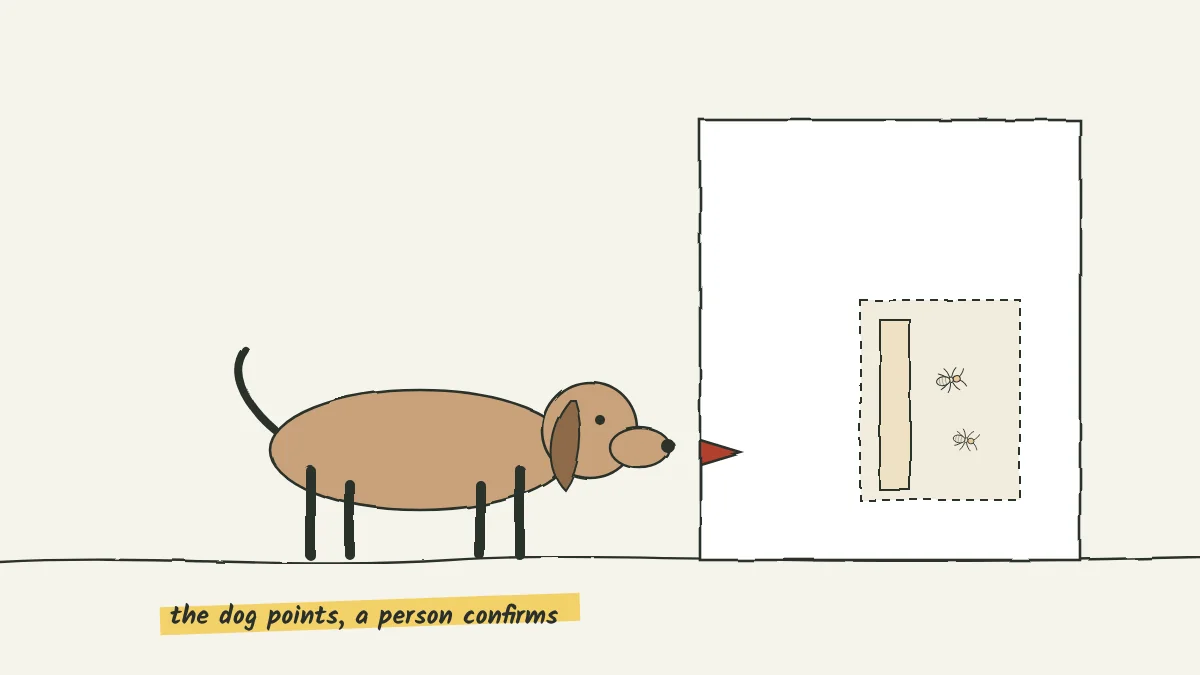
They can work well. In University of Florida tests, trained dogs found hidden termites in about 96 percent of containers and responded to empty ones less than 3 percent of the time. They were less reliable around termite-damaged wood and drywood termites. Maryland requires dog teams to pass an annual certification. A dog alert is a lead to confirm, not a finding by itself.
On this page
What the research found
The best-known tests were run by University of Florida entomologists in the early 2000s and published in the Journal of Economic Entomology, with a two-part summary in Pest Control Technology. Six dogs, a German shepherd and five beagles, were trained for three weeks to three months until they could find about 100 termite workers buried under gravel every time. Then the researchers hid containers of termites, empty containers and look-alike material, and watched which the dogs picked.
The results were strong:
- About 96 percent of containers with eastern subterranean termites were found, whether they held 160, 80 or 40 termites.
- Fewer than 3 percent of empty containers drew a false alert.
- Dogs trained on eastern subterranean termites found Formosan, dark southeastern subterranean and other species about as well.
An earlier study the researchers cited, from 1997, had reported 81 percent accuracy and a 28 percent false-positive rate with beagles. The Florida team suspected the difference came from training material contaminated with damaged wood and nest debris, and trained most of its dogs on clean termites only.
Where dogs did well, and where they didn't
From the University of Florida canine research, as reported in Pest Control Technology in 2003.
| Test | Result |
|---|---|
| Containers of live eastern subterranean termites | Found about 96 to 97 percent of the time |
| Empty containers | False alerts about 2 to 3 percent of the time |
| Other subterranean species, including Formosan | Detected about equally well |
| Drywood termites | Detected significantly less often |
| Termite-damaged wood with no live termites | False alerts about 25 percent of the time, mostly from one dog trained on mixed material |
| American cockroaches and carpenter ants | False alerts about 7 and 3 percent |
The researchers suggested a properly trained termite dog should hit at least 90 percent of real targets with no more than 10 percent false alerts. Searches were kept under 40 minutes, since performance drops after 40 to 60.
The limits that matter in a house
The damaged-wood result is the one to remember. In a real house, old damage is common, and a dog that alerts on it can point to a spot with no live termites. The researchers traced most of those false alerts to a dog trained on a mix of termites and debris, which is a reason to ask how a dog was trained.
Other limits come from the setting. Tests used one target at a time in a controlled space; a house has many smells, drafts and temperatures. The research team listed handler error, maintenance training, search time, temperature and wind among the reasons field accuracy can vary. And drywood termites, which matter in Florida, California and Hawaii, were harder for the dogs.
So the right way to use a dog is as a pointer. When a dog alerts, a human inspector should confirm with a probe, a moisture meter, a borescope or by opening a small area. Other tools that help are in termite detection tools.
Maryland certifies the teams
Most states regulate the company and the inspector, not the dog. Maryland's inspection regulation, COMAR 15.05.01.14, goes further. A canine pest detection team must be certified every year, and the test is specific:
- At least four search areas
- Two distractors and three hides in each area
- A 20-minute search limit per area
- Two evaluators, each with at least five years of documented experience
Training and certification records must be kept for two years. Elsewhere, ask the company what testing its dog team has passed and how recently. Dog work also runs through licensed companies. In a 2013 letter about bed bug detection dogs, North Carolina's agriculture department said dog-based detection must be done under the supervision of a licensed structural pest control company.
Getting the most from a dog inspection
-
Use it for what can't be seen
Finished basements, wall voids, built-ins and stored-full garages are where a dog adds most.
-
Ask about training and certification
Ask whether the dog trained on live termites only, and when it last passed a test.
-
Put your own pets away
A detection dog works best without other animals in the way.
-
Confirm every alert
An alert should lead to a closer look by a licensed inspector before anyone recommends treatment.
-
Get it in writing
Ask for the alert locations on a diagram, with what was done to confirm them.
Termite dogs
Do
- Use a dog for areas a visual inspection can't reach
- Ask how the dog was trained and certified
- Have every alert confirmed by a person
- Get alert locations on a diagram
Don't
- Treat a dog alert alone as proof of termites
- Expect a dog to replace the written inspection report
- Rely on a dog for drywood termites
- Hire a team that can't show recent testing
Questions people ask
Do termite sniffing dogs really work?
In controlled University of Florida tests, trained dogs found hidden eastern subterranean termites about 96 percent of the time and gave false alerts on empty containers less than 3 percent of the time. Field results depend on training, the handler and conditions.
Can termite dogs tell old damage from live termites?
Not always. In the Florida research, dogs gave false alerts on termite-damaged wood about 25 percent of the time, mostly from one dog trained on mixed material. Every alert should be confirmed.
Can termite dogs find drywood termites?
Less reliably. The Florida dogs detected drywood termites significantly less often than subterranean species.
Are termite detection dogs regulated?
In Maryland, yes. Dog teams must be certified every year under a specific test. In most states, the company doing the inspection is licensed but the dog isn't separately tested.
Keep reading
Termites in your state
Sources
- Pest Control Technology: Focus on termite control, top dog, part I (University of Florida researchers, January 2003)
- Pest Control Technology: Focus on termite control, top dog, part II (September 2003)
- Brooks, Oi and Koehler: Ability of canine termite detectors to locate live termites and discriminate them from non-termite material, Journal of Economic Entomology 96(4), 2003
- COMAR 15.05.01.14: Standards for inspection for pests
- NCDA&CS: Canine detection licensure letter (2013)