What Termite Inspectors Look For (and Miss)
A termite inspection looks simple from the outside: someone with a flashlight walks around your house for an hour. State rules spell out a lot more than that, including what the inspector has to check, what counts as a warning sign, and what they're allowed to skip. Knowing the checklist helps you get a better inspection, and read the report more carefully.
The short version
Inspectors look for termites and their evidence: mud tubes, damaged wood, swarmer wings, droppings, kick-out holes and suspicious patching. They also note conducive conditions like wood touching soil, excess moisture and cellulose debris. They inspect only visible, accessible areas, so stored boxes, finished walls and low crawlspaces become "inaccessible" on the report.
On this page
The tools
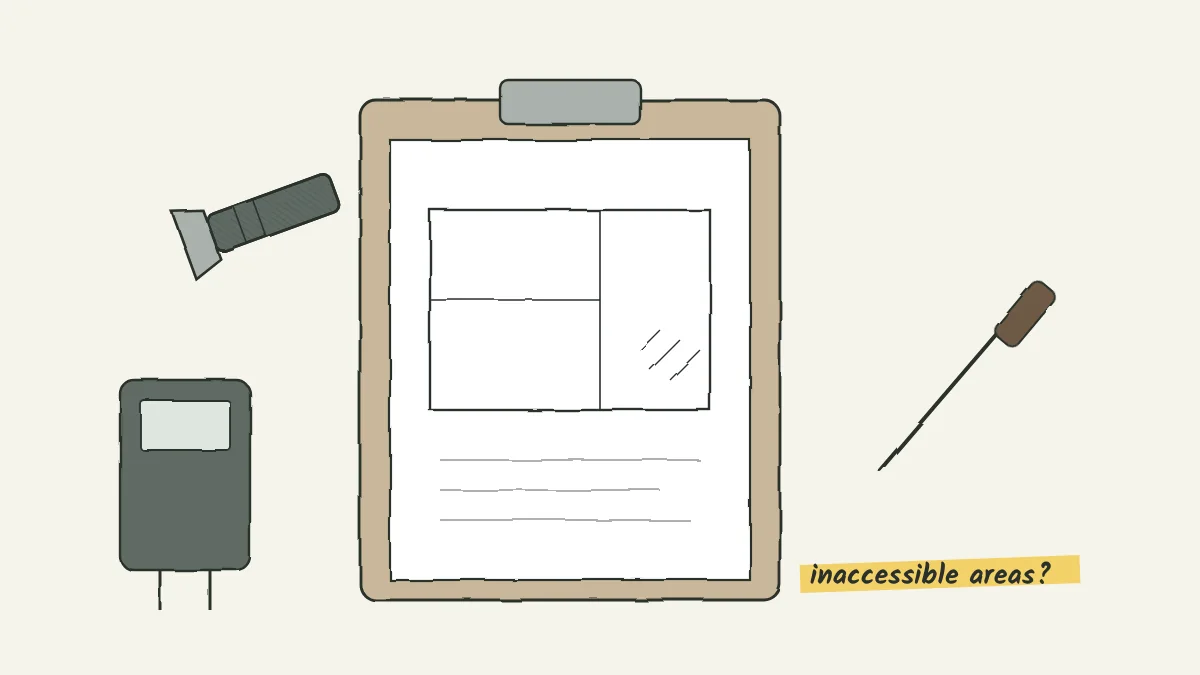
Inspection is mostly eyes and hands. Hawaii's termite inspection standards set the minimum kit: a flashlight, a probe such as an ice pick to confirm damage, and supplies to diagram the structure. A moisture meter earns its place too, since some states treat wet wood as a reportable condition; North Carolina's report, for example, flags wood at 20 percent moisture or more.
Probing and tapping are allowed; tearing things open isn't. Arizona's rule permits non-destructive probing and sounding, and Hawaii's standards call for tapping and probing wood that needs a closer look. Destructive testing, like cutting into a wall, isn't part of a standard inspection.
The signs inspectors look for
Drawn from Hawaii's inspection standards, North Carolina's wood-destroying insect report guidance and Arizona's inspection rule.
| Sign | What it suggests |
|---|---|
| Mud tubes | Subterranean termites traveling between soil and wood |
| Damaged or hollow-sounding wood | Feeding inside the wood, found by tapping and probing |
| Swarmer wings or bodies | A colony nearby; inside the house, a colony in or under it |
| Fecal pellets | Drywood termites in the wood above |
| Kick-out holes | Openings drywood termites use to push out pellets |
| Patching or cosmetic repairs to wood | Possible covered-over damage worth a closer look |
| Past treatment evidence | Drill holes, bait stations or records of a previous job |
Inspectors also look for other wood-destroying insects. North Carolina's report commonly notes powderpost beetles, old house borers and carpenter ants.
Where they look
State rules make the route predictable. Hawaii's standards walk the inspector through the exterior, the crawlspace if accessible, the interior including baseboards and door and window frames, and the attic if accessible, with every finding located on a diagram. North Carolina's report includes permanently attached decks, porches and storage sheds, but detached outbuildings only if you ask. Arizona's rule requires the inspector to check any area with evidence of termites and any area with a conducive condition.
Before starting, Hawaii's inspectors ask the owner for any termite history or treatment records, and in a sale they ask for the seller's disclosure statement. Have yours ready. A past treatment that left drill holes in the patio isn't alarming if you can show the paperwork.
The inspector's basic kit
As an Amazon Associate I earn from qualifying purchases.
-
View on Amazon
Bright LED flashlight, 1,000+ lumens
The one tool that really matters. A tight, bright beam shows mud tube texture and wing piles in dark corners.
-
View on Amazon
Awl or flat-head screwdriver
Press it into suspect wood. Healthy wood fights back. Eaten wood gives way like a stale cracker.
-
View on Amazon
Pin-type wood moisture meter
Wood that reads above about 20% is wet enough to invite rot and termites. Great for sills and subfloors.
Conducive conditions
Half of a good report is about the house, not the termites. Conducive conditions are what make an infestation more likely, and state report forms ask inspectors to note them:
- Wood touching soil: siding, steps, posts or form boards in the dirt
- Excess moisture: leaks, wet crawlspaces, water against the foundation
- Cellulose debris: scrap wood and cardboard under the house
- Faulty grade: soil too close to the top of the foundation or the framing
- Poor crawlspace access: Arizona treats crawlspace areas with less than 24 inches of clearance as a conducive condition
Nevada's rule goes furthest, defining several of these with exact numbers; see the Nevada termite page. These notes are a free repair list. Fixing them is cheap and makes termites less likely. See what attracts termites.
What inspectors miss, and why
Inspections cover what can be seen and reached on one day. Hawaii's report form lists the usual blind spots: fixed ceilings, double walls, stored belongings, hidden joists or rafters, areas under or behind floor and wall coverings, cabinets, furniture, appliances and crawlspaces less than 24 inches high. Arizona lets inspectors exclude areas behind permanent coverings or built-ins, or that would require moving furniture or damaging finishes, but the report has to list each one with the reason.
That's why the "inaccessible areas" section matters as much as the findings. A clean report with half the garage blocked is a clean report on half the garage. No report is a warranty: Hawaii's form says it isn't a guarantee that termites are absent and gives no opinion on structural integrity or repair costs.
Help the inspector help you
-
Clear the walls
Pull boxes and furniture a couple of feet from garage and basement walls.
-
Open the hatches
Make sure the crawlspace and attic hatches open, with a clear path to each.
-
Have the history ready
Previous treatment contracts, bait station records and repair invoices.
-
Don't cover anything up
Fresh paint or patching right before an inspection gets noted, not ignored.
-
Walk along
Ask to be shown anything they find, and ask what they couldn't reach.
During a termite inspection
Do
- Clear access to crawlspaces, attics and garage walls
- Share past treatment records
- Ask for a diagram of findings
- Read the inaccessible areas section closely
Don't
- Patch or paint suspicious wood right before the visit
- Expect the inspector to open walls
- Assume a clean report covers areas they couldn't see
- Ignore the conducive conditions list
Questions people ask
What do termite inspectors look for?
Evidence of termites, such as mud tubes, damaged or hollow wood, wings, droppings and kick-out holes, plus conditions that invite them, like wood touching soil, excess moisture and debris under the house. They also note areas they couldn't inspect.
What tools do termite inspectors use?
At minimum a flashlight, a probe such as an ice pick and a way to diagram the house, under Hawaii's standards. A moisture meter helps where wet wood is a reportable condition.
What can't a termite inspector see?
Anything hidden or blocked: inside finished walls and ceilings, under floor coverings, behind stored items and appliances, and crawlspaces too low to enter. The report should list each area that wasn't inspected.
Will an inspector open walls to look for termites?
Not in a standard inspection. State rules allow non-destructive probing and tapping, and destructive testing is a separate step if evidence calls for it.
Keep reading
Termites in your state
Sources
- Hawaii Administrative Rules 16-94-73: Termite inspection standards
- Hawaii Pest Control Board: Termite Inspection Report form PC-9
- Arizona Administrative Code R3-8-307: Performing a wood-destroying insect inspection; WDIIRs
- NCDA&CS: Homeowner's guide to the wood destroying insect report
- Nevada Department of Agriculture: Structural pest control (C3) study manual (2014)