Termite Detection Tools: Moisture Meters, Thermal Cameras, Radar
A thermal camera looks like magic in an ad. In a wall full of drywood termites, it mostly sees a wall. Here's what each detection gadget actually does, what the University of California found when it tested them, and the cheap tools worth owning yourself.
The short version
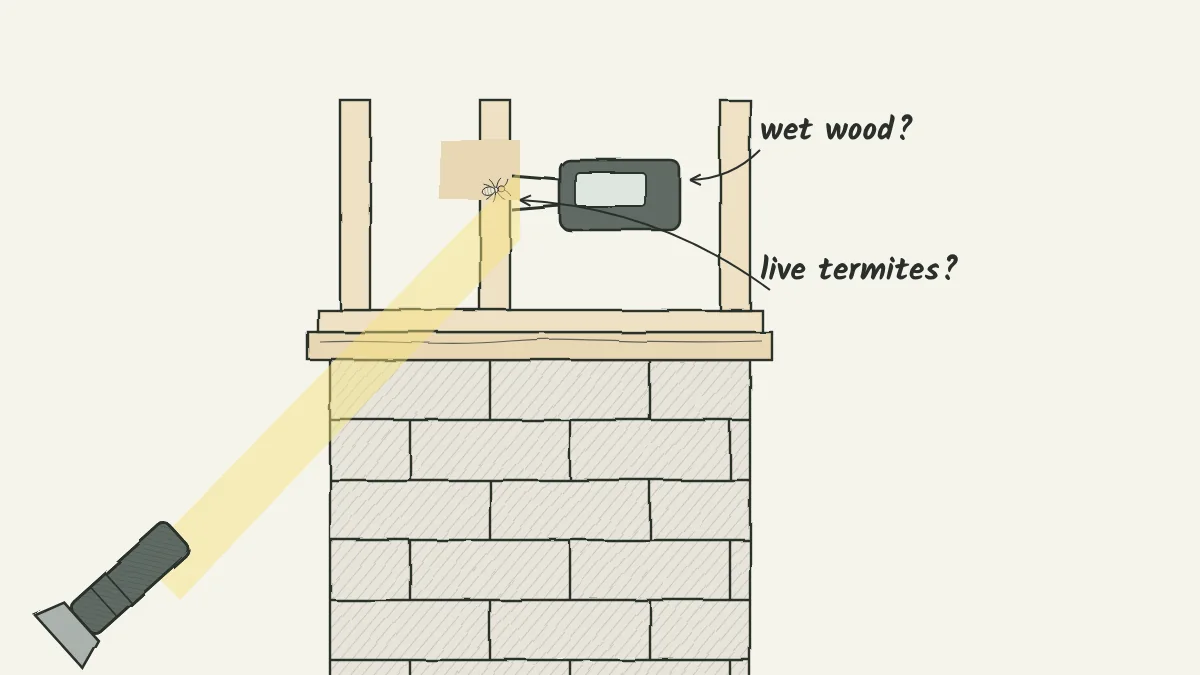
No gadget reliably finds termites hiding behind walls. In University of California tests, thermal cameras couldn't tell live termites from old damage, while acoustic and microwave sensors confirmed activity in boards they could reach. A moisture meter finds the damp wood termites like. The most reliable tool is still an experienced inspector allowed to open walls.
On this page
Why termites are hard to find
Termites spend their lives hidden. Subterranean termites travel in soil and mud tubes; drywood termites live sealed inside the wood. UC IPM says visual inspection is still the mainstay of the industry, and that drywood colonies can be so hard to see that finding them may mean removing wall coverings, paneling or stucco.
That's the problem every detection tool is trying to solve: telling you what's going on inside wood or a wall without tearing it open. The best evidence on how well they do it comes from a set of studies the University of California ran for California's Structural Pest Control Board, led by UC Berkeley entomologist Vernard Lewis. The team tested devices in a purpose-built, termite-infested test structure and in real buildings.
Detection tools, what they sense and how they did
A summary of the UC Berkeley findings for the California Structural Pest Control Board, with other studies the report cited. "Board" means a single piece of wood the device was aimed at.
| Tool | What it senses | What the research found | Main limits |
|---|---|---|---|
| Visual inspection | Pellets, tubes, wings, damage | Still the industry's mainstay | Can't see inside walls |
| Borescope | A camera on a thin tube pushed into a wall void | At least 90% accurate in the lab; 36% to 79% by inspector in real wall voids, and small amounts of pellets were missed more than half the time | Needs a hole; insulation and tight voids block the view |
| Thermal (infrared) camera | Surface temperature differences | Couldn't tell whether boards were active or just damaged, even after heating; knots, paint and chips created false patterns | Shows temperature, not termites |
| Acoustic sensor | The sound of termites chewing | Every board it called active was confirmed when cut open | Wall coverings get in the way; noise causes false alarms |
| Microwave motion sensor | Movement inside the wood | Reliable on active boards it could reach | Covers only a few square inches; wind, water and footsteps cause false readings |
| X-ray | Galleries and termites inside wood | The only device that showed both damage and live termites in the test structure | Slow, costly, best on exposed boards |
| Detection dog | Smell | A Florida lab study cited 88.8% correct on drywood termites in containers; mixed results on subterranean termites in California | Not tested on California drywood in houses |
| Electronic nose | Gases termites give off | 20% to 100% detection of subterranean termites in a cited study; no reported success with drywood | Not widely used |
Sources: Lewis et al., Assessment of devices and techniques for improving inspection, UC Berkeley for the California Structural Pest Control Board, and the project's executive summary.
Thermal cameras: the most oversold tool
Infrared cameras are popular because the pictures are dramatic. They measure the temperature of a surface, so they can show a wet spot, a missing patch of insulation or a cold draft. Termite colonies can be associated with moisture, which is why a thermal image sometimes points somewhere interesting.
But in the UC Berkeley tests, the camera couldn't tell active boards from damaged ones, even after the researchers heated the boards to make differences show. Patterns that looked like damage often turned out to be knots, paint or chips. A thermal camera is a reasonable way to find moisture problems. It isn't a termite detector, and an inspection sold on the camera alone is selling the picture.
Microwave "radar" and acoustic sensors
The tools that did best in the research listen or feel for termites rather than look for them.
- Acoustic emission sensors pick up the tiny sounds of termites chewing. In the UC study, every board the sensor flagged as active was confirmed when the board was cut open. Earlier research the report cited put the detection range at about 80 centimeters along a board but less than 8 centimeters across the grain.
- Microwave motion sensors, often called termite radar and sold under names like Termatrac, sense movement inside wood. They were also reliable on active boards, but the UC team found they covered only a patch about 5 by 6.5 centimeters, about 3.5 centimeters deep, and wind, water and foot traffic could trigger false readings.
Both are good at answering "is this board active?" Neither scans a whole wall. The UC team's best electronic approach was a two-step one: confirm activity with an acoustic sensor, then map the galleries with a microwave sensor held steady on a tripod. That's most useful for planning a local drywood treatment, where knowing exactly which boards are infested decides whether local work can succeed.
Moisture meters: the homeowner's best gadget
A pin-type wood moisture meter doesn't find termites. It finds wet wood, and wet wood is where subterranean termites, dampwood termites and rot all start. That makes it the most useful gadget you can own for your own walk-through.
The readings mean something. Decay fungi need wood near 30 percent moisture to get going, and wood scientists at the USDA Forest Products Laboratory use 20 percent as the line below which wood is safe. A sill or subfloor reading in the 20s or above is your cue to hunt for a leak, a grading problem or condensation, termites or not.
How to use one: push the pins into the wood along the grain, compare a suspect spot with a dry spot nearby, and check sills, subfloor under bathrooms and kitchens, and wood near downspouts. For how to read what you find, see termite damage vs water damage.
Tools worth owning
As an Amazon Associate I earn from qualifying purchases.
-
View on Amazon
Bright LED flashlight, 1,000+ lumens
The one tool that really matters. A tight, bright beam shows mud tube texture and wing piles in dark corners.
-
View on Amazon
Pin-type wood moisture meter
Wood that reads above about 20% is wet enough to invite rot and termites. Great for sills and subfloors.
-
View on Amazon
Awl or flat-head screwdriver
Press it into suspect wood. Healthy wood fights back. Eaten wood gives way like a stale cracker.
-
10x magnifying loupe
Tells a six-sided drywood pellet from sawdust, and a termite wing from an ant wing.
The cheap tools that still win
For a homeowner, the best detection kit costs less than one infrared inspection:
- A bright flashlight to follow mud tubes and spot pellets and wings in dark corners.
- An awl or a flat screwdriver to probe wood. Sound wood resists. Eaten or rotted wood gives way.
- A magnifying loupe to tell six-sided drywood pellets from sawdust and dirt.
- A moisture meter to find the damp wood that invites trouble.
Those four, plus an hour in the crawlspace or garage, find most of what you need to know before calling anyone. The method is in how to inspect for termites, and what each clue means is in signs of termites.
When a company sells you on technology
Do
- Ask what the device actually detects: heat, moisture, sound or movement
- Ask how the inspector confirms a reading before recommending treatment
- Get the inspection report to list areas that weren't inspected
- Use your own moisture meter and screwdriver between inspections
Don't
- Pay extra for a thermal image as proof of termites
- Accept a whole-wall diagnosis from a device that reads a few square inches
- Skip opening a suspect wall when the stakes are high
- Assume a clean scan means a clean house
Questions people ask
Can a thermal camera detect termites?
Not reliably. A thermal camera shows surface temperature, so it can point to moisture or missing insulation. In University of California tests, infrared couldn't tell active termite boards from damaged ones, and knots and paint created misleading patterns.
What is the most accurate termite detection tool?
In UC Berkeley's tests, X-ray was the only device that showed both damage and live termites, but it's slow and costly. Acoustic and microwave sensors reliably confirmed activity in boards they could reach. The researchers' top choice was still an experienced inspector allowed to open walls.
Is a moisture meter useful for finding termites?
It finds wet wood, not termites, but wet wood attracts subterranean and dampwood termites and rot. Readings in the 20s or higher on sills and subfloors are worth investigating for a leak or drainage problem.
Do termite sniffing dogs work?
A Florida lab study cited by UC researchers found dogs identified drywood termites in containers 88.8 percent of the time, but results on subterranean termites in California were mixed, and dogs haven't been tested on California drywood termites in houses.
Keep reading
Termites in your state
Sources
- UC Berkeley for the Structural Pest Control Board: Assessment of devices and techniques for improving inspection of drywood termite infestations
- UC Berkeley: Detection methods executive summary
- UC IPM Pest Notes: Drywood termites (Publication 7440)
- Morris and Winandy, USDA Forest Products Laboratory: Limiting conditions for decay in wood systems (2002)