How Fast Can Termites Damage a House?
Finding termites can feel like an emergency. It almost never is. Termite damage builds over months and years, not days, which is good news twice: you have time to make a careful decision, and a house that's inspected regularly rarely gets far enough along to be in real trouble.
The short version
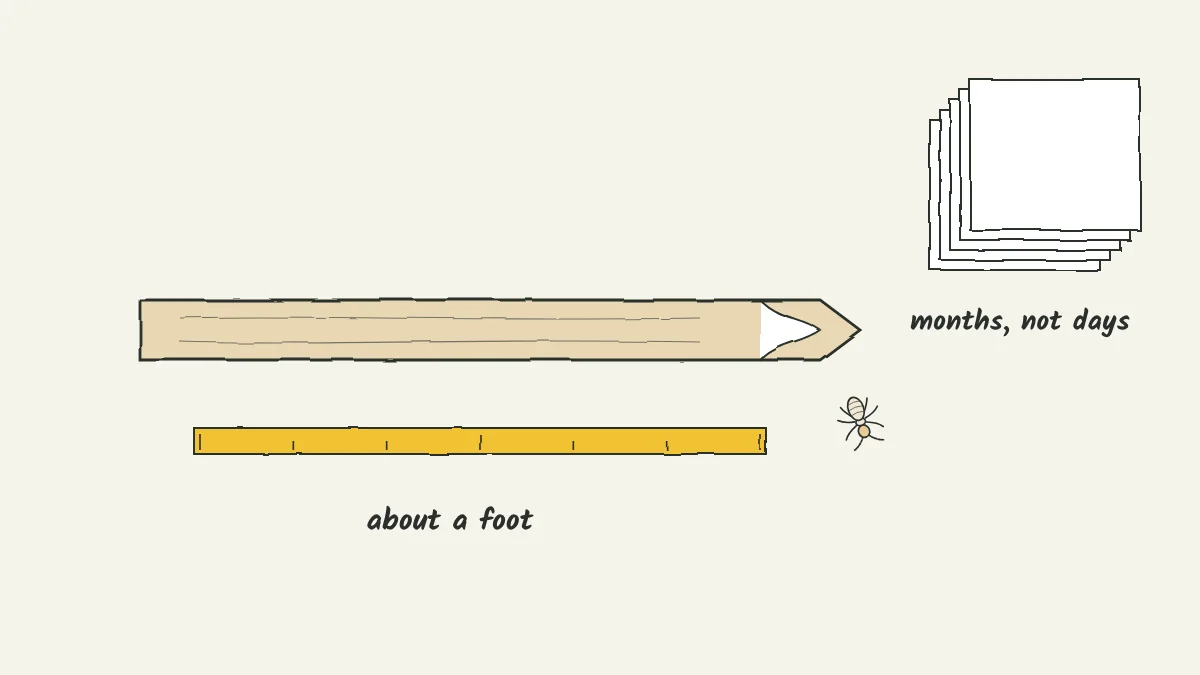
Slowly. NC State Extension estimates that a colony of about 60,000 eastern subterranean termites can eat a foot of 2x4 in about five months, and an average mature colony is around 300,000. Serious structural damage usually takes years. Formosan colonies are far bigger and work faster. You have time to get several inspections and quotes before treating.
On this page
The numbers behind "slowly"
The best single figure comes from NC State Extension: a colony of about 60,000 eastern subterranean termites can eat one foot of a 2x4 in about five months. NC State puts an average mature colony at roughly 300,000 termites, with some reaching several million, so a big colony eats proportionally more. Even so, that's a pace measured in months per board, not hours.
Several other extension services say the same thing in words. The University of Kentucky says termites damage wood slowly. Penn State says termite damage "is not a sudden onslaught" that will bring down a building in a few days, and that problems usually show up 10 years or more after a house is built. Iowa State says termites work slowly in Iowa's climate and are largely inactive in winter.
Termite timelines from extension research
Figures from NC State, UF/IFAS, UT Extension and Penn State. They describe typical colonies, not your house.
| Measure | Figure | Source |
|---|---|---|
| Wood eaten by a colony of 60,000 | About 1 foot of 2x4 in 5 months | NC State Extension |
| Average mature eastern subterranean colony | About 300,000 termites | NC State Extension |
| Age before a colony produces swarmers | Usually more than 3 years | UT Extension |
| Formosan colony size | Several million | UF/IFAS |
| Formosan colony maturity | 5 to 8 years | UF/IFAS |
| Mud tube building speed | About 2.5 inches per hour | North Carolina agriculture department |
| When problems typically appear in a new house | 10 years or more after construction | Penn State Extension |
Tube building is fast; eating is slow. That's why a tube can appear between inspections while the damage behind it is still minor.
What speeds it up
Not every house sees the same pace. A few things make damage build faster:
- Species. Formosan termites live in colonies of several million, according to UF/IFAS, and can do more damage in less time than native colonies. That's why Gulf Coast cities treat them differently. See Formosan termites.
- Moisture. Wet wood and wet soil keep termites active and close. Leaks speed everything up.
- Season. Cold slows termites down. Iowa State notes they're largely inactive in winter there, so the feeding season is shorter in the North.
- Time undetected. The biggest factor of all. Kentucky notes infestations can go undetected for years, and damage keeps adding up the whole time.
Why damage seems to appear overnight
If termites are slow, why do people find so much damage at once? Because they find it late. Subterranean termites work inside wood and behind walls, and Kentucky says infestations can go unnoticed for years. Iowa State adds that there's no way to tell how long termites have been active in an area, and Texas A&M says the age of wood damage can't be judged just by looking.
So when a remodel opens a wall and reveals hollow studs, that damage may represent several seasons of feeding. The termites weren't fast. They were hidden. Regular inspections are the fix: see how often should you get a termite inspection.
What this means for you
Slow damage gives you room to make good decisions:
- Don't sign on the spot. Iowa State says there's no need to panic or rush, and recommends at least three opinions and estimates. Kentucky warns against companies that use pressure or scare tactics.
- Don't wait a year either. Slow isn't stopped. Get inspections within a few weeks and treat once you've compared options.
- Look at what's already damaged. If wood is structural, have a contractor look at it. Costs are in termite damage repair cost.
The questions that make quotes comparable are in questions to ask a termite company.
You just found termites
Do
- Get at least three inspections and quotes
- Ask each inspector what areas are damaged and how badly
- Fix leaks that are feeding the colony
- Schedule treatment within weeks, not months
Don't
- Sign the same day under pressure
- Assume the damage happened recently
- Spray the termites you can see and call it done
- Leave known termites untreated for another season
Questions people ask
How fast do termites damage a house?
Slowly. NC State Extension estimates that a colony of about 60,000 termites eats a foot of 2x4 in about five months. Serious structural damage usually takes years, which is why it's often found late rather than fast.
Can termites destroy a house?
Over many years without treatment, termites can cause serious structural damage. Penn State notes it isn't a sudden onslaught that brings down a building in days, and regular inspections usually catch infestations long before that.
How long have termites been in my house?
There's no reliable way to tell. Iowa State says there's no method to determine how long termites have been active, and Texas A&M notes the age of damage can't be judged by looking at it.
Do I need to treat termites immediately?
Soon, but not today. Extension entomologists recommend getting several inspections and quotes first. Treating within a few weeks is reasonable for most homes.
Keep reading
Termites in your state
Sources
- NC State Extension: Biology and behavior of eastern subterranean termites (2025)
- University of Kentucky Entomology: Termite control, answers for homeowners (EF604, 2018)
- Penn State Extension: Eastern subterranean termites
- Iowa State University Extension: Termites
- UF/IFAS EDIS IN278: Formosan subterranean termite (2025)
- UT Extension PB1344: Subterranean termite control
- NCDA&CS: Homeowner's guide to the wood destroying insect report
- Texas A&M AgriLife Extension: Subterranean termites (E-368)