Termites in Washington, D.C.: Rowhouses, the Capitol and District Rules
If termites can get into the U.S. Capitol, they can get into a Capitol Hill rowhouse. Washington's termites are native subterranean species, its housing is old, and much of it sits in historic districts with their own repair rules. Here's how those pieces fit together for a D.C. homeowner.
The short version
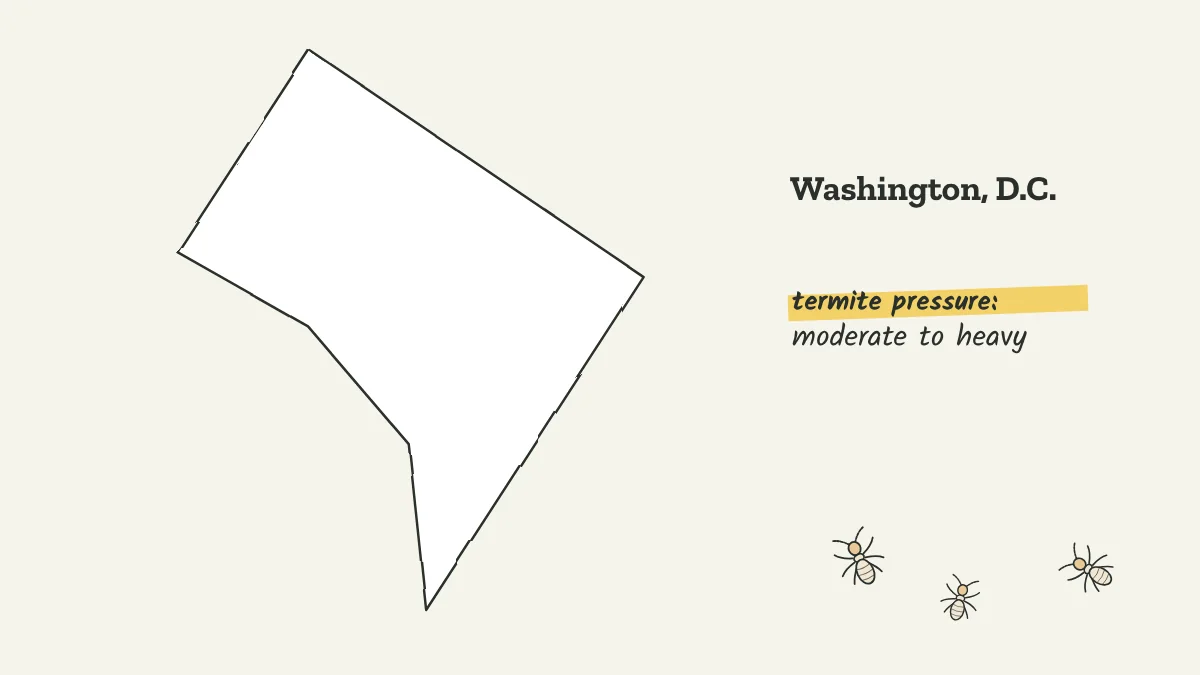
D.C.'s termites are native subterranean termites; in 2002 a native species swarmed inside the U.S. Capitol. In historic districts, D.C.'s preservation office says repair and in-kind replacement on homes can usually be approved by staff, often within a day. Pest control businesses and applicators are licensed by the Department of Energy and Environment, and VA loans require a termite report throughout the District.
Washington, D.C. at a glance
- Termite pressure
- Moderate to heavy
- Termites to know
- Eastern subterranean
- Why termites like it here
- Hot, humid summers and mild winters, with native subterranean termites and a large stock of older rowhouses.
- Who licenses pest control
-
District of Columbia Department of Energy and Environment, Pesticide Program
Check a company's license - Inspection report for home sales
- NPMA-33 Wood Destroying Insect Inspection Report
On this page
Termites in the Capitol
In February 2002, termites appeared inside the U.S. Capitol. According to the USDA Agricultural Research Service, the Capitol superintendent's office had hired a private contractor, and two treatments with a commercial termiticide hadn't stopped the swarming. The office asked ARS scientists at the Southern Regional Research Center in New Orleans for help.
ARS identified the termites as Reticulitermes virginicus, a native subterranean termite, the southeastern subterranean termite. Infested baseboards were taken out of the affected room and the perimeter was treated, and no later activity was detected. Two lessons carry over to a rowhouse: a swarm inside a heated building can come well before spring, and a repeat swarm after treatment means the job isn't finished. See do termites come back after treatment.
The termites D.C. has
The District's termites are the native subterranean termites of the Mid-Atlantic. University of Maryland Extension, which serves the region, says they live in the soil in colonies that can reach several million and use food sources more than 200 feet apart, which matters in a city of attached houses where one colony can feed under several. Swarmers about a quarter inch long are often the first sign people see, and UMD says a flight means a healthy colony is nearby. What to do next is in termites swarming in your house.
When termites swarm in Washington
Native swarms are mostly a spring event. The Capitol's swarm came in February, inside a heated building.
| Termite | J | F | M | A | M | J | J | A | S | O | N | D |
|---|---|---|---|---|---|---|---|---|---|---|---|---|
| Eastern subterranean Daytime, often after a warm rain | some swarms | peak | peak | common | some swarms |
Rowhouse repairs in a historic district
Much of D.C.'s older housing sits in historic districts, and termite repairs often touch exterior wood: porches, window frames, cornices, steps. The District's Historic Preservation Office makes the routine work easy:
- No permit or preservation review for ordinary repairs such as reattaching or tightening loose materials, for painting, or for window repairs like reglazing, weather-stripping and consolidating deteriorated elements.
- Interior alterations need a building permit but aren't subject to preservation review, unless the interior itself is designated.
- Repair and in-kind replacement that does need a permit can typically be approved by preservation staff, often within a day, according to a District preservation FAQ.
On a rowhouse front, changes are generally limited to repair, in-kind replacement or minor work, and wood windows are expected on street-visible elevations. So if termites have eaten a front window frame or porch floor, plan to replace it to match. How to judge what can be saved is in termite damage repair.
Who licenses termite work
Pest control in the District is licensed by the Department of Energy and Environment's Pesticide Program. Any business that advertises or performs pest control needs a District business license approved by the program, liability insurance, and a District resident agent if it's based elsewhere. Applicators qualify by exam or by reciprocity with a neighboring state's certification, and must carry a District-issued photo ID card when applying pesticides; the program says applying without it makes the application illegal. Ask to see the card. The Pesticide Program's number is (202) 535-2600. More in how to check a pest control license.
Buying in the District
VA loans require a wood-destroying insect report throughout Washington, D.C., and many buyers order one regardless of loan type. The District uses the national NPMA-33 form. Read the inaccessible areas closely: party walls, finished basements and stored belongings are common blind spots in a rowhouse. See WDI inspection and NPMA-33.
For D.C. homeowners
Do
- Treat an indoor swarm as a reason for an inspection, any month
- Ask neighbors in attached houses whether they've treated
- Check the preservation rules before exterior repairs
- Ask the applicator for the District ID card
Don't
- Assume winter means no termites in a heated house
- Replace a historic front window with a different material without approval
- Ignore repeat swarms after a treatment
- Close on a rowhouse without reading the inaccessible areas
Questions people ask
Are there termites in Washington, D.C.?
Yes, native subterranean termites. In 2002 a native species, the southeastern subterranean termite, swarmed inside the U.S. Capitol, according to the USDA Agricultural Research Service.
Do I need approval to repair termite damage in a D.C. historic district?
Ordinary repairs and window repairs need no permit or preservation review. Repair and in-kind replacement that needs a permit can usually be approved by preservation staff, often within a day.
Who licenses termite companies in D.C.?
The Department of Energy and Environment's Pesticide Program. Applicators must carry a District photo ID card when applying pesticides. The program's number is (202) 535-2600.
Is a termite inspection required to buy a house in D.C.?
VA loans require one throughout the District. Other loans depend on the lender, and many buyers order one anyway.
Keep reading
Sources
- USDA Agricultural Research Service: Scientists take on termites at the Capitol (2002)
- University of Maryland Extension: Eastern subterranean termite (2024)
- University of Maryland Extension via Ask Extension: Termite swarm question (2022)
- D.C. Office of Planning: Work not requiring a building permit or preservation review
- Capitol Hill Restoration Society: FAQs on historic districts (D.C. Historic Preservation Office, 2014)
- D.C. Department of Energy and Environment: Pesticide licensing
- Veterans United: VA termite and pest inspections (updated 2026)