Do Termites Come Back After Treatment?
A termite treatment kills termites and protects the house for a while. It doesn't make the house permanently termite-proof, because the soil around it is full of other colonies. Here's why termites come back, how to tell a real return from leftovers, and what the rules in several states say a company has to do about it.
The short version
Yes, they can. Neighboring colonies can move in when a treatment wears off or has a gap, soil work can break a liquid barrier, and bait systems stop protecting when monitoring stops. Several states build in protection: Tennessee contracts include annual inspections and retreatment of new activity, and Georgia requires a full retreatment after repeated infestations. Keep the annual inspection.
On this page
Why termites come back
A treatment works on the colonies it reaches and the soil it protects. The soil around a house has other colonies, and they don't know the house was treated. University of Kentucky's Michael Potter notes that termites from neighboring colonies can move back in, which is why bait systems need ongoing checks even after an infestation is eliminated. Texas A&M makes the same point from the other direction: colonies eliminated by baits are replaced by new colonies from the surrounding soil.
The usual reasons a return happens:
- The barrier aged. Texas A&M's testing found registered termiticides last roughly four to ten years in soil. NC State's Formosan update flags newer houses whose original pretreatment is roughly a decade old as more likely to be invaded.
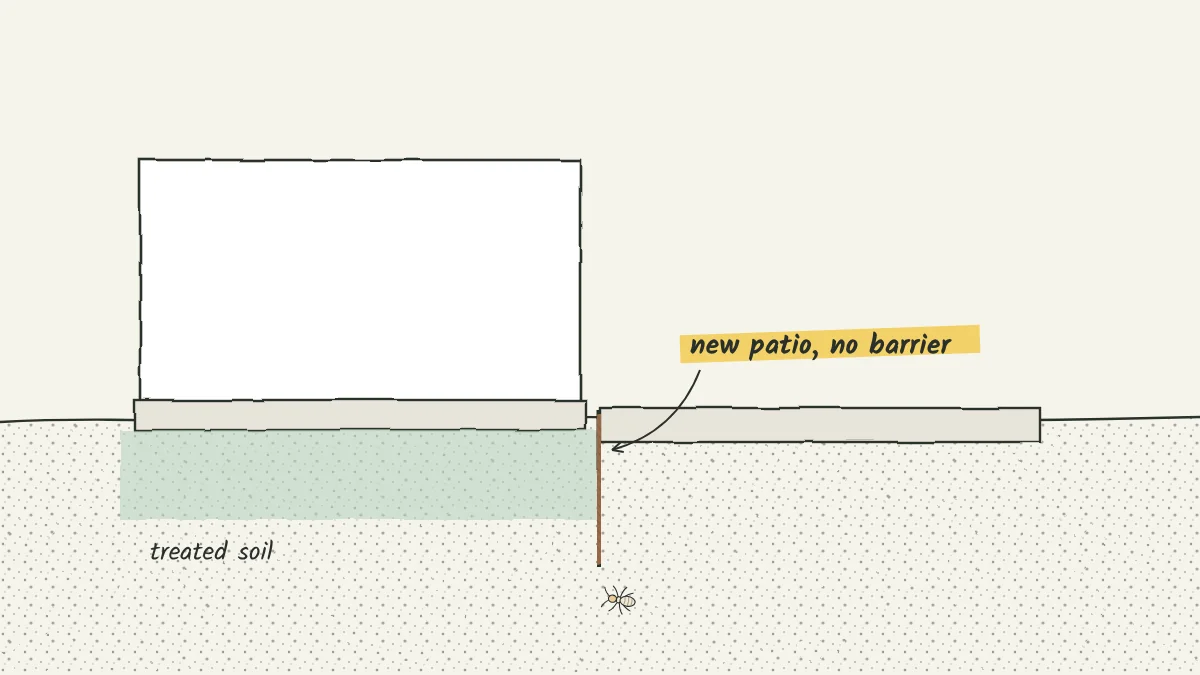
- The barrier was broken. New patios, additions, landscaping, utility trenches and regrading move or cover treated soil. Florida's building code requires retreatment of soil disturbed after construction for this reason.
- The treatment had gaps. Areas a company couldn't reach, such as a shallow crawlspace or a slab it didn't drill, can be left out. In Georgia and North Carolina those gaps have to be written on an official waiver.
- Bait monitoring stopped. Kentucky warns that baits leave no residual pesticide in the soil, so letting the renewal lapse leaves the house unprotected.
Is it a return, or leftovers?
Not every termite sighting after treatment is a failure. These clues help sort it out before you call the company.
| What you see | What it may mean | What to do |
|---|---|---|
| Old mud tubes, dry and crumbly | Leftovers from before treatment | Scrape them off and watch for rebuilding |
| A rebuilt or fresh, moist tube | Active termites getting through | Call the company for an inspection |
| Swarmers from the same spot soon after treatment | Possibly termites already inside the wood when it was treated | Report it and ask for an inspection |
| Swarmers or tubes in a new area, years later | Likely a new infestation | Retreatment under your contract, or a new treatment |
| Activity at a new patio, addition or regraded bed | Barrier disturbed by soil work | Ask about spot retreatment of the disturbed area |
Slow-acting non-repellent liquids and baits take time. Rutgers says liquid treatments may eliminate colonies within one or two months, and baits can take a few months.
What the rules say happens next
State rules treat a return differently, and your contract matters most. A few examples from states we've covered:
- Tennessee requires every termite contract to include at least a one-year retreatment warranty and an annual inspection of contracted properties. If new activity shows up, the company must treat it and draw a new graph.
- Georgia requires a complete retreatment when three or more separate active subterranean termite areas turn up within five years, and the state can order retreatment within five years if a soil treatment didn't meet the standards in effect.
- New Jersey allows a liquid retreatment only after five years, unless there's a reinfestation or the barrier was disturbed, so a genuine return is the exception to the rule.
- North Carolina gives companies 30 days to correct a treatment the state finds deficient after a complaint.
If your contract is retreatment-only, the company retreats and repairs are yours; if it includes repair, check its limit. See repair vs retreatment warranties.
If termites come back
-
Photograph it
Take pictures of the tubes, swarmers or damage, with the date.
-
Check your contract
Find the warranty terms, the renewal date and whether repair is covered.
-
Call the company first
Ask for an inspection under the contract and read what it says about retreating new activity.
-
Ask what changed
Was there soil work, a leak or a new structure? The answer tells you whether the barrier was broken or bypassed.
-
Escalate if needed
If a company won't honor a current contract, your state agency can investigate. See how to file a complaint.
After a termite treatment
Do
- Keep the annual inspection and the contract renewal
- Tell the company before pouring concrete or regrading near the house
- Scrape off old tubes so new ones stand out
- Fix leaks that keep soil wet at the foundation
Don't
- Let a bait contract lapse without another plan
- Assume one swarm right after treatment means failure
- Pile new soil or mulch over the treated zone
- Pay for a new treatment if a current contract covers it
Questions people ask
Do termites come back after treatment?
They can. Neighboring colonies move in when a treatment ages, has gaps or is disturbed by soil work, and baits stop protecting when monitoring stops. Annual inspections catch returns early.
Why do I still see termites after treatment?
Old, dry tubes are often leftovers from before treatment, and slow-acting products take weeks to months to work. Fresh, rebuilt tubes or activity in new areas mean termites are getting through and the company should inspect.
How long before termites come back after treatment?
There's no set time. Liquid termiticides last roughly four to ten years in soil, according to Texas A&M, but soil work or gaps can let termites in sooner.
Will the company retreat for free if termites come back?
If your contract is current and covers retreatment, it should. Tennessee, for example, requires termite contracts to include at least a one-year retreatment warranty and annual inspections.
Keep reading
Termites in your state
Sources
- University of Kentucky Entomology: Termite baits, a guide for homeowners (EF639, revised 2026)
- University of Kentucky Entomology: Termite control, answers for homeowners (EF604, 2018)
- Texas A&M AgriLife Extension: Frequently asked questions about subterranean termite control
- NC State Extension: Update on Formosan termites in NC (2018)
- Rutgers Cooperative Extension FS338: Termites (2019)
- Tennessee Rule 0080-09-04-.08: Requirements of specific categories and pesticides
- Georgia Department of Agriculture: 2014 WDO rule changes
- New Jersey Administrative Code 7:30-10.4: Restrictions on use of termiticides
- NCDA&CS: Structural investigation and complaint guide
- Charlotte County, Florida: Termite protection, Florida Building Code Residential (2023 edition)