Termites in West Virginia: The State's Treatment Standards
West Virginia has a rule that spells out what a proper termite treatment is: how deep to treat, how far apart to drill and what to write down before the work starts. Many rural West Virginia homes also have private wells, and the rule has a section just for them. Here's what the standards say and how to use them when you hire a company.
The short version
West Virginia's termite is the eastern subterranean termite, which swarms in spring. The state's Wood Destroying Insect Treatment Standards require a certified applicator to prepare a treatment graph and specifications before any termite job, record wells within 100 feet, follow minimum treatment depths and spacing, and label anything less as a partial treatment. Termite firms are licensed by the West Virginia Department of Agriculture under Category 8B.
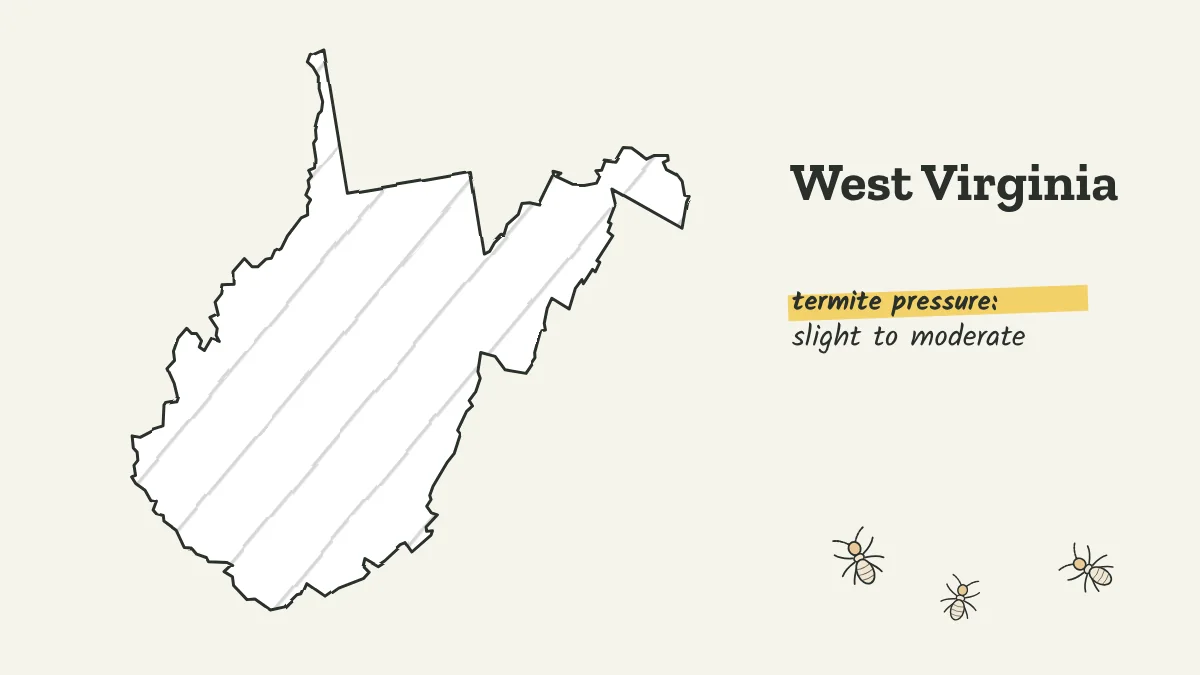
West Virginia at a glance
- Termite pressure
- Slight to moderate
- Termites to know
- Eastern subterranean
- Why termites like it here
- Humid and mountainous, with cold winters, warm summers, subterranean termites statewide and many homes on private wells.
- Who licenses pest control
-
West Virginia Department of Agriculture, Pesticide Regulatory Programs
Check a company's license - Inspection report for home sales
- NPMA-33 Wood Destroying Insect Inspection Report
On this page
West Virginia's termite
The eastern subterranean termite lives in the soil statewide and reaches wood through mud tubes. It swarms in spring, usually on a warm day after rain, and swarmers inside the house point to a colony in or under it. Indoor swarmers can't damage wood themselves; the colony behind them can. See signs of termites.
When termites swarm in West Virginia
Eastern subterranean termites swarm in spring, usually on a warm day after rain.
| Termite | J | F | M | A | M | J | J | A | S | O | N | D |
|---|---|---|---|---|---|---|---|---|---|---|---|---|
| Eastern subterranean Daytime, often after a warm rain | some swarms | peak | peak | common | some swarms |
The graph comes first
West Virginia's rule, W. Va. Code R. 61-12C, in effect since 1992, requires every termite treatment to be documented before treatment with a graph and specifications prepared by a certified commercial applicator. The documentation covers nine items: the address, the person ordering the work, the supervising certified applicator, the target pests, product names and quantities, a diagram showing where pesticides will go along with hazards like wells and the infestation sites, special safety precautions, the names of the applicators and the dates.
The rule also requires termiticides registered with both the EPA and the state, mixed and used by the label, with equipment kept in sound working condition. It even bans using an air compressor to pressurize holding tanks. Ask for the graph before work starts; it's your best record of what you're paying for.
West Virginia's minimum treatment standards
For existing structures, from W. Va. Code R. 61-12C-4.
| Situation | Minimum standard |
|---|---|
| Basement, poured concrete, outside | Treat soil at least 1 foot below grade around the whole structure |
| Hollow block walls | At least 1 gallon of diluted product per 5 linear feet, unless the label says otherwise |
| Slabs next to the house and basement floors | Drill no more than 18 inches apart, within 18 inches of the wall |
| Slab-on-ground, outside | Trench or rod to the top of the footer, no deeper than 30 inches |
| Crawlspace | Rake out cellulose debris and remove mud tubes before treating |
A treatment that doesn't meet these minimums must be labeled a partial treatment. See liquid termite treatment.
Partial treatments
Section 4.2 of the rule is the one to know when comparing bids. If a guarantee implies complete control, the minimum procedures apply. Anything less must be labeled "PARTIAL TREATMENTS." So a low bid that treats only one side of the house should say so plainly. If a company can't fully comply because of an unusual structural condition, it must explain that condition to you in writing, and still treat the rest of the house to the minimum standard. See spot treatment for termites.
If you have a well
Section 6 covers wells. The applicator must record any well within 100 feet of the structure: for drilled wells, details including overall depth and the type and depth of casing; for dug wells, details including overall depth and the depth to the water surface. Near wells, the rule allows alternative methods, such as applying termiticide in two or more applications or trenching with less than the label amount, and the owner must be told when those methods are used. Some labels limit treatment near wells, so a well can also affect which product or method a company uses. Baits are another option to ask about. See termite bait stations.
Licensing
The West Virginia Department of Agriculture licenses pesticide applicators and businesses, and termite work falls under Category 8B, Structural Pest Control, which covers restricted-use pesticides used to control wood-destroying pests in structures. Ask the company for its license and the name of the certified applicator who will supervise your job; that name belongs on the graph.
For West Virginia homeowners
Do
- Ask for the treatment graph before work starts
- Point out every well within 100 feet
- Check whether a bid is labeled partial
- Get any unusual-condition explanation in writing
Don't
- Accept a "full" guarantee on a one-side treatment
- Let a crew treat without a supervising certified applicator named
- Leave wood debris in the crawlspace
- Hire an unlicensed applicator
Questions people ask
What does West Virginia require before termite treatment?
A graph and specifications prepared by a certified commercial applicator, including a diagram of where pesticide will go, hazards like wells, products and quantities, and the applicators' names.
Can termites be treated near a well in West Virginia?
Yes, with care. Wells within 100 feet must be recorded with their depth details, alternative methods are allowed, and the owner must be told when they're used.
What is a partial termite treatment in West Virginia?
Any treatment that doesn't meet the state's minimum standards. West Virginia's rule requires it to be labeled "PARTIAL TREATMENTS."
Who licenses termite companies in West Virginia?
The West Virginia Department of Agriculture. Termite work is Category 8B, Structural Pest Control.
Keep reading
Sources
- W. Va. Code R. 61-12C: Wood destroying insect treatment standards (via Cornell LII)
- W. Va. Code R. 61-12C-3: General requirements for termite treatments
- W. Va. Code R. 61-12C-4: Minimum standards for existing structures
- W. Va. Code R. 61-12C-6: Treatment near water wells
- W. Va. Code R. 61-12C-8: Exceptions
- West Virginia Department of Agriculture: Category descriptions