Termites in Indiana: Five Species, One Big Problem
Indiana has more kinds of termites than most people would guess: Purdue entomologists collected five species from 45 counties. Almost all the trouble comes from one of them. Here's what Purdue found, how to spot termites in an Indiana house, and the state's rules for termite companies and inspectors.
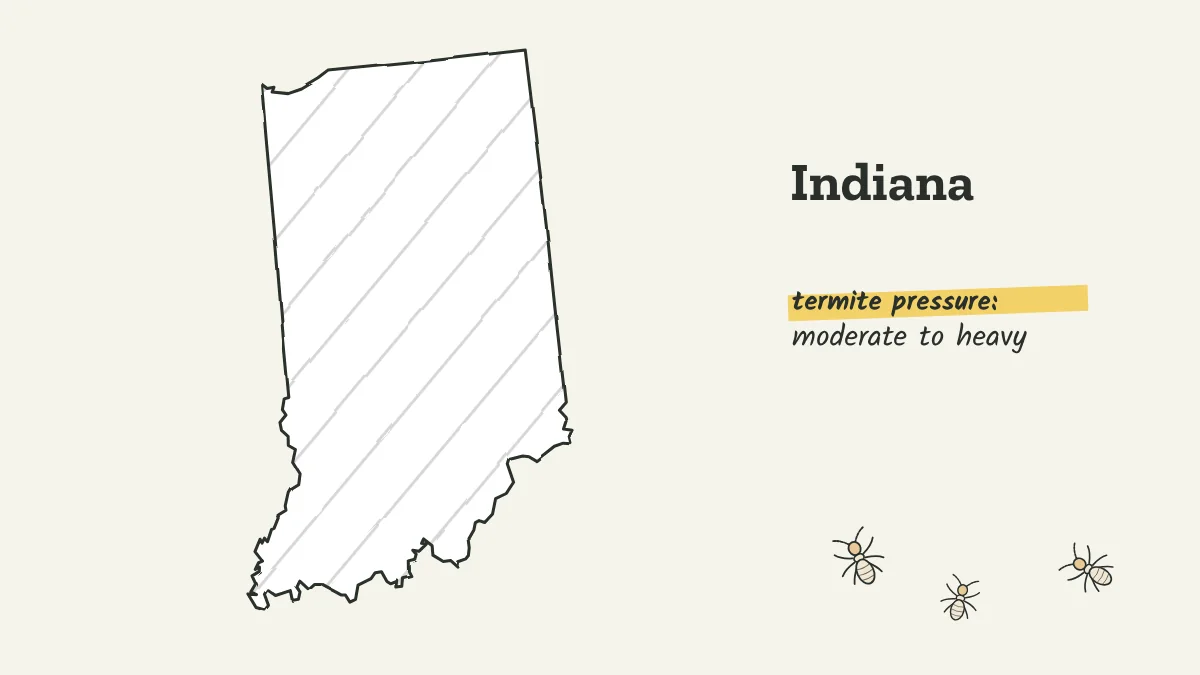
The short version
Indiana has five subterranean termite species, but Purdue's statewide survey found 90 percent of samples were the eastern subterranean termite, collected in 44 of 45 counties sampled. Swarms come in spring. Termite control in Indiana is done by firms licensed through the Office of Indiana State Chemist, and real estate inspections by certified wood-destroying pest inspectors.
Indiana at a glance
- Termite pressure
- Moderate to heavy
- Termites to know
- Eastern subterranean
- Why termites like it here
- Cold winters and warm, humid summers, with subterranean termites found statewide and most samples collected around buildings.
- Who licenses pest control
-
Office of Indiana State Chemist (Purdue University)
Check a company's license - Inspection report for home sales
- NPMA-33 Wood Destroying Insect Inspection Report
On this page
Indiana's termites
The Purdue survey, led by Changlu Wang with Gary Bennett and others, used both microscope and DNA identification to sort the samples. About 89 percent of collection sites were tied to buildings or other structures, and the rest came from woods.
The eastern subterranean termite dominated. Four other Reticulitermes species turned up in small numbers, including one, R. hageni, found only in Evansville, and another, R. arenincola, whose known range had been limited to the sand dunes near Lake Michigan. For a homeowner they behave alike: colonies in the soil, mud tubes to wood, swarms in spring.
What Purdue found
From Wang and colleagues, Annals of the Entomological Society of America, 2009.
| Species | Share of samples | Counties found |
|---|---|---|
| Eastern subterranean (R. flavipes) | 90.0% | 44 |
| R. virginicus | 7.6% | 13 |
| R. arenincola | 1.0% | Part of 5 counties with rare species |
| R. tibialis | 1.0% | 3 |
| R. hageni | 0.3% | Evansville only |
289 samples from 45 counties, collected 2002 to 2004.
When termites swarm in Indiana
The eastern subterranean termite swarms in spring, usually on a warm day after rain. Swarmers indoors mean the colony is close, and often in the house.
| Termite | J | F | M | A | M | J | J | A | S | O | N | D |
|---|---|---|---|---|---|---|---|---|---|---|---|---|
| Eastern subterranean Daytime, often after a warm rain | some swarms | peak | peak | common | some swarms |
Signs, in Purdue's words
Purdue Extension's Termite Control bulletin, by Gary Bennett, gives three main signs. Swarmers have wings about twice as long as their straight bodies, unlike winged ants, which have a pinched waist and unequal wings. Shelter tubes of mud are usually under 1/4 inch wide; wider ones suggest a bigger infestation. And hidden damage: workers eat the soft grain and leave a thin outer shell.
Purdue suggests probing wood near the foundation, especially plates, header joists, the ends of floor joists and hardwood flooring. More in signs of termites and how to inspect for termites.
Treatment, and the numbers to know
Purdue describes two professional approaches. Liquid soil termiticides go in by trenching at least 1 foot deep against the foundation, rodding and drilling slabs, and control is immediate. Baits go in stations every 10 to 20 feet, about 2 feet from the house, checked monthly, and control can take several months to a year. Purdue says preconstruction soil treatments should give at least five years of protection in most settings. Compare them in termite treatment options.
Who's allowed to do what in Indiana
The Office of Indiana State Chemist, at Purdue, licenses pest control firms. Termite control falls under its Category 7b. Since a 2010 rule change, a 7b business must notify the State Chemist's office at least 3 hours before a preconstruction termite treatment, so inspectors can check the job against the label. A customer disclosure form must still be completed and kept in the treatment record.
Real estate inspections are separate. Indiana licenses wood-destroying pest inspectors only after certification, which means Purdue's training and an exam passed at 75 percent or better. A certified inspector may not apply pesticides under that credential, and licenses renew every December 31. Most reports go on the NPMA-33.
For Indiana homeowners
Do
- Check a firm's license with the Office of Indiana State Chemist
- Ask how long the guarantee lasts and whether there's a yearly charge
- Probe sill plates and joist ends in the basement or crawlspace
- Keep wood and wood scraps out of contact with soil
Don't
- Sign with a door-to-door crew pointing at a tree
- Treat it as an emergency; take time to compare
- Assume a guarantee means the firm is reliable
- Apply professional termiticides yourself
Questions people ask
What termites live in Indiana?
Five subterranean species, according to Purdue's statewide survey, but 90 percent of samples were the eastern subterranean termite, found in 44 of the 45 counties sampled.
When do termites swarm in Indiana?
In spring, usually on a warm day after rain. Swarmers indoors usually mean an infestation in or very near the house.
Who licenses termite companies in Indiana?
The Office of Indiana State Chemist at Purdue University. Termite control is Category 7b, and firms can be checked by calling the office.
Who can do a real estate termite inspection in Indiana?
A licensed wood-destroying pest inspector, certified after Purdue training and an exam passed at 75 percent or higher. That credential doesn't allow applying pesticides.
Keep reading
Sources
- Wang and others: Survey and identification of termites (Isoptera: Rhinotermitidae) in Indiana, Annals of the Entomological Society of America 102(6), 2009
- Purdue Extension E-4: Termite control (Bennett, 2017)
- Purdue Extension E-2: Selecting a termite control service (Bennett, 2017)
- Office of Indiana State Chemist: Preconstruction termiticide treatment notification rule (2010)
- Office of Indiana State Chemist: How do I become a wood destroying pest inspector
- Indiana Department of Workforce Development: Wood destroying pest inspection certification