Termites in Colorado: Dry Air, Wet Yards
Colorado's dry climate keeps termite damage less common than in wetter states, but it doesn't keep termites out. Colorado State University says people have made the problem worse, mostly with water. Here's which termites live in Colorado, what draws them to a house and how to find licensed help.
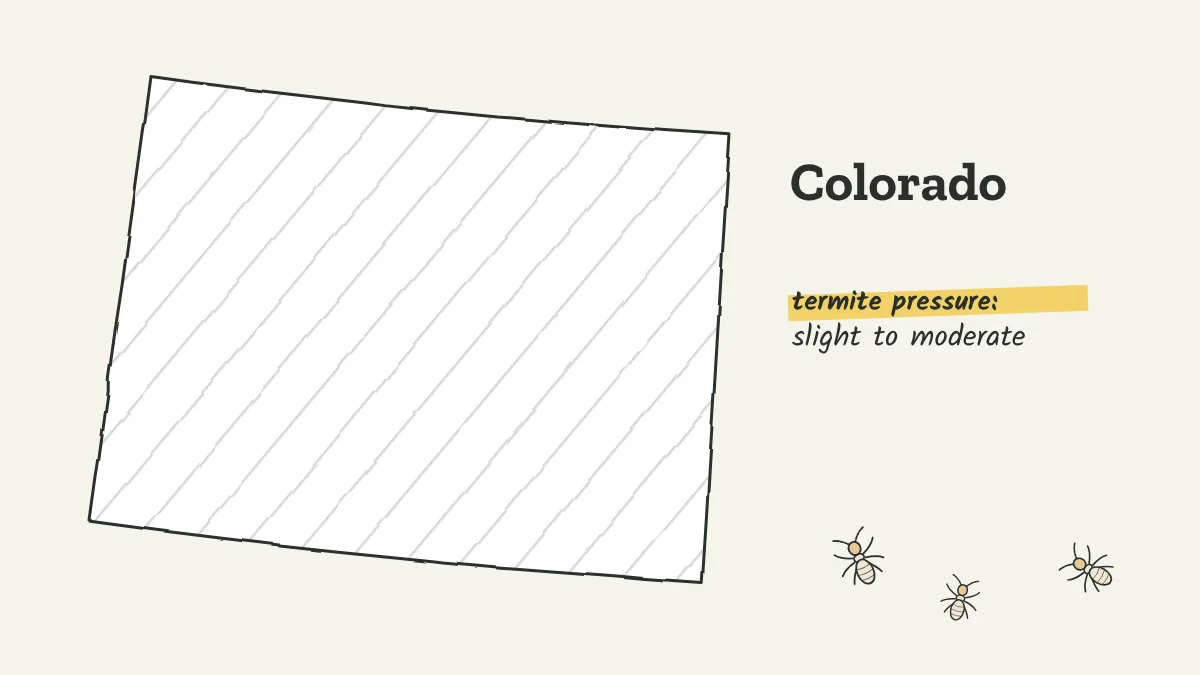
The short version
Colorado has at least three native subterranean termite species. The aridland subterranean termite is the most widespread, found across most of the state below about 7,500 feet, but Colorado State University says the eastern subterranean termite usually causes the structural damage. Drywood termites occur only in a small area around Grand Junction. Over-watering near the foundation is a big part of the risk.
Colorado at a glance
- Termite pressure
- Slight to moderate
- Termites to know
- Arid-land subterranean, Eastern subterranean
- Why termites like it here
- Semi-arid, with cold winters, termites common below about 7,500 feet and damage concentrated where irrigation or high water tables keep soil moist.
- Who licenses pest control
-
Colorado Department of Agriculture, Pesticide Applicator Program
Check a company's license - Inspection report for home sales
- NPMA-33 Wood Destroying Insect Inspection Report
On this page
Colorado's termites
Colorado State University Extension's PlantTalk says at least three native subterranean termites, all Reticulitermes species, occur in the state and can be locally common. The aridland subterranean termite is the most widespread, found throughout most of Colorado below about 7,500 feet and very common on the eastern plains, where it's often found under fallen logs or dried cattle manure. The eastern subterranean termite is the one usually responsible for structural damage.
Drywood termites are a separate case. CSU says they affect only a small area around Grand Junction, and they need different management because they live in the wood itself rather than the soil. CSU also notes damage reports from places as far apart as Del Norte in the San Luis Valley and Burlington on the eastern plains.
When termites swarm in Colorado
Colorado State University's agricultural sciences guidance says winged termites leave the colony in large numbers in spring or fall. The months below are typical for these species.
| Termite | J | F | M | A | M | J | J | A | S | O | N | D |
|---|---|---|---|---|---|---|---|---|---|---|---|---|
| Arid-land subterranean Depends on elevation | common | common | common | common | common | |||||||
| Eastern subterranean Daytime, often after a warm rain | some swarms | peak | peak | common | some swarms |
Why water is the risk factor
CSU says structural damage is less common in Colorado than in wetter or warmer parts of the country, and has historically been worst where water tables are high. The newer problem is people. CSU lists the habits that have increased infestations:
- Over-irrigating near buildings
- Poor downspout drainage next to foundations
- Buried wood, such as old fence posts, tree stumps and firewood piles
- Construction that skips basic termite-proofing, leaving wood touching soil or open access points
In a dry state, a watered strip of lawn along the foundation can be the dampest soil on the block, and termites follow moisture. CSU's prevention list follows from that: remove waste wood, seal foundation and plumbing cracks, cover crawlspace and porch soil with thick plastic sheeting, ventilate crawlspaces and water carefully. Keep hollow masonry like cinder block from bridging soil and wood. See landscaping to prevent termites and firewood and termites.
Signs and checks in a Colorado house
From Colorado State University's agricultural sciences IPM guidance.
| Look for | Notes |
|---|---|
| Winged termites indoors | A sign of infestation in the house |
| Mud tubes | Moist tubes are active; dry, crumbling ones are old |
| Cracking or blistered paint in damp spots | Can hide feeding behind it |
| Basement supports and window frames | Common entry and feeding areas |
| Wood near soil | CSU advises keeping wood at least 8 inches above soil |
More in signs of termites.
Getting help, and checking a license
CSU recommends hiring a certified pesticide applicator for termite treatment. It says liquid termiticides form a barrier that can last for years and work best when applied during construction, while baits often cost more and don't give immediate control. Compare them in termite treatment options.
The Colorado Department of Agriculture licenses commercial applicators, and its online Pesticide Applicator Search lets you look up both businesses and individual qualified supervisors and certified operators. Only current, valid licenses appear. Colorado's structural rules treat termites and other wood-destroying organisms as their own license category, and applicators must leave a written notice naming each pesticide applied and the date. When a lender or buyer wants a termite inspection, the form used nationally is the NPMA-33.
For Colorado homeowners
Do
- Pull sprinkler heads back from the foundation
- Extend downspouts away from the house
- Dig out buried fence posts and stumps near the house
- Look up the applicator on the state's search before hiring
Don't
- Assume a dry climate means no termites
- Water the foundation strip every day
- Bury scrap lumber when you landscape
- Treat a Grand Junction drywood problem like a soil termite
Questions people ask
Are there termites in Colorado?
Yes. Colorado State University says at least three native subterranean termites live in the state, common below about 7,500 feet, plus drywood termites in a small area around Grand Junction.
Which Colorado termite causes the most damage?
The eastern subterranean termite is usually responsible for structural damage, according to CSU, even though the aridland subterranean termite is more widespread.
Why do Colorado houses get termites?
Mostly water and wood. CSU names over-irrigation near buildings, poor downspout drainage and buried wood like fence posts and stumps.
How do I check a Colorado termite company's license?
Use the Colorado Department of Agriculture's Pesticide Applicator Search, which lists businesses and individual applicators with current, valid licenses.
Keep reading
Sources
- Colorado State University Extension PlantTalk 1400-3: Termites in Colorado
- Colorado State University, Agricultural Biology: Termites (IPM pests, updated 2024)
- Colorado Department of Agriculture: Pesticide applicator search
- Colorado Department of Agriculture: Pesticide applicator certification and licensing program
- 6 CCR 1007-1 Part 10: Structural applicators (via Cornell LII)