Termites in Michigan: Yes, They're Here
Plenty of Michiganders think termites are a Southern problem. Michigan State University entomologists have been saying otherwise for fifty years. Here's where termites live in Michigan, what MSU says to look for in a basement, and how to check that a termite company is licensed.
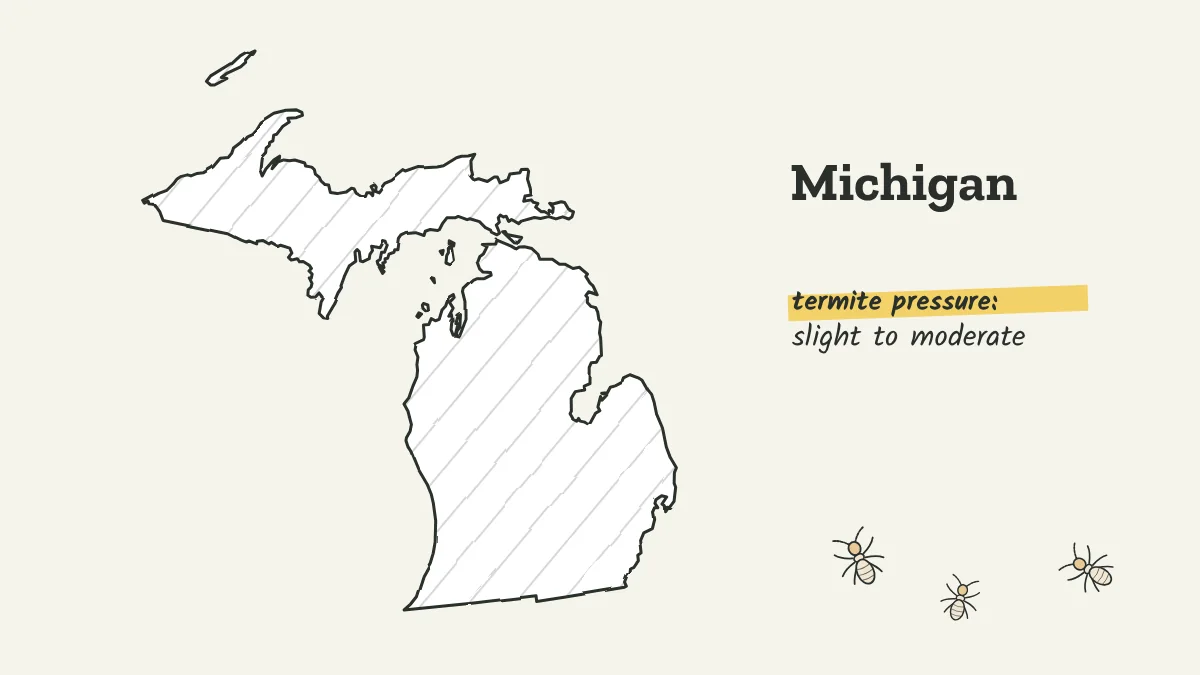
The short version
Yes, Michigan has termites. Michigan State University calls subterranean termites the most serious wood-destroying pest in the state, and they've been damaging buildings there since at least 1920. The species is the eastern subterranean termite, and in basement houses MSU says the first mud tubes usually show up on rim joists and sill plates. Termite firms are licensed by MDARD under Category 7B.
Michigan at a glance
- Termite pressure
- Slight to moderate
- Termites to know
- Eastern subterranean
- Why termites like it here
- Cold winters and warm summers, with subterranean termites established for over a century and many houses on basements.
- Who licenses pest control
-
Michigan Department of Agriculture and Rural Development (MDARD), Pesticide and Plant Pest Management
Check a company's license - Inspection report for home sales
- NPMA-33 Wood Destroying Insect Inspection Report
On this page
Michigan's termites
In 1973, E. A. Behr of Michigan State University published a paper titled Termite Distribution in Michigan in The Great Lakes Entomologist. His point then still holds: subterranean termites have been in Michigan for a long time, reported damaging buildings as early as 1920, yet many residents think of them as a Southern insect.
Behr found the eastern subterranean termite to be the most common species in the state. Two relatives turned up too: Reticulitermes arenincola in the far southwest corner, and R. tibialis at scattered sites. All three live in soil colonies and reach wood through mud tubes. Behr also noted that Michigan's termite losses were lower than those of a southern state like Tennessee, but that effective control methods existed and most of the public didn't know about them. Fifty years on, the second half of that is still the bigger problem.
When termites swarm in Michigan
Eastern subterranean termites swarm in spring. MSU says winged termites inside a house strongly suggest an active infestation.
| Termite | J | F | M | A | M | J | J | A | S | O | N | D |
|---|---|---|---|---|---|---|---|---|---|---|---|---|
| Eastern subterranean Daytime, often after a warm rain | some swarms | peak | peak | common | some swarms |
What MSU says to look for
MSU Extension's guidance is built around the Michigan basement. Termites nest in moist soil and build shelter tubes over or through concrete foundations to reach wood that isn't touching soil, and in basement houses the tubes are often first found on rim joists and sill plates. MSU suggests probing boards and sill plates with an ice pick, knife or screwdriver.
Winged termites indoors are the other big clue, and MSU says they come from a mature colony that has likely been there 5 to 7 years. A mature colony of about 60,000 termites eats roughly 2 feet of 2x4 a year, so damage builds slowly, which is also why there's time to choose a company carefully. More in how to inspect for termites.
Conditions MSU links to termite damage
From MSU Extension. Termites prefer wood with high moisture content.
| Condition | Why it matters |
|---|---|
| Poor ventilation in enclosed spaces | Keeps wood damp |
| Boards in contact with soil | A direct route from the colony |
| Poor flashing at porches and decks | Lets water and termites reach the frame |
| Grade sloping toward the house | Holds moisture at the foundation |
| Slab-on-grade construction | Termites enter through cracks wider than 1/32 inch, and the frame is hard to inspect |
MSU calls slab construction the most vulnerable. See crawlspace moisture and termites and termites in fences and decks.
Treatment and licensing
MSU says only pest control companies have the equipment and materials for effective treatment, and that do-it-yourself bait systems may reduce termite numbers but probably won't eliminate them. Professional liquid treatments and commercial bait systems may cost over $2,000 for an average home. Pick a firm with a good track record and a strong guarantee, and don't rush. See termite treatment options.
The Michigan Department of Agriculture and Rural Development licenses pesticide application businesses, and termite work falls under Category 7B, Wood Destroying Pest Management, covering pesticide use in, on or around structures for wood-destroying pests. MDARD's business license page links to a list of businesses currently licensed in Michigan, and licenses expire each December 31. Ask the company for its license and category before you sign, and get the guarantee terms in writing: what's covered, for how long, and what the renewal costs.
For Michigan homeowners
Do
- Look at rim joists and sill plates every year
- Probe suspect wood with a screwdriver
- Check a firm on MDARD's licensed business list
- Fix grading, flashing and wood-to-soil contact
Don't
- Assume Michigan is too cold for termites
- Count on a store-bought bait system to finish the job
- Panic-sign a contract the day you find swarmers
- Cover foundation walls so they can't be inspected
Questions people ask
Are there termites in Michigan?
Yes. Michigan State University calls subterranean termites the most serious wood-destroying pest in the state, and they were reported damaging Michigan buildings as early as 1920.
What kind of termites are in Michigan?
Mostly the eastern subterranean termite. A 1973 MSU study also found Reticulitermes arenincola in the far southwest corner and R. tibialis at scattered sites.
Where do termites show up in a Michigan house?
In basement houses, MSU says mud tubes are often first found on rim joists and sill plates. Damage is often discovered during remodeling.
How do I check a termite company's license in Michigan?
MDARD licenses pesticide application businesses, and termite work is Category 7B. Its business license page links to a list of currently licensed businesses.