Crawlspace Moisture and Termites
A damp crawlspace is the closest thing to a termite welcome mat. The soil stays moist, the wood stays soft, and nobody looks down there for years at a time. Several states write that into their termite rules with specific numbers. Here's what those numbers are, and how to use them on your own crawlspace.
The short version
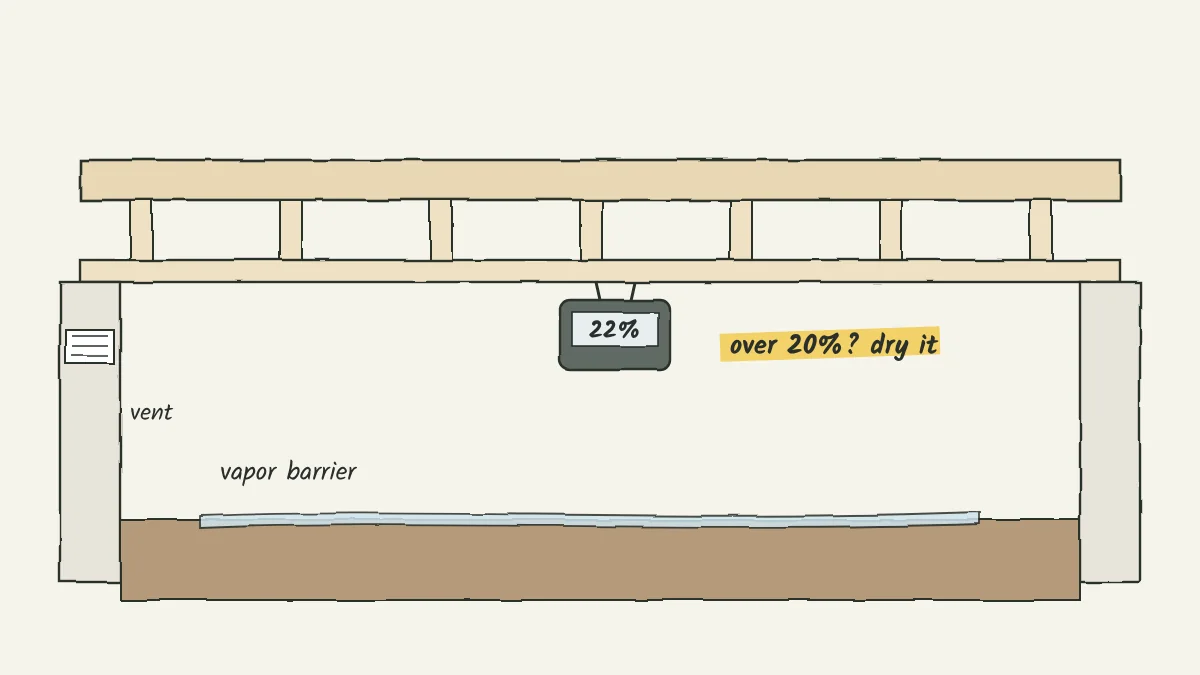
Wood at about 20 percent moisture or higher is the line several state rules treat as a problem: North Carolina's sale report flags it, and Kentucky requires moisture-control steps when crawlspace wood reads above it. The usual fixes are a vapor barrier over most of the soil, ventilation or dehumidification, drainage and keeping wood well above the dirt. Check the crawlspace at least once a year.
On this page
Why the crawlspace matters
Subterranean termites need moisture, and a crawlspace delivers it: bare soil evaporating into a closed space under the floor, often with plumbing leaks and poor drainage on top. Penn State lists ventilating and draining basements, cellars and crawlspaces among its basic termite prevention steps, and HUD's rehabilitation guide sums it up: a dry building generally won't have problems with decay or subterranean termites.
Wet crawlspaces also invite wood-decay fungi, and in a 1993 lab study eastern subterranean termites ate more decayed wood than sound wood. That's why many state rules handle termites, decay fungi and wood-boring beetles together in crawlspaces. Telling the two kinds of damage apart is in termite damage vs water damage.
The crawlspace numbers in state termite rules
Different states draw the line in different places. These come from state rules and guidance we've covered.
| State | Number | What it's for |
|---|---|---|
| North Carolina | Wood at 20 percent moisture or more | A conducive condition the sale report must note |
| Kentucky | Above 20 percent in joists, sills or subfloor | Triggers a vapor barrier, ventilation, drainage or waterproofing before a moisture treatment |
| Kentucky | 1 square foot of vent per 150 square feet | Minimum ventilation when there's no vapor barrier |
| Georgia | Vapor barrier over at least 70 percent of the soil | Part of the standard for wood-decay fungus and beetle treatments |
| Tennessee | About 80 percent of the soil covered with polyethylene, and 30 inches of clearance | University of Tennessee Extension's prevention advice |
| Tennessee | 18 percent moisture in at least five spots | Required before a preventive wood-boring beetle treatment |
| Nevada | Less than 1 square foot of vent per 300 square feet, or per 1,500 with a vapor barrier | Counts as insufficient ventilation on the state report |
| Arizona | Less than 24 inches of clearance | A conducive condition the inspector must check |
The building code adds its own clearances: 18 inches under wood joists and 12 inches under girders in a crawlspace, or the wood must be treated or naturally durable. See building code termite requirements.
The 20 percent line
If one number is worth remembering, it's 20 percent wood moisture content. North Carolina's wood-destroying insect report lists wood at 20 percent or higher among the three conducive conditions every inspection must report. Kentucky's rules go further: when moisture readings in joists, sills or subfloor exceed 20 percent because of damp soil, the applicator must use one or more moisture fixes, and a complete crawlspace fungicide treatment is allowed only when readings exceed 20 percent in four separate areas, recorded on a graph.
A pin-type moisture meter, pushed into a joist or sill, gives you the same number. Take readings in several spots, near the foundation walls and in the middle, and compare them through the seasons. If you're above 20 percent, it's time to find out why.
For checking your crawlspace
As an Amazon Associate I earn from qualifying purchases.
-
View on Amazon
Pin-type wood moisture meter
Wood that reads above about 20% is wet enough to invite rot and termites. Great for sills and subfloors.
-
View on Amazon
Crawlspace or basement dehumidifier
Dry wood is the cheapest termite protection there is. Aim for wood readings under 15%.
-
View on Amazon
LED headlamp
Keeps both hands free for probing and photographing in a crawlspace or attic.
-
View on Amazon
Knee pads
Only if you have a crawlspace. You inspect twice as carefully when you're not kneeling on gravel.
Drying out a crawlspace
-
Find the water first
Look for plumbing leaks, a condensate line dripping under the house, gutters dumping at the foundation and soil sloping toward the house.
-
Cover the soil
A vapor barrier over most of the exposed soil cuts the moisture rising from the ground. Georgia's standard calls for at least 70 percent coverage for decay and beetle treatments; UT Extension suggests about 80 percent.
-
Ventilate or dehumidify
Vents need to stay open and unblocked by plants or mulch. In crawlspaces sealed off from outside air, a dehumidifier does the work vents would.
-
Keep the clearances
Keep soil and debris well below joists and girders; NC's agriculture department advises crawlspace beams at least 18 inches above the ground.
-
Clear out the cellulose
Remove form boards, scrap lumber, cardboard and stumps under the house. Nevada counts half a cubic foot of raked debris as a conducive condition.
When moisture becomes a treatment sale
Moisture problems can lead to sales pitches for fungicide or "moisture control" treatments. Kentucky's rule offers a useful model even outside Kentucky: fix the moisture first with a barrier, ventilation, drainage or waterproofing, record readings on a graph, and apply a whole-crawlspace treatment only when readings are high in several places. Tennessee requires readings of at least 18 percent in at least five places, and a written report, before a preventive wood-boring beetle treatment. Ask for the readings before you pay for a treatment based on them.
For crawlspace houses
Do
- Check moisture readings in several spots once a year
- Cover most of the soil with a vapor barrier
- Keep vents clear, or dehumidify a sealed crawlspace
- Remove wood and cardboard from under the house
Don't
- Store boxes, lumber or firewood in the crawlspace
- Let gutters or condensate lines drain under the house
- Pay for a moisture treatment without seeing the readings
- Let soil build up toward the joists
Questions people ask
Do crawlspaces attract termites?
Damp ones do. Moist soil and wet wood under a house help subterranean termites survive and feed, and the space is rarely inspected. Drying it out is one of the best prevention steps.
What wood moisture level is too high?
About 20 percent is the line several state rules use. North Carolina's sale report flags wood at 20 percent or more, and Kentucky requires moisture-control steps when crawlspace wood reads above it.
How much of a crawlspace should a vapor barrier cover?
Georgia's standard for decay and beetle treatments calls for at least 70 percent of the exposed soil, and University of Tennessee Extension suggests about 80 percent.
Should crawlspace vents be open or closed for termites?
State rules focus on the result rather than the design: ventilation standards for vented crawlspaces, and moisture readings in the wood either way. A sealed crawlspace needs a dehumidifier or other moisture control to stay dry.
Keep reading
Termites in your state
Sources
- Kentucky Administrative Regulation 302 KAR 29:050: Structural pest control
- NCDA&CS: Homeowner's guide to the wood destroying insect report
- NCDA&CS: Post-construction subterranean termite control
- Georgia Department of Agriculture: 2014 WDO rule changes
- UT Extension PB1344: Subterranean termite control
- Tennessee Rule 0080-09-04-.08: Requirements of specific categories and pesticides
- Nevada Department of Agriculture: Structural pest control (C3) study manual (2014)
- Arizona Administrative Code R3-8-307: Performing a wood-destroying insect inspection; WDIIRs
- NPMA: Suggested guidelines for completing the NPMA-33 (version 1.3, 2019)
- Penn State Extension: Eastern subterranean termites
- HUD: Residential rehabilitation inspection guide (2000)
- Jones: Effect of a decay fungus on subterranean termite response to bait toxicant treated wood, International Conference on Urban Pests (1993)