Termites in North Carolina: Swarms, State Standards and the WDIR
North Carolina doesn't leave termite work to the honor system. The state sets treatment standards down to the gallon, has its own sale report, and sends an inspector within a couple of days when a homeowner complains. Here's how those rules work for you, and what the state's termites actually do.
The short version
The eastern subterranean termite lives in every North Carolina county and usually swarms in daylight in spring, often after rain. Formosan termites have been found only in Brunswick and Rutherford counties. Home sales use the state's WDIR 100 report, and the agriculture department sets minimum treatment standards and investigates complaints for free.
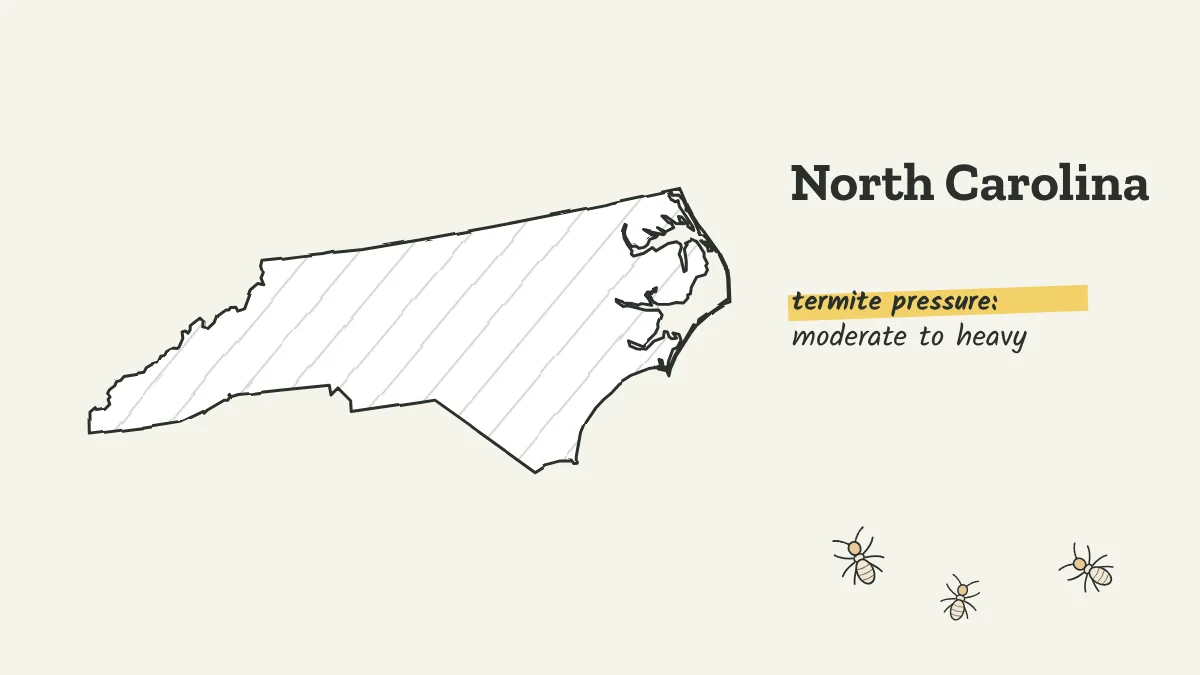
North Carolina at a glance
- Termite pressure
- Moderate to heavy
- Termites to know
- Eastern subterranean, Formosan subterranean
- Why termites like it here
- Humid subtropical in the Piedmont and on the coast, cooler in the mountains, with eastern subterranean termites in every county and a few Formosan finds.
- Who licenses pest control
-
North Carolina Department of Agriculture and Consumer Services, Structural Pest Control and Pesticides Division
Check a company's license - Inspection report for home sales
- North Carolina Wood-Destroying Insect Information Report (WDIR 100)
On this page
- One termite, every county
- Formosans: two counties, so far
- Native or Formosan?
- When termites swarm in North Carolina
- The rulebook: minimum treatment standards
- New houses: four visits and a release form
- The WDIR 100, North Carolina's sale report
- Filing a complaint
- For North Carolina homeowners
- Questions
One termite, every county
North Carolina's termite is the eastern subterranean termite, and NC State Extension says it can be found in all of the state's counties. Colonies live in the soil and reach houses through mud tubes or wood touching the ground. NC State puts an average mature colony at roughly 300,000 termites, and a colony of about 60,000 can eat a foot of 2x4 in about five months.
Swarming is the sign most people notice. NC State's guidance puts the usual swarms in spring, during the day, and often right after rain, though colonies stay active all year and swarms can show up on warm days outside the usual season. A swarm doesn't damage anything by itself. It means a colony is nearby, so an inspection is due. The ant-or-termite question is in flying ants vs termites.
Formosans: two counties, so far
The Formosan subterranean termite has a short North Carolina record, and NC State keeps it:
- 1992, Brunswick County. Formosans turned up in railroad ties used for landscaping. The ties went to a landfill, and no termites were found at the house.
- 1994 and 1996, Spindale, Rutherford County. Two infestations at the same site, both controlled by a local company.
- 2002, Rutherford County. Another infestation about 0.4 mile from the first Spindale sites, with more found elsewhere in the county.
NC State's 2018 update says most of the infested crossties along an abandoned rail line through Rutherfordton, Spindale and Forest City were removed during a trail project, though nearby trees and properties can still become infested. No Formosans had been found elsewhere in the state. Mississippi's Formosan quarantine rule, which tracks other states' infested areas, lists the same two counties. More in Formosan termite quarantine laws.
Native or Formosan?
From NC State Extension's Formosan update.
| Eastern subterranean | Formosan subterranean | |
|---|---|---|
| Where in NC | Every county | Brunswick and Rutherford counties |
| When it swarms | Daytime, usually spring, often after rain | Dusk, April through June |
| Soldier's head | Rectangular | Oval, egg-shaped |
If you think you've found Formosans, collect swarmers or soldiers and take them to your county's NC State Extension center or a licensed company for identification.
When termites swarm in North Carolina
Native swarms are mostly a spring event. Formosan swarms, where they occur, come at dusk from April through June.
| Termite | J | F | M | A | M | J | J | A | S | O | N | D |
|---|---|---|---|---|---|---|---|---|---|---|---|---|
| Eastern subterranean Daytime, often after a warm rain | some swarms | peak | peak | common | some swarms | |||||||
| Formosan subterranean Dusk, in big clouds around lights | some swarms | peak | peak | some swarms |
The rulebook: minimum treatment standards
Termite work in North Carolina is regulated by the Structural Pest Control and Pesticides Division of the NC Department of Agriculture and Consumer Services, under rules adopted by the Structural Pest Control Committee. The division publishes the standards a treatment of an existing house is held to, and they're specific:
- Trench at least 6 inches deep along the foundation, and treat the soil from grade to the top of the footing or to at least 30 inches deep.
- Apply the termiticide at 4 gallons per 10 linear feet for each foot of depth.
- On slabs, drill along cracks and construction joints at 12-inch intervals, no more than 6 inches from the foundation.
- Where there's evidence of termites in block or brick walls, drill and treat the voids at least 4 feet in every direction from it.
When part of that can't be done, say a crawlspace too shallow to work in or drilling you don't want inside the house, the company uses the state's Official Waiver of Minimum Requirements, and every waived part has to be explained on it. Read it before you sign. The division also notes that bait service agreements typically cost more than conventional treatment warranties. How the methods compare is in termite treatment options.
New houses: four visits and a release form
For new construction, the division's guidance calls for treating the soil along foundations to at least 4 feet below grade and under slabs at 1 gallon per 10 square feet, or 1.5 gallons over washed stone. The treatment usually takes three or four visits as the house goes up. If a slab is poured without the required soil treatment, a Sub-Slab Treatment Release Form tells the owner which areas weren't treated, and the division says only the property owner should sign it. The building side of new-house protection is in termite pretreatment.
Enforcement isn't theoretical. In a December 2023 settlement, a Mecklenburg County company paid $5,000 after its technicians skipped crawlspaces on preconstruction treatments, and a Wake County company and one of its technicians paid a combined $2,800 for placing bait stations more than 20 feet apart, against the label.
The WDIR 100, North Carolina's sale report
For home sales, North Carolina uses the Wood-Destroying Insect Information Report, Form WDIR 100. The agriculture department calls it the only legal form for the purpose and says it's needed for almost every residential sale. Only a person licensed by the division, or working for a licensed company, can issue it.
The inspector looks at all accessible areas, including attached decks, porches and storage sheds, and lists anything inaccessible. Beyond termites, the report covers powderpost beetles, old house borers and carpenter ants, plus three conducive conditions at minimum: wood touching soil, cellulose debris under the house, and wood at 20 percent moisture or more.
Three things the department wants buyers and sellers to understand:
- It isn't a "termite letter" or a clearance. It reports evidence, present and past, and it doesn't measure the extent of damage.
- A clean report isn't required to close. The department says most North Carolina homes older than 10 to 15 years will show some evidence of wood-destroying insects.
- Damage doesn't disappear. Issuing a later "no evidence" report on a house with known damage and no repairs would break the rules and could be considered fraud.
If a house is treated for the sale, the treatment contract and any warranty go with the WDIR. The national form is covered in WDI inspection.
Filing a complaint
If you think termite work wasn't done right, ask the division for a state inspection using its online request form or by mail. There's no fee. An inspector contacts you within one to two business days after the complaint reaches Raleigh, reviews contracts and records, interviews everyone involved and may take soil samples for the department's lab.
When a treatment deviates from the rules, the company has 30 days after written notice to correct it. Penalties can reach $2,000 per violation, and licenses can be suspended or revoked. The state doesn't compensate homeowners for damage, so getting money back may still take a civil case. Ask for a copy of the file when the investigation closes. The general approach is in how to file a complaint.
For North Carolina homeowners
Do
- Read any Official Waiver before you sign a contract
- Ask for the WDIR early in a purchase and read the inaccessible areas
- Keep the treatment contract with the WDIR
- Request a state inspection if a treatment seems to have failed
Don't
- Sign a Sub-Slab Release Form unless you're the owner and understand it
- Expect a "clear" report on an older house
- Bring used railroad ties into your landscape
- Treat the soil yourself; the department warns against it
Questions people ask
When do termites swarm in North Carolina?
Native eastern subterranean termites usually swarm in spring, during the day and often after rain, though swarms can happen on warm days at other times. Formosan termites, found only in Brunswick and Rutherford counties, swarm at dusk from April through June.
Are there Formosan termites in North Carolina?
Only in a few places. NC State Extension records finds in Brunswick County in 1992 and in Rutherford County from 1994 on, and none elsewhere in the state.
What is a WDIR in North Carolina?
It's the Wood-Destroying Insect Information Report, Form WDIR 100, the state's required report for termite inspections in home sales. It reports evidence of termites and other wood-destroying insects and certain conducive conditions. It isn't a warranty or a clearance letter.
Does a house need a clean WDIR to close in North Carolina?
No. The agriculture department says a clear report isn't required for a sale to close, and that most homes over 10 to 15 years old will show some evidence of wood-destroying insects.
How do I check a pest control license in North Carolina?
Use the NC Department of Agriculture's structural pest control license search, or call the Structural Pest Control Section at 984-236-4625.
Keep reading
Sources
- NC State Extension: Biology and behavior of eastern subterranean termites (2025)
- NC State Extension: Termite swarmers, what do they mean for you? (reviewed 2023)
- NC State Extension: Update on Formosan termites in NC (2018)
- NCDA&CS: Post-construction subterranean termite control
- NCDA&CS: Pre-construction subterranean termite control
- NCDA&CS: Homeowner's guide to the wood destroying insect report
- NCDA&CS: Structural investigation and complaint guide
- NCDA&CS: Structural Pest Control Committee announces case settlements (December 2023)
- NCDA&CS: License search
- Mississippi Administrative Code 2-1-3-01-135: Formosan subterranean termite quarantine