Termites in New Mexico: Licensed Inspectors and Graph Paper
New Mexico's dry air doesn't stop subterranean termites; it just sends them looking for the damp spots. The state's agriculture department, run through New Mexico State University, has clear rules about who can inspect and treat for termites and what records they keep. Here's what those rules and NMSU's advice mean for a homeowner.
The short version
In New Mexico, anyone who inspects for termites must be licensed with the New Mexico Department of Agriculture, and anyone who treats must hold a commercial applicator certification in category 7D or a termite technician license. The NPMA-33 form is common but not required. Firms must keep a graph-paper drawing of each treated foundation. NMDA can tell you whether a company is licensed and whether it's had problems.
New Mexico at a glance
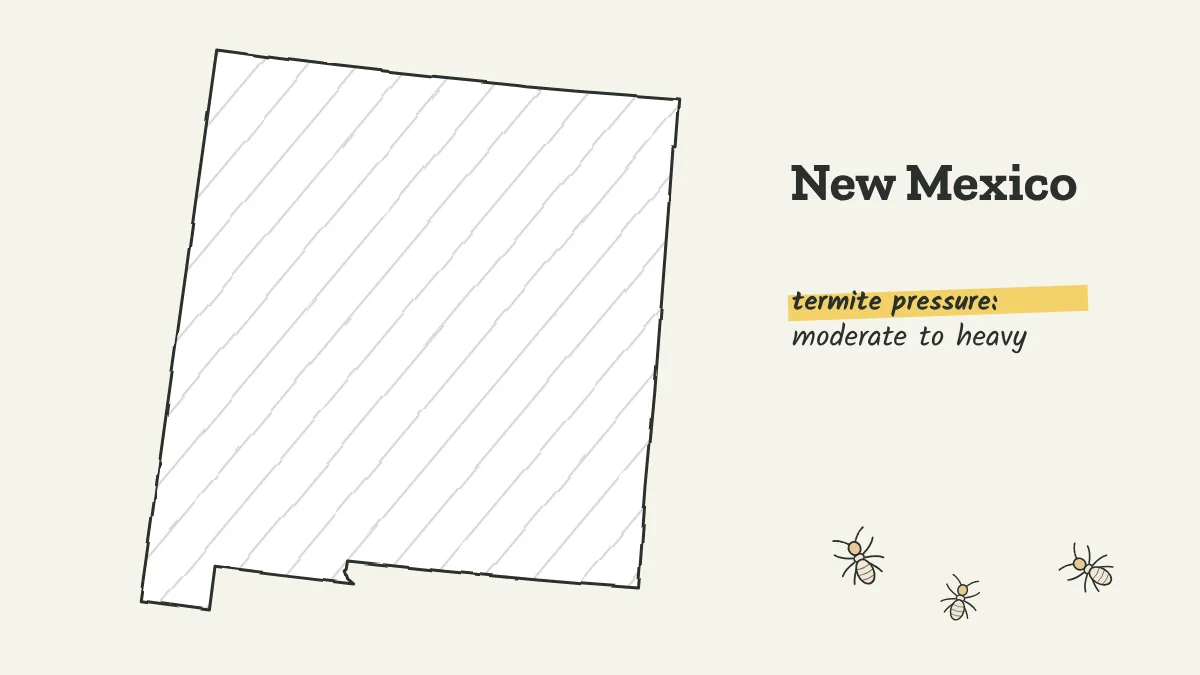
- Termite pressure
- Moderate to heavy
- Termites to know
- Arid-land subterranean
- Why termites like it here
- Arid to semi-arid, with termites drawn to moisture around foundations, crawlspaces and plumbing.
- Who licenses pest control
-
New Mexico Department of Agriculture (NMSU), Pesticide Compliance
Check a company's license - Inspection report for home sales
- NPMA-33 (common but not required)
On this page
New Mexico's termites
Subterranean termites are New Mexico's main concern, and in an arid state they go where the water is. NMSU's Marisa Thompson advised regular checks of the crawlspace and wet areas like bathrooms, utility rooms and kitchens for mud tunnels, which termites build to stay out of dry air. She also drew a useful line: termites in the yard, away from the house, may be harmless, while termites inside can cause serious damage.
The New Mexico Department of Agriculture lists the signs an inspector looks for: termite tubing or damage outside, hollow-sounding walls or floors, areas that feel damp or give way when touched, and drill holes or other marks of an earlier treatment. See signs of termites.
When termites swarm in New Mexico
NMDA and NMSU don't publish New Mexico swarm dates. The months below are typical for the arid-land subterranean termite, the main soil termite of the dry West.
| Termite | J | F | M | A | M | J | J | A | S | O | N | D |
|---|---|---|---|---|---|---|---|---|---|---|---|---|
| Arid-land subterranean Depends on elevation | common | common | common | common | common |
Conditions NMDA says to correct
From the New Mexico Department of Agriculture's Termites 101.
| Condition | Why it matters |
|---|---|
| Wood touching soil next to the house | Firewood stacked against the wall is the classic example |
| Stucco below soil grade | Hides termite tubes between stucco and foundation |
| Separated brick veneer | Opens a hidden route up the wall |
| Excess moisture in a crawlspace | Gives termites the damp they need |
| Leaking plumbing | Moisture in a dry climate draws termites |
| Heavy landscaping at the foundation | Keeps soil damp and hides the wall |
More on stucco and moisture in what attracts termites.
Who may inspect and treat
New Mexico's rule on wood-destroying pests, 21.17.51 NMAC, says anyone who inspects for wood-destroying pests must hold a termite service technician license, a pest management consultant license or a commercial applicator certification in category 7D. NMDA's homeowner page adds that inspectors must be licensed as pest management consultants, and those who both inspect and treat need a commercial applicator or termite technician license too.
Training is ongoing. A 7D applicator needs at least a year of experience in wood-destroying pest control, four hours of approved training and a passing exam, then four hours of training every year; miss it and the certification lapses. Only a 7D applicator or licensed termite technician may mix or apply restricted-use termiticides.
The report and the records
NMDA says the NPMA-33 is the most common inspection form but isn't required, and some companies use their own. A good report includes a scale drawing marking activity or damage, the construction type, conducive conditions, features that could complicate treatment and signs of earlier treatment. You can ask to be present, and NMDA says to move stored items out of the way so the inspector can see the garage, attic and crawlspace. See NPMA-33.
After treatment, the rule requires the firm to keep the client's name and address, the property location, the termiticide brand and EPA number, the concentration and gallons, the supervising applicator's name and a graph-paper drawing of the foundation plan showing treated areas. Ask for your own copy. NMDA can also send an inspector to watch a treatment and check it follows the label.
For New Mexico homeowners
Do
- Check the company on NMDA's license search
- Ask for a scale drawing with the inspection report
- Keep stucco and soil from meeting at the foundation
- Fix plumbing leaks and crawlspace moisture
Don't
- Stack firewood against the house
- Assume yard termites mean the house is infested
- Accept a treatment with no record of what was used
- Hire an inspector who can't show a license
Questions people ask
Who can inspect a house for termites in New Mexico?
Someone licensed with the New Mexico Department of Agriculture as a pest management consultant or termite service technician, or certified in category 7D, under 21.17.51 NMAC.
Is the NPMA-33 form required in New Mexico?
No. NMDA says it's the most common form, but the state doesn't require it and some companies use their own.
What records should I get after termite treatment in New Mexico?
The product used, how much and exactly where. The state's rule requires firms to keep those details and a graph-paper drawing of the treated foundation.
How do I check a termite company in New Mexico?
Use NMDA's online pesticide license search, or call the department. NMDA can confirm a license and whether the company has had past issues, though it won't recommend a company.