Termites in New York: Long Island Swarms, State Limits and Disclosure
New York doesn't get the termite headlines of the Gulf Coast, but where termites are common, they're a big part of homeownership. On Long Island, they're the insect people ask Cornell Cooperative Extension about most. Here's what New York's termite does, the limits the state puts on treating it, and what sellers have to say about it.
The short version
New York's termite is the native eastern subterranean termite. Cornell Cooperative Extension in Nassau County says Long Island swarms run from March through June and that termites are the county's most common insect question. State rules limit treatment near wells and in finished basements, and sellers must answer a termite question on the property condition disclosure.
New York at a glance
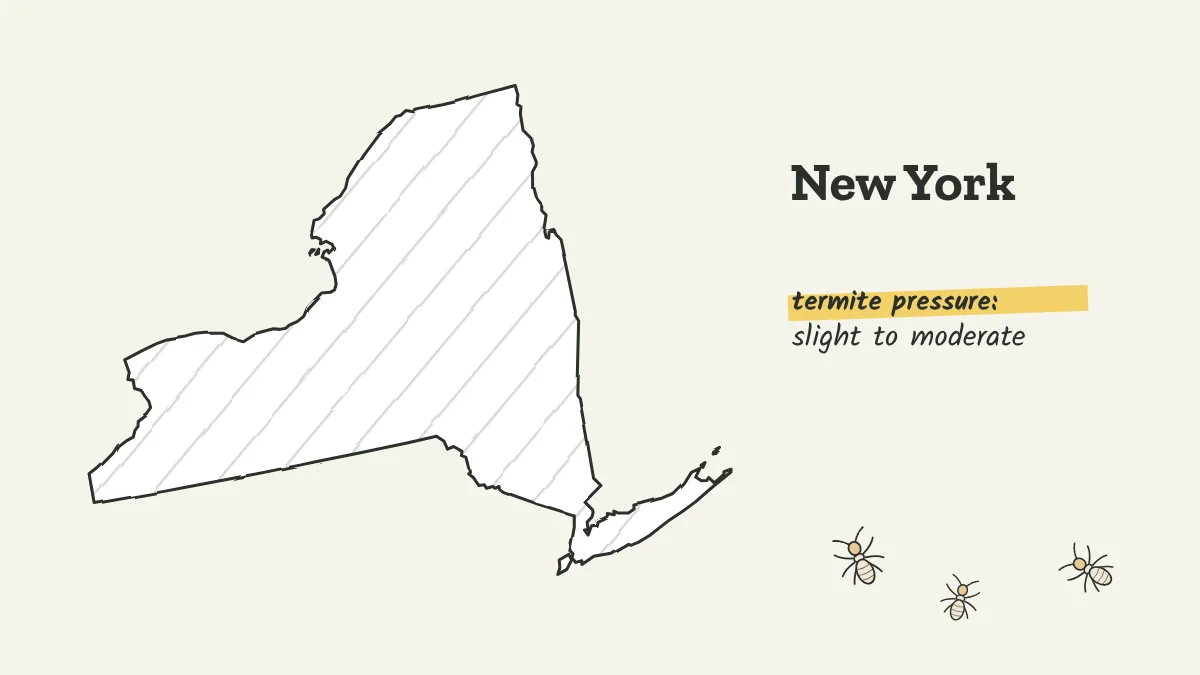
- Termite pressure
- Slight to moderate
- Termites to know
- Eastern subterranean
- Why termites like it here
- Cold winters and warm summers, with native subterranean termites and many older homes on basements, especially on Long Island.
- Who licenses pest control
-
New York State Department of Environmental Conservation, Bureau of Pest Management
Check a company's license - Inspection report for home sales
- NPMA-33 Wood Destroying Insect Inspection Report
On this page
Long Island's termite
Cornell Cooperative Extension's Nassau County office says termites are the most common insect subject people ask it about, and that Long Island has many homes affected by termite colonies. Officially, the Island has one species: the eastern subterranean termite, a native, though Cornell notes unofficial reports of others.
Its guide describes the familiar pattern. Workers stay underground and in wood, so damage often goes unnoticed for years. Termites favor the heat from furnaces, chimneys and hot-water pipes, especially in winter, and their mud tubes run from wheat-straw width to wider than a thumb along foundations, basement walls, posts and window and door frames. More on the species in subterranean termites.
When termites swarm in New York
Cornell puts Long Island's swarms from March through June. Swarmers head for light and often end up at windows and doors indoors.
| Termite | J | F | M | A | M | J | J | A | S | O | N | D |
|---|---|---|---|---|---|---|---|---|---|---|---|---|
| Eastern subterranean Daytime, often after a warm rain | some swarms | peak | peak | common | some swarms |
What a swarm means
Cornell says more than 99 percent of swarmers fail or die, so the swarm itself isn't the threat. It's a sign of a well-established colony nearby, and swarmers inside mean that colony is in or under the house. Cornell's identification tips: termite swarmers have a broad waist, four wings of equal length that extend well past the body, and antennae like a string of beads.
If you want a sample identified, Cornell asks for 10 to 15 intact insects in a clean pill bottle; freezing is fine, tape isn't. Mud tubes or damaged wood without live insects are a job for a professional inspection. See termites swarming in your house.
New York's treatment limits, as Cornell summarizes them
From Cornell Cooperative Extension Nassau County's homeowner guide, which summarizes state restrictions on termite treatment. Rules can change; your applicator should know the current version.
| Limit | What it means for you |
|---|---|
| No termiticide within 10 feet of a well or cistern | Houses on wells may need baits or other methods |
| High water table | If water appears in a test hole dug to the footing within two hours, the soil can't be treated |
| Finished basements | Can't be treated without removing wall and floor coverings |
| Cracked foundations | Cracks and voids must be sealed before treatment |
| Reapplication | Termiticide can't be reapplied unless live termites are present |
| Certified applicators only | Uncertified people may not handle termiticides |
Cornell is blunt about the effect: current regulations don't allow every home to be treated effectively, which is why combining methods matters.
Combining methods
Cornell's guide makes the case for using more than one tool. Soil barrier treatments have been used for more than 50 years and work, but they're disruptive and put pesticide into the soil. Baits use slow-acting, insect-specific toxicants that workers carry back to the colony. Borate-treated wood kills the gut microbes termites need to digest wood. Stainless steel mesh barriers exist but can be costly and hard to get. The best results, Cornell says, usually come from combining methods; there's no silver bullet.
Its prevention list will look familiar: seal foundation cracks, replace wet or infested wood, remove wood debris and buried stumps, use treated or non-wood materials in soil contact, direct downspouts away and fix plumbing leaks, ventilate basements and crawlspaces, and keep shrubs from blocking vents. Compare methods in termite treatment options.
Licenses and the seller's disclosure
Termite work in New York has to be done by applicators certified by the Department of Environmental Conservation, and Cornell notes many control methods may only be used by DEC-licensed applicators. You can look up an applicator or business in the DEC's online search. More in how to check a pest control license.
When you sell, New York's Property Condition Disclosure Statement asks whether there is any termite, insect, rodent or pest infestation or damage, and whether the property has been tested for them, with reports attached. Amendments effective March 20, 2024 made the statement mandatory by removing the old option of giving the buyer a $500 credit instead. VA loans require a termite report in certain New York counties. See termite disclosure laws.
For New York homeowners
Do
- Check basements near the furnace, chimney and hot-water pipes
- Seal foundation cracks before a liquid treatment
- Tell the company about any well or cistern
- Answer the disclosure's termite questions fully
Don't
- Tape swarmers to paper for identification; use a bottle
- Expect a finished basement to be treated without opening walls
- Ask for retreatment without evidence of live termites
- Let an uncertified person apply termiticide
Questions people ask
When do termites swarm in New York?
On Long Island, Cornell Cooperative Extension says swarms come from March through June. Swarmers are drawn to light and often gather at windows and doors indoors.
Are termites common on Long Island?
Yes. Cornell Cooperative Extension in Nassau County says termites are the most common insect people ask it about, and that many Long Island homes are affected.
Can a house with a well be treated for termites in New York?
With limits. As Cornell summarizes the state rules, termiticide can't be applied within 10 feet of a well or cistern, so baits or other methods may be needed.
Do New York sellers have to disclose termites?
Yes. The Property Condition Disclosure Statement asks about termite, insect, rodent or pest infestation or damage, and about any testing. Since March 2024, sellers can no longer skip it by giving a $500 credit.
Keep reading
Sources
- Cornell Cooperative Extension Nassau County: Homeowner's guide to eastern subterranean termites (reviewed 2003)
- New York State Bar Association: PCDA amended, $500 seller credit deleted (2023)
- New York Property Condition Disclosure Statement, via Justia Forms
- NYS Department of Environmental Conservation: Pesticide applicator and business search
- NYS Department of Environmental Conservation: Pesticide applicator technician guidance
- Veterans United: VA termite and pest inspections (updated 2026)