Termites in Washington: Loamy Soil and Licensed Inspectors
Washington is one of the few states that licenses termite inspectors as their own profession and gives every real estate inspection report a tracking number. It also has a state-mapped termite history. Here's what Washington State University and the state agriculture department say about the state's termites and the inspections that go with a home sale.
The short version
Washington has two native structural termites: the dampwood termite, which lives in wet, rotting wood and swarms in late summer or fall, and the subterranean termite, which lives in soil and attacks sound wood. A state mapping project found subterranean termites mostly in loamy soils. Real estate termite inspections must be done by a licensed structural pest inspector working for a licensed company, and each report carries an inspection control number.
Washington at a glance
- Termite pressure
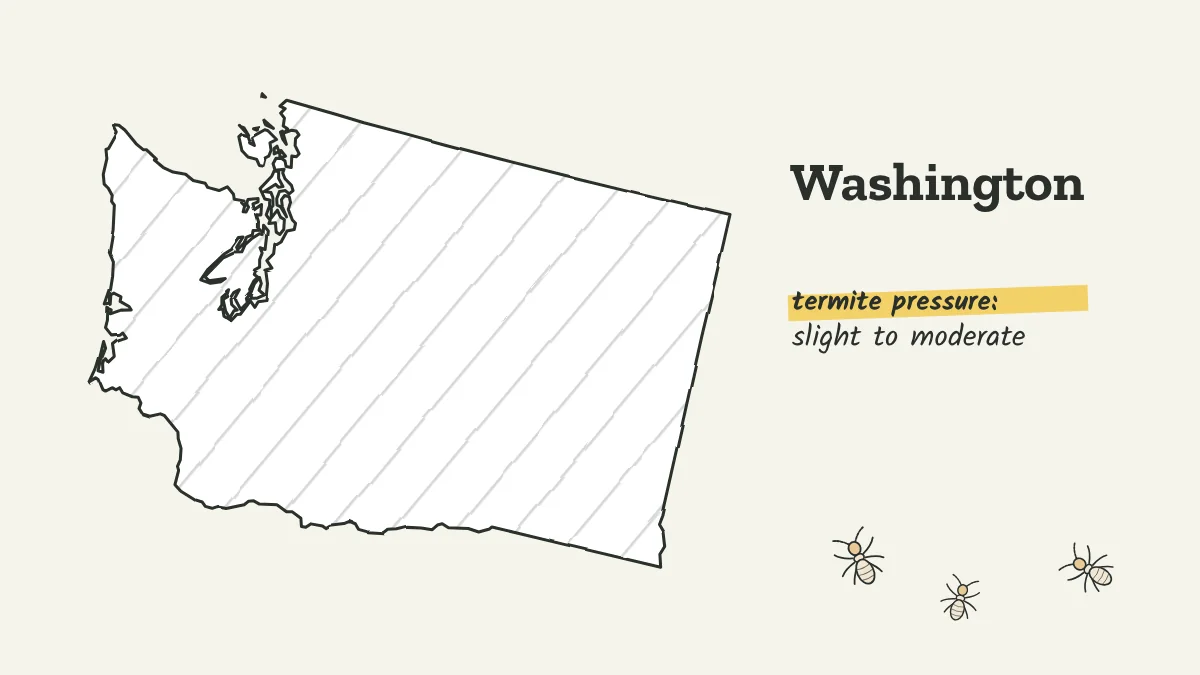
- Slight to moderate
- Termites to know
- Western subterranean, Pacific dampwood
- Why termites like it here
- Wet and mild west of the Cascades, dry and continental east of them, with subterranean termites mostly in loamy soils.
- Who licenses pest control
-
Washington State Department of Agriculture (WSDA), Pesticide Management Division
Check a company's license - Inspection report for home sales
- Washington complete WDO inspection report (with an inspection control number)
On this page
Washington's termites
Washington State University Extension's Pestsense names two native termites in the region. The dampwood termite, the large Pacific dampwood species, lives in wet or rotting wood and doesn't nest in dry, sound wood; finding it usually points to an earlier problem like wood touching soil. The subterranean termite lives in soil, moves into wood and commonly attacks sound wood in homes, where it can do serious damage.
WSU's sizes help with identification: winged dampwood termites are orange-brown and about 3/4 inch, while winged subterranean termites are black and about 3/8 inch. Dampwood termites swarm in late summer or fall, especially after rain; subterranean termites may swarm any time of year. See types of termites.
When termites swarm in Washington
WSU says dampwood termites swarm in late summer or fall, especially after rain, and subterranean termites can swarm at any time of year.
| Termite | J | F | M | A | M | J | J | A | S | O | N | D |
|---|---|---|---|---|---|---|---|---|---|---|---|---|
| Western subterranean Sunny days after the first fall rains | some swarms | some swarms | some swarms | some swarms | peak | common | ||||||
| Pacific dampwood Evenings, late summer and fall | some swarms | common | peak | common |
Where the subterranean termites are
WSU's entomology extension hosts the Subterranean Termite Mapping Project, in which the state agriculture department and the state pest management association plotted known termite locations against Washington soil types with GIS. The finding: termites are found predominantly in loamy soils rather than clay or rocky soils. The project produced 33 maps covering Greater Seattle, Tacoma, Olympia, Kitsap County, Spokane, the Tri-Cities and Yakima, plus a statewide map.
WSU notes the project isn't currently funded, so the maps are historical reference rather than a current risk forecast. They still show termites on both sides of the Cascades.
How Washington handles termite inspections
From WSDA guidance and Washington's rules on structural pest inspections (RCW 15.58 and WAC 16-228).
| Rule | What it means |
|---|---|
| Licensed company | A business needs a company license to do complete WDO inspections |
| Licensed inspector | Inspections are done by a WSDA structural pest inspector |
| Complete inspection | Required standards apply when a report is used in a sale, exchange or refinance |
| Inspection control number | Every report for a property transaction carries a unique number |
| Specific inspection | A separate report must go with any proposal to prevent or control WDOs |
WSDA treats an inspection as a real estate inspection if the report is used in the transaction in any way, whatever it's called.
What the report must note
Washington's rule on conducive conditions, WAC 16-228-2025, lists what a complete WDO report must flag. Among them: earth in direct contact with wood or too little clearance between soil and wood; vegetation touching the house; restricted or nonfunctioning gutters; conducive debris in the crawlspace; bare or unimproved ground in the crawlspace; standing water or signs of seasonal standing water under the house; failed caulk or grout at splash areas; and moisture from plumbing leaks or poor ventilation.
Several of those are about water rather than termites, which fits a state where dampwood termites and decay go together. Fix them and you help on both fronts. See crawlspace moisture and termites.
Prevention and treatment
For dampwood termites, WSU says prevention is non-chemical and pesticides are rarely needed: remove construction formwood from soil around the foundation, avoid wood-soil contact, ventilate the crawlspace with a vapor barrier in place and keep woodpiles away from the house. For subterranean termites, WSU says there's no reliable non-chemical prevention, and once they're established chemical control is usually the only option; call a pest management professional if termites are coming from inside or under the house. Check the inspector or applicator with WSDA's online license search. See termite treatment options.
For Washington homeowners
Do
- Look for the inspection control number on a sale report
- Check the inspector and company on WSDA's license search
- Fix gutters, standing water and crawlspace debris
- Pull construction formwood out of the soil
Don't
- Accept a "not for real estate" report for a sale
- Treat dampwood termites with chemicals before fixing moisture
- Ignore swarmers coming from under the house
- Leave vegetation touching the siding
Questions people ask
What termites live in Washington State?
Two native species matter for homes: the dampwood termite, which lives in wet, rotting wood, and the subterranean termite, which lives in soil and attacks sound wood.
Where are subterranean termites found in Washington?
A state mapping project found them mostly in loamy soils, with maps covering Seattle, Tacoma, Olympia, Kitsap, Spokane, the Tri-Cities and Yakima.
Who can do a termite inspection for a Washington home sale?
A licensed structural pest inspector working for a licensed company. The report must meet the state's complete-inspection standards and carry an inspection control number.
What is an inspection control number?
A unique number Washington law requires on wood-destroying organism reports prepared for a property sale, exchange or refinance.