Termites in Oklahoma: Every County, Spring Swarms and State Rules
Oklahoma State University's entomologists don't sugarcoat it: termites live in every county, and a new house can be attacked within a few years of being built. The upside is that Oklahoma spells out what a termite company owes you on paper. Here's how both sides of that work.
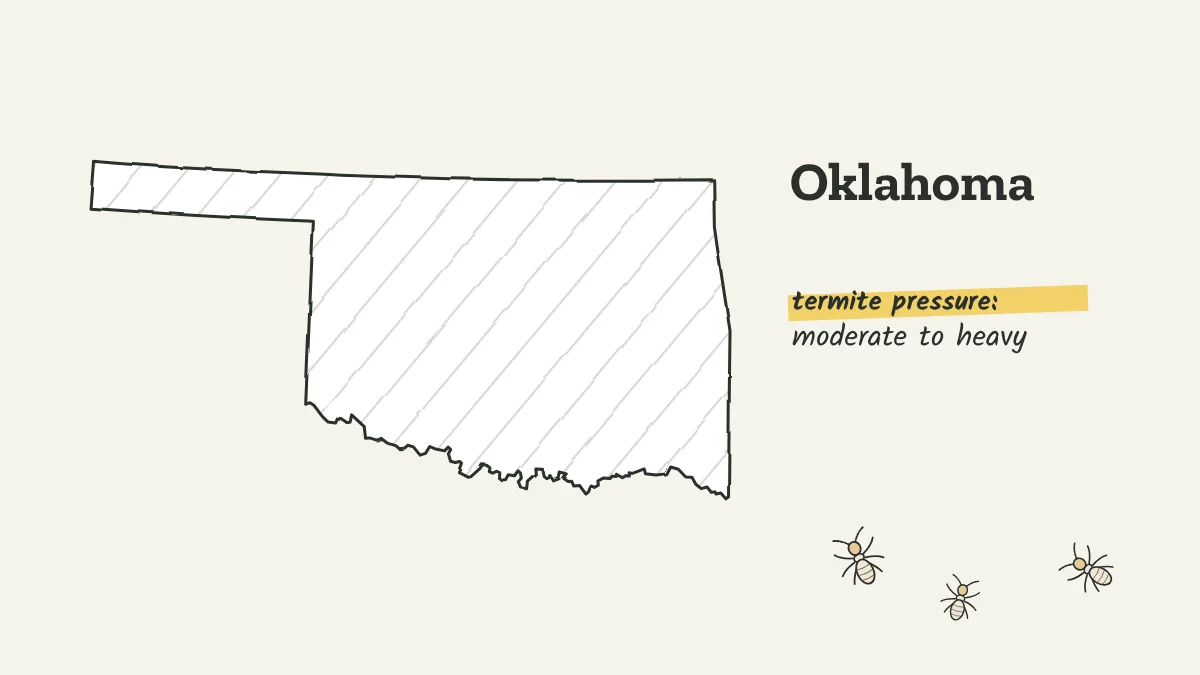
The short version
Termites live in every Oklahoma county, with the heaviest pressure in the southeast. Native subterranean termites swarm mainly in March, April and May, with smaller fall swarms in some years. Home sales use the state's Form ODAFF-1. Before treating, a company must give you a disclosure statement with a diagram, product information and the full warranty.
Oklahoma at a glance
- Termite pressure
- Moderate to heavy
- Termites to know
- Eastern subterranean
- Why termites like it here
- Hot summers and cold snaps, wetter in the southeast and drier toward the Panhandle, with native subterranean termites in every county.
- Who licenses pest control
-
Oklahoma Department of Agriculture, Food and Forestry, Consumer Protection Services
Check a company's license - Inspection report for home sales
- Oklahoma Official Termite and Wood Destroying Insect Report (Form ODAFF-1)
On this page
Termites in every county
OSU Extension says termites are present in all Oklahoma counties. Pressure is very heavy in the southeastern counties and moderate to heavy in the rest of the state, a bit lower toward the north and west where it's colder and drier. OSU's entomology museum notes that subterranean termites cause most of the structural damage in Oklahoma, with about five native species. Drywood termites have been found but don't appear to establish, and dampwood termites occasionally arrive in lumber from the West Coast.
The message for new houses is the one most people don't expect. OSU says attack within a few years of construction is highly probable and could begin within a year, which is why it says a pre-construction termiticide treatment significantly reduces the threat. See termite pretreatment.
When termites swarm in Oklahoma
OSU says spring swarms come in March, April and May, with less consistent fall swarms in September or October.
| Termite | J | F | M | A | M | J | J | A | S | O | N | D |
|---|---|---|---|---|---|---|---|---|---|---|---|---|
| Eastern subterranean Daytime, often after a warm rain | some swarms | peak | peak | common | some swarms |
What a swarm tells you
OSU entomologist Brad Kard's swarm-season advice distinguishes outdoors from in. Swarmers outdoors are normal, but they mean substantial numbers of termites are living in your yard and planting beds. Swarmers indoors almost certainly mean an infestation. Termite swarmers have straight, bead-like antennae and no pinched waist, which separates them from flying ants. See flying ants vs termites.
Kard's first steps are about sanitation: scrape mud tubes off walls and siding, clear wood debris, dead shrubs and cardboard from around the house, rake wood mulch about six inches back from the walls, keep firewood off the ground and away from the house, and make sure water drains away. Then call a licensed company; termiticides and baits are generally sold only to licensed applicators.
What Oklahoma companies must give you
From OSU Extension's guide to choosing a termite company and the Oklahoma Department of Agriculture's rules.
| Document | What it includes |
|---|---|
| Disclosure statement, before treatment | A diagram, product names and labels and full warranty details, signed by a certified applicator |
| Written contract | The terms, warranties and a diagram of active and damaged areas |
| Form ODAFF-1, for a home sale | The state's official termite and wood-destroying insect report; companies may add their contact details but can't alter it |
| ID cards | Company employees carry state ID cards showing their certification categories |
Since September 14, 2020, the old Form ODAFF-2 is no longer recognized. For work recommended on an ODAFF-1, the state advises keeping treatment records, repair invoices and photos instead.
How Oklahoma houses are treated
OSU's guide describes what a proper treatment involves, which helps you compare quotes:
- Slab houses usually need treatment under the slab, trenching and treating the soil around the perimeter, and treating voids behind brick veneer. Trenches typically run 6 to 8 inches wide and deep, and holes drilled through slabs should be no more than 12 inches apart.
- Pier-and-beam houses need trenches 4 to 6 inches deep around piers and utility pipes.
- Bait systems may take two to six months or longer to clear termites.
OSU doesn't recommend do-it-yourself or over-the-counter baits, and says no electronic or ultrasonic device has been scientifically proven to work. It recommends a warranty for at least two to three years after treatment, and adds a caution worth remembering: a warranty guarantees service, not an effective barrier. More in termite treatment options and DIY termite treatment.
Selling a house
For a real estate transaction, termite inspections in Oklahoma must be recorded on Form ODAFF-1, the Oklahoma Official Termite and Wood Destroying Insect Report, and any addenda have to be listed and attached. On the seller's side, Oklahoma's residential property condition disclosure statement asks whether the seller is aware of treatment for termite or wood-destroying organism infestation, a termite bait system on the property and its annual cost, and any damage from termites or wood-destroying organisms. VA loans require a termite report statewide. See termite disclosure laws and WDI inspection.
For Oklahoma homeowners
Do
- Treat a newer house as at risk, not immune
- Get the disclosure statement and diagram before treatment
- Keep wood mulch about six inches from the walls
- Keep a warranty for at least two to three years
Don't
- Assume outdoor swarms mean the house is infested; indoor ones do
- Buy an ultrasonic termite device
- Rely on over-the-counter baits
- Accept an ODAFF-2 as proof of completed work
Questions people ask
When do termites swarm in Oklahoma?
Mainly in March, April and May, according to OSU. Fall swarms in September or October happen in some years but are less consistent.
Are termites a problem everywhere in Oklahoma?
Yes. OSU Extension says termites are present in all Oklahoma counties, with very heavy pressure in the southeast and moderate to heavy pressure elsewhere.
What is Form ODAFF-1?
It's the Oklahoma Official Termite and Wood Destroying Insect Report, the required form for termite inspections in real estate transactions. Companies can't alter it.
What should a termite company give me in Oklahoma?
Before treatment, a disclosure statement with a diagram, the product names and labels and the full warranty, signed by a certified applicator, and a written contract with a diagram of active and damaged areas.
Keep reading
Sources
- OSU Extension EPP-7308: Choosing a pest management company to protect your home against termites (2014)
- OSU Plant Disease and Insect Advisory: Termite swarming season (Kard, 2008)
- OSU K.C. Emerson Entomology Museum: Isoptera of Oklahoma
- Oklahoma Administrative Code 35:30-17-107: Forms for wood infestation reports
- Oklahoma Department of Agriculture, Food and Forestry: Termite handout (ODAFF-2 retired)
- Oklahoma Real Estate Commission: Residential property condition disclosure statement (2026)
- Veterans United: VA termite and pest inspections (updated 2026)