What Do Termites Look Like? Workers, Soldiers, Swarmers
Most people picture one termite. There are really four or five, depending on the job, and the one you're most likely to see, the winged swarmer, looks nothing like the pale insects actually eating your house. Here's what each looks like and where you'd find it.
The short version
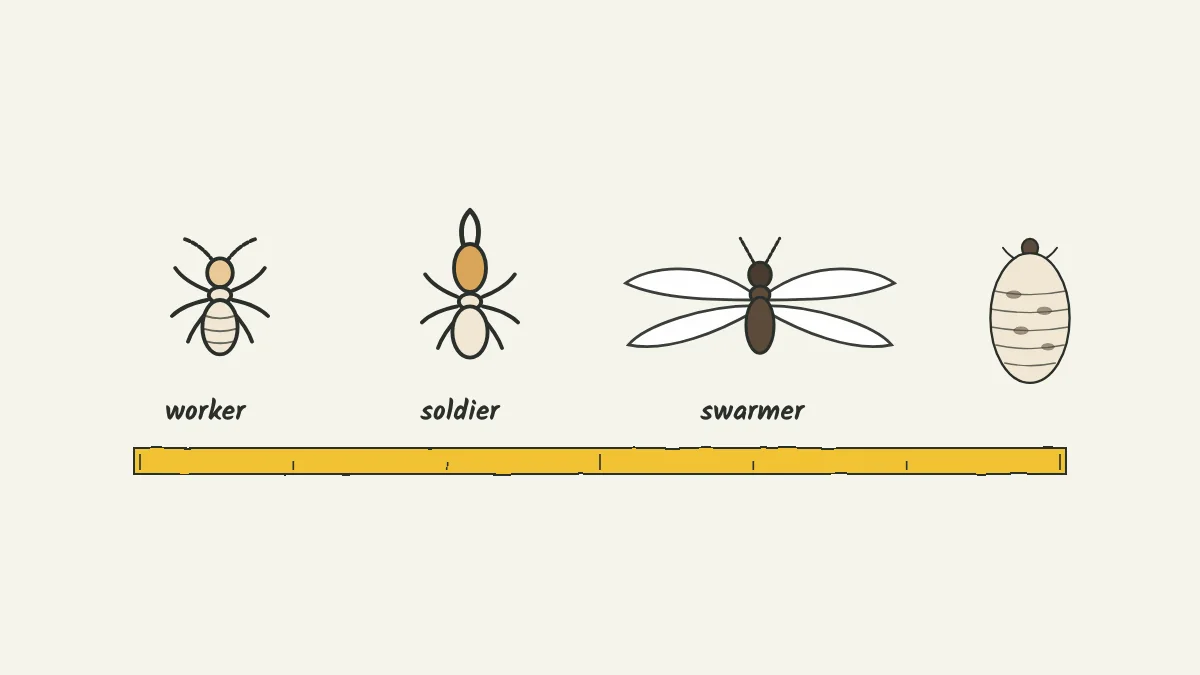
Termite workers are small, soft and creamy white, with no eyes, and you find them inside wood or broken mud tubes. Soldiers look similar but have large, darker heads with big jaws. Swarmers are the winged ones: dark brown to black for most native termites, with four wings of equal length. Termites have straight antennae and a thick waist, unlike ants.
On this page
A colony, sorted by job
Termites live in colonies with a division of labor, and each job comes with its own body. NC State Extension lists the castes as workers, soldiers, primary reproductives and secondary reproductives. Mississippi State University Extension adds the details that matter for identification:
- Workers make up about 90 to 98 percent of a subterranean colony.
- Soldiers make up about 2 to 4 percent in eastern subterranean termites, and up to 10 percent in Formosan colonies by MSU's count.
- Swarmers, the winged reproductives, appear only at certain times of year.
- Queens and kings stay hidden in the colony.
The insects you see depend on where you look: workers and soldiers in damaged wood and broken mud tubes, swarmers at windows and lights, and almost never a queen.
The castes at a glance
Descriptions from Mississippi State University, NC State, the University of Kentucky and UGA Extension. Sizes are for native subterranean termites unless noted.
| Caste | What it looks like | Where you'd see it |
|---|---|---|
| Worker | Small, soft, creamy white; no eyes and no pigment | Inside damaged wood and broken mud tubes |
| Soldier | Like a worker with a large, hardened, darker head and powerful jaws | Rushing to a break in a tube or gallery |
| Swarmer | Dark brown to black, about 8 to 10 mm head to wingtip, four equal wings, with eyes | Windows, lights and sills during swarm season |
| Dealate | A swarmer that has dropped its wings: a short, dark, ant-sized insect | Crawling on floors after a swarm |
| Queen | Enlarged body; produces thousands of eggs a year | Hidden deep in the colony |
| Secondary reproductive | Pale, with wing pads but no full wings | Inside the colony |
Formosan swarmers are larger and lighter, about 1/2 inch with wings and caramel to golden brown, per UGA and MSU. The termite wings guide covers what shed wings look like.
Workers: the ones eating your house
Workers are the colony's engine. The University of Kentucky describes them as small, creamy-white insects you'll find when you break open a mud tube. MSU notes they have no eyes and no pigment, which is why they look almost translucent. They stay out of sight, traveling inside soil, wood and mud tubes; UF/IFAS notes the tubes protect foragers from predators and from drying out.
That's why most homeowners never see them until something gets opened up: a rotten sill, a baseboard pulled off, a broken tube. If you find pale, soft insects inside damaged wood, you've almost certainly found termite workers.
Soldiers: the heads give it away
Soldiers look like workers with a weapon attached. NC State describes heavily hardened head capsules and powerful mandibles, and MSU says their heads are enlarged and darker than the rest of the body.
Head shape is the best field clue for telling termite species apart:
- Native subterranean soldiers have long, rectangular heads.
- Formosan soldiers have teardrop- or oval-shaped heads, and UGA notes they ooze a white, glue-like drop when disturbed.
If you can catch a soldier, a photo of its head next to a ruler is the single most useful thing you can send an extension office or inspector. More on Formosans in Formosan termites.
For a closer look
As an Amazon Associate I earn from qualifying purchases.
-
10x magnifying loupe
Tells a six-sided drywood pellet from sawdust, and a termite wing from an ant wing.
-
View on Amazon
Bright LED flashlight, 1,000+ lumens
The one tool that really matters. A tight, bright beam shows mud tube texture and wing piles in dark corners.
Swarmers: the ones you'll actually see
Swarmers are the only termites built for daylight, with pigment and working eyes. NC State describes native eastern subterranean swarmers as dark brown to black and about 8 to 10 millimeters from head to wingtip, with four wings of roughly equal size and shape. UGA puts native swarmers at about three-eighths of an inch and Formosan swarmers at about half an inch.
They don't stay winged long. After a short flight, swarmers break off their wings and pair up, and the Kentucky guide notes they live only about a day if they don't find a place to start a colony. That's why a swarm often leaves behind piles of identical wings and a few short, dark, wingless insects crawling around. Neither one bites or eats wood. What a swarm in the house means is covered in termites swarming in your house.
Termite or ant?
The three checks from the University of Kentucky. They work on winged and wingless insects alike.
| Feature | Termite | Ant |
|---|---|---|
| Antennae | Straight | Elbowed |
| Waist | Thick, uniform | Pinched, narrow |
| Wings | Four, equal in length | Front pair longer than the back pair |
Still unsure? Try our termite or flying ant quiz, or read flying ants vs termites.
Queens, kings and replacements
The queen is the termite most people imagine and almost nobody sees. NC State says an eastern subterranean queen lays about 5,000 to 10,000 eggs a year, and MSU notes queens of established colonies can lay thousands of eggs per day. She lives deep in the colony, usually far from where the damage is. The king's role is covered in what does a termite king do.
Colonies also have backups. MSU describes secondary reproductives that develop from nymphs, with wing pads but no full wings. They can take over egg-laying or help a colony expand, which is one reason killing a few termites at the surface never kills a colony.
Questions people ask
What do termites look like to the human eye?
The ones in wood are small, soft and creamy white, with no eyes. Soldiers look similar but have bigger, darker heads with large jaws. The winged swarmers you see at windows are dark brown to black with four equal-length wings.
What does a termite look like compared to an ant?
Termites have straight antennae, a thick waist with no pinch, and four wings of equal length if they have wings. Ants have elbowed antennae, a narrow waist, and front wings longer than the back wings.
Are white ants termites?
Yes. There's no such insect as a white ant. Pale, soft insects found inside damaged wood or mud tubes are almost always termite workers.
What color are termites?
Workers are creamy white. Soldiers have darker, often amber to brownish heads. Native swarmers are dark brown to black, while Formosan swarmers are lighter, caramel to golden brown.
Keep reading
Termites in your state
Sources
- MSU Extension: Termite biology, eastern subterranean and Formosan termites
- NC State Extension: Biology and behavior of eastern subterranean termites (2025)
- University of Kentucky Entomology: Termite control tips for homeowners (EF604)
- UGA Extension Circular 868: Identifying the Formosan subterranean termite (2022)
- UF/IFAS EDIS IN278: Formosan subterranean termite
- MSU Extension Publication P3999: Pest snapshot, Formosan subterranean termite (2024)