Termites in Hardwood Floors: Signs and Fixes
A hardwood floor is a strange place to find termites: it's off the ground, finished and walked on every day. But floors sit right on top of the joists and subfloor termites are already eating, and some termites live in the boards themselves. Here's how termites get into wood floors, how to tell their damage from water damage, and what fixing it involves.
The short version
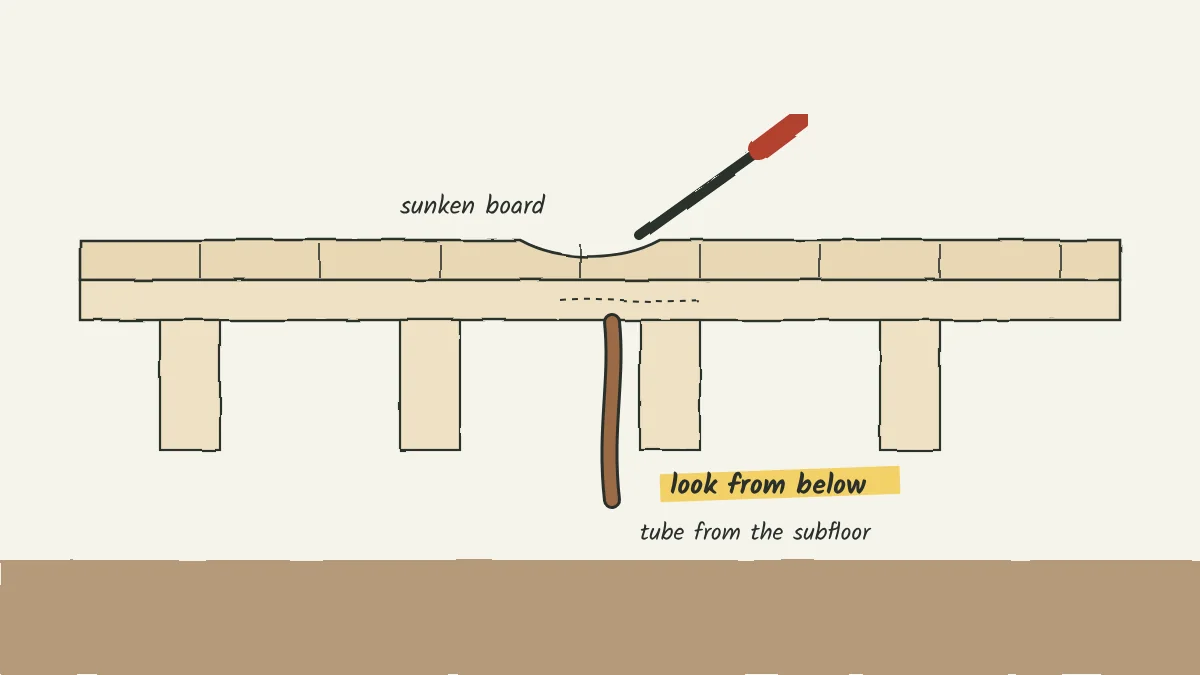
Subterranean termites reach hardwood floors from below, through the joists and subfloor, so the first signs are often in the basement or crawlspace: mud tubes hanging from the subfloor. From above, look for boards that sag, blister or sound hollow, and soil-lined galleries if a board is lifted. Drywood termites can live in flooring itself and leave six-sided pellets. Either way, find and treat the termites first, then repair the floor.
On this page
How termites get into a floor
Subterranean termites, the kind in most of the U.S., live in the soil and travel up to wood through mud tubes. A hardwood floor sits on a subfloor, which sits on joists, which rest on the sill and foundation, so termites eating their way up the frame eventually reach the floor from underneath. NC State Extension notes that termite mud tubes may be found hanging from sub-flooring. Purdue's termite bulletin lists hardwood flooring among the places to probe, along with plates, header joists and the ends of floor joists.
Drywood termites, found mainly in warm coastal areas and the Southwest, don't need soil. University of Florida entomologists say they can infest wood flooring, framing, window sills, doors and furniture, attacking dry, sound wood, and are more often a problem in older homes. See drywood termites.
Slab houses get termites in floors too. Termites can come up through cracks and gaps in a slab and reach a wood floor laid on sleepers or a subfloor over the concrete.
Signs in a hardwood floor
From extension and state sources on termite damage.
| Sign | What it suggests |
|---|---|
| Boards that sag, cup or feel spongy | Hollowed wood under a thin intact surface |
| Blistered or darkened finish | Feeding close to the surface; California's pest board lists darkened or blistered wood |
| Hollow sound when tapped | Galleries inside; Connecticut's experiment station says infested wood sounds hollow |
| Soil-lined galleries along the grain | Subterranean termites; no sawdust |
| Mud tubes from the subfloor | Subterranean termites coming up from below |
| Six-sided pellets, tiny holes | Drywood termites in the boards |
A screwdriver or awl pushed into a suspect board will break through termite-hollowed wood easily.
Termite damage or water damage?
Both make boards cup, buckle and soften, and termites often follow moisture, so the two can overlap. The tie-breaker is inside the wood. The Connecticut Agricultural Experiment Station says subterranean termite galleries are lined with soil, feces and saliva, and that there's no sawdust or powder with termite feeding. University of Florida says drywood termites leave six-sided fecal pellets that collect below infested wood and tiny kick-out holes about 1 to 2 millimeters wide. Water damage alone leaves stained, soft or delaminated wood with no galleries, mud or pellets. See termite damage vs water damage.
For checking floors from above and below
As an Amazon Associate I earn from qualifying purchases.
-
View on Amazon
Awl or flat-head screwdriver
Press it into suspect wood. Healthy wood fights back. Eaten wood gives way like a stale cracker.
-
View on Amazon
Pin-type wood moisture meter
Wood that reads above about 20% is wet enough to invite rot and termites. Great for sills and subfloors.
-
View on Amazon
Bright LED flashlight, 1,000+ lumens
The one tool that really matters. A tight, bright beam shows mud tube texture and wing piles in dark corners.
-
View on Amazon
Knee pads
Only if you have a crawlspace. You inspect twice as carefully when you're not kneeling on gravel.
Checking a suspect floor
-
Look from below first
In a basement or crawlspace, check the subfloor and joists under the area for mud tubes and soft wood. This is where subterranean termites usually show themselves.
-
Tap and press from above
Tap boards with a screwdriver handle and listen for a hollow sound. Press for give or sponginess.
-
Probe one spot
Push an awl into a gap or an inconspicuous spot. Termite-hollowed wood breaks through easily.
-
Look for pellets
Check along baseboards and under furniture for small piles of pellets, which point to drywood termites.
-
Call for an inspection
If you find tubes, galleries or pellets, get a professional inspection before pulling up flooring.
Treatment comes before repair
Fix the termites first, or the new floor gets eaten too. For subterranean termites, that usually means a soil treatment around the foundation or a bait system. NC State notes that finished interior floors are often exempt from drilling, because drilling would damage them, so a company may treat from outside or from the crawlspace instead. Ask how they'll treat under your floor and what's covered if termites come back. For drywood termites, options range from spot treatments in the infested boards to whole-structure fumigation or heat. See termite treatment options and heat treatment for termites.
Repairing the floor
Once the termites are dealt with, damaged boards can usually be replaced individually, with new boards woven in to match. If the subfloor or joists underneath are damaged, those have to be repaired first, and that's structural work. Check whether your termite warranty includes repairs; many cover only retreatment. California's Structural Pest Control Board warns that damage can progress unseen behind floor coverings, so expect the repair to grow once boards come up. See termite damage repair.
Termites and hardwood floors
Do
- Check the subfloor from below at least once a year
- Probe any board that sags or sounds hollow
- Save pellets or wings for identification
- Treat the termites before replacing boards
Don't
- Assume a cupped board is only water damage
- Sand and refinish over soft spots
- Pull up a whole floor before an inspection
- Rely on a warranty without checking whether it covers repairs
Questions people ask
Can termites eat hardwood floors?
Yes. Subterranean termites reach floors from the joists and subfloor below, and drywood termites can infest wood flooring directly, according to University of Florida entomologists.
What does termite damage look like on a hardwood floor?
Boards that sag, cup or blister, sound hollow when tapped, or break easily when probed. Inside, subterranean termite galleries run along the grain and are lined with soil, with no sawdust.
How do I tell termite damage from water damage in a floor?
Look inside the wood. Termite damage has galleries lined with soil or six-sided pellets; water damage is stained and soft but has no galleries, mud or pellets.
Do I have to replace the whole floor?
Usually not. Damaged boards can often be replaced individually after treatment, unless the subfloor or joists below need structural repair.
Keep reading
Termites in your state
Sources
- NC State Extension: Monitoring and management of eastern subterranean termites (Hayes and Alder, 2025)
- Purdue Extension E-4: Termite control (Bennett, 2017)
- University of Florida IFAS ENY-211: Drywood and dampwood termites (Oi and others, revised 2008)
- Connecticut Agricultural Experiment Station: Eastern subterranean termite fact sheet (Dugas)
- California Structural Pest Control Board: Termites, questions and answers (2019)