Is Termite Damage Tax Deductible?
A $15,000 termite repair feels like exactly the kind of disaster the tax code should help with. It doesn't. The IRS has a specific reason, a sixty-year paper trail behind it, and one narrow situation where the rules still matter.
The short version
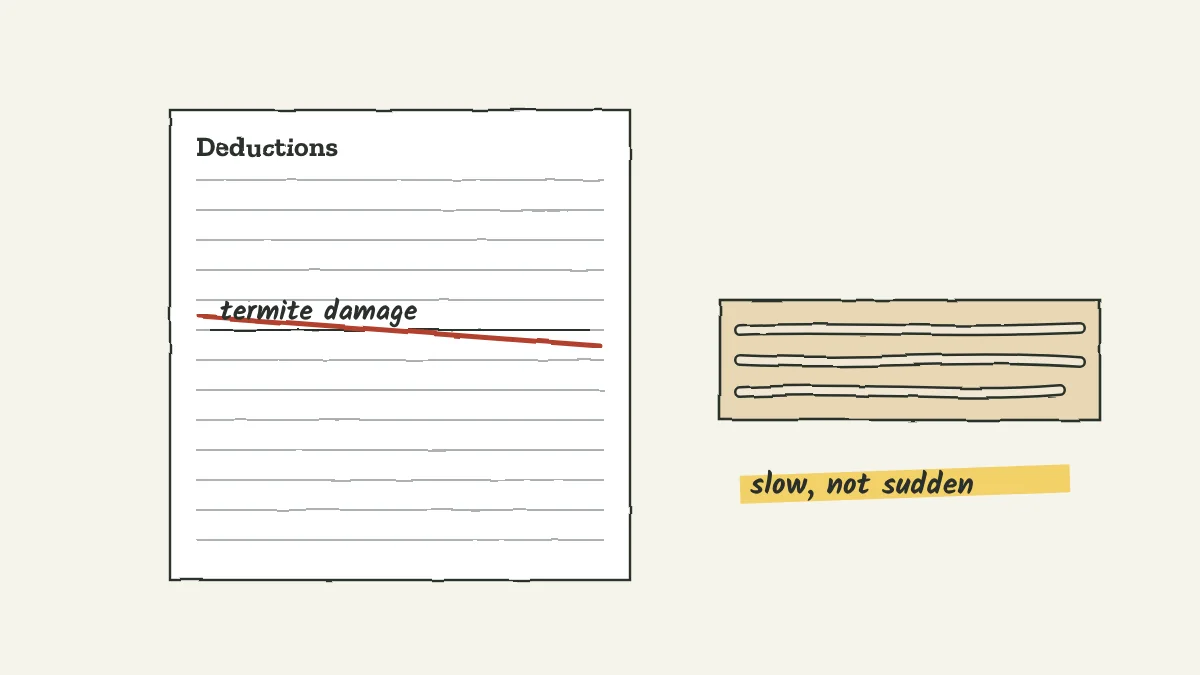
No. On your own home, termite damage isn't deductible. IRS Publication 547 lists termite damage as progressive deterioration, which isn't a casualty loss. And since 2018, personal casualty losses are deductible only if they're caused by a federally declared disaster. Treatment costs on a personal residence aren't deductible either. Rental property follows different rules.
On this page
Why the IRS says no
A casualty loss, in the IRS's definition, comes from an identifiable event that is sudden, unexpected or unusual. Publication 547 spells each one out: sudden means quick rather than gradual, unexpected means not foreseen or intended, and unusual means not something that happens routinely.
Termites fail the first test. Publication 547 says loss of property due to progressive deterioration isn't deductible as a casualty loss, because the damage comes from a steady, ongoing cause rather than a sudden event, and it names termite damage as an example. Moth damage is in the same sentence.
The IRS has drawn the line this way for a long time. A 1957 ruling on trees killed by insects and disease reasoned that even when the insects arrive suddenly, the loss that follows is progressive deterioration. In 1963, the IRS revisited an earlier ruling that had allowed termite damage done in less than 15 months to count as a casualty, citing scientific data that termites almost never cause substantial structural damage in the first two years of an infestation, and that extensive repairs usually follow three to eight years of feeding.
The 2018 change makes it moot for most people
Even a truly sudden loss to your home isn't automatically deductible now. Publication 547 says that for tax years beginning after 2017, casualty losses of personal-use property are deductible only if the loss is attributable to a federally declared disaster. The one exception is a taxpayer with personal casualty gains in the same year, who can deduct other losses up to those gains.
And where a disaster loss does qualify, there are two reductions: $100 per casualty event, then 10 percent of your adjusted gross income on the total. Qualified disaster losses have different, more generous rules. So for most homeowners, termite damage is out twice: once because it's progressive, and again because it isn't a federally declared disaster.
Termite costs and taxes, at a glance
A summary for a personal residence, based on IRS Publication 547. Tax situations vary; ask a tax professional about yours.
| Cost | Deductible on your own home? | Why |
|---|---|---|
| Termite damage repairs | No | Progressive deterioration isn't a casualty loss |
| Termite treatment or a bond | No | A personal home maintenance expense |
| Damage from a federally declared disaster, such as a hurricane | Possibly | Sudden and declared; subject to the $100 and 10%-of-AGI reductions unless it's a qualified disaster loss |
| Termite damage found after that disaster | No | The termite part is still progressive deterioration |
| Termite costs on a rental property | Different rules | Business property; see IRS Publication 527 and a tax professional |
Insurance usually follows similar logic about gradual damage; see does insurance cover termite damage.
When a storm and termites meet
Here's where it gets messy in termite country. A hurricane in a federally declared disaster area tears off part of a roof. The repair crew opens the wall and finds the plates and studs underneath honeycombed by termites.
The storm damage may be a deductible disaster loss. The termite damage behind it isn't, because it happened over years before the storm. Keep the two separate in your records: get the contractor to itemize what was storm damage and what was preexisting termite damage, and photograph both before repairs. That separation helps with insurance claims too.
What to keep anyway
Even if termite costs don't help you at tax time, the paperwork can still be worth keeping:
- Treatment records and bonds. Buyers ask for them, and in states like Texas and South Carolina, sellers answer termite questions on disclosure forms. See termite disclosure laws.
- Repair invoices. They show what was fixed, by whom and when, which matters for the next inspection report, the next sale and any warranty claim.
- Disaster documentation. If you're ever in a declared disaster area, photos and itemized invoices separating storm damage from preexisting damage keep both the IRS and your insurer happy.
The money side of repairs is in termite damage repair cost, and how to keep the next infestation from starting is in how to prevent termites.
Termites and taxes
Do
- Keep treatment records and repair invoices with your house papers
- Separate storm damage from termite damage in any disaster repair
- Ask a tax professional if the property is a rental
Don't
- Deduct termite repairs on your home as a casualty loss
- Rely on the insect exception for termite damage
- Assume a hurricane makes hidden termite damage deductible
Questions people ask
Is termite damage tax deductible?
Not on your own home. IRS Publication 547 lists termite damage as progressive deterioration, which isn't a casualty loss, and since 2018 personal casualty losses are generally deductible only when caused by a federally declared disaster.
Can I deduct termite treatment?
Not for a home you live in. Treatment and termite bonds are personal home maintenance costs. Rental property is treated as business property under different rules, so ask a tax professional.
Why isn't termite damage a casualty loss?
A casualty has to be sudden, unexpected or unusual. Termite damage builds up gradually over years, which the IRS treats as progressive deterioration rather than a sudden event.
What if termite damage is found after a hurricane?
The storm damage may qualify as a disaster loss if the area was federally declared, but the termite damage that existed before the storm still doesn't. Have repairs itemized to separate the two.